

In September, »Chapter Radar« turns its attention to five new releases and exhibitions from across the world of design. Riva continues to evolve its flybridge series with the 96’ Argo Super, Volkswagen explores how a rigorous approach to aerodynamics can change the energy consumption of an electric car, and Cartier brings back the Roadster. Meanwhile, two exhibitions in Hamburg and Hong Kong examine processes of design and creation: the relationship between travel and writing, and the question of how architecture can be conveyed within a museum.
Writing and Travel
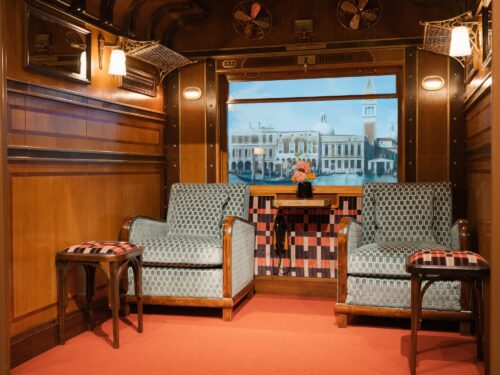
With the special exhibition »Words & Voyages«, the Montblanc Haus in Hamburg has been exploring since early September how travel has shaped writing and the forms of recording that have emerged from it. The scope extends beyond literature, photography and music are also included as media in which travel experiences are captured and processed. Visitors can create their own travel diary and write at various stations. The scenography evokes a colorful train station and incorporates motifs from Wes Anderson’s short film »Let’s Write« for Montblanc. A train compartment from the film set is part of the exhibition.
The Montblanc Haus itself was designed by Nieto Sobejano Arquitectos. Opened in 2022 directly adjacent to the Hamburg writing instrument manufactory, the building is over 100 meters long and appears as a nearly closed black volume. Its form is derived from the historical packaging of Montblanc writing instruments—behind the relief-like concrete facade, the exhibition spaces are arranged across three levels.

Closer to the Water
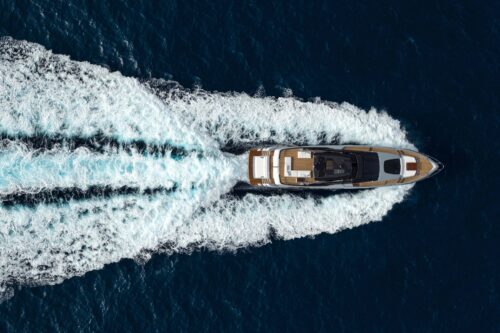
The new 96’ Argo Super evolves Riva’s flybridge series with a fundamentally redesigned stern. The Riva 96’ Argo Super made its official debut at the Cannes Yachting Festival. The 28.79-meter yacht had already been launched in La Spezia in July and is a further development of the 90’ Argo. The Riva 96’ Argo Super was designed by Officina Italiana Design, Riva’s long-standing design studio, in collaboration with the Ferretti Group.
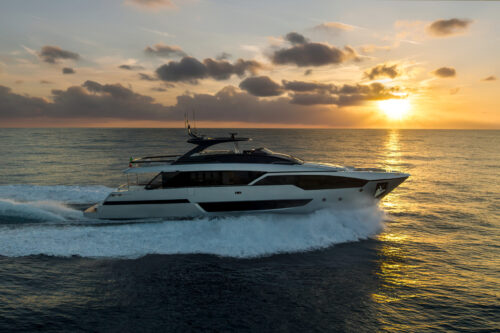
The most significant change is found at the stern. A large sun deck is integrated directly into the garage hatch. In front of it, the swimming platform can be lowered via a lifting mechanism. The interior layout has also been modified: a new day head on the main deck creates additional space for guest cabins on the lower deck. Large glazing and the arrangement of furniture bring more natural light into the master suite. At the World Yachts Trophies 2026 in Cannes, the 96’ Argo Super was awarded best layout in the 80 to 98-foot category.
How can architecture be exhibited?
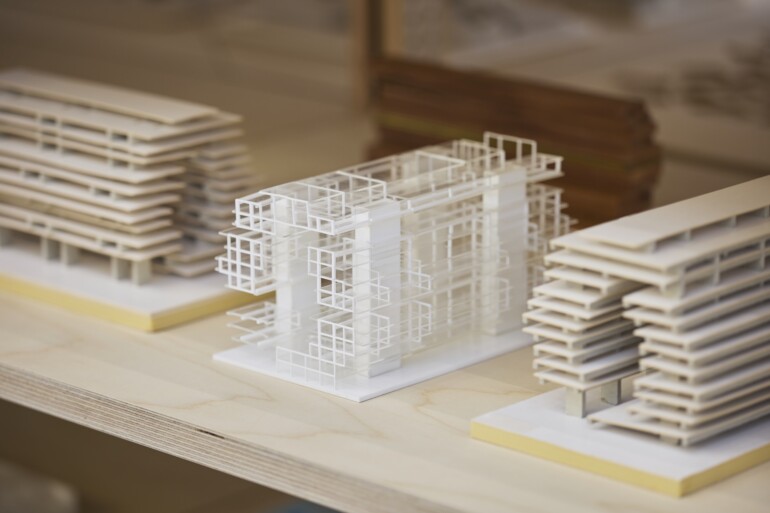
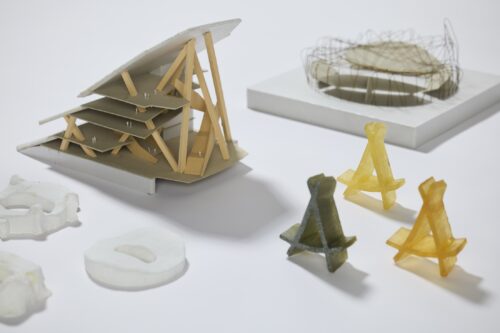
M+, Hong Kong’s museum of visual culture, answers this question with a look at the design process. »Herzog & de Meuron: In Focus« gathers models, drawings, material samples, and prototypes for ten realized and unrealized projects by the renowned Swiss architectural firm in China between 2002 and 2021. Realized buildings include M+ itself, Tai Kwun in Hong Kong, and the National Stadium in Beijing.
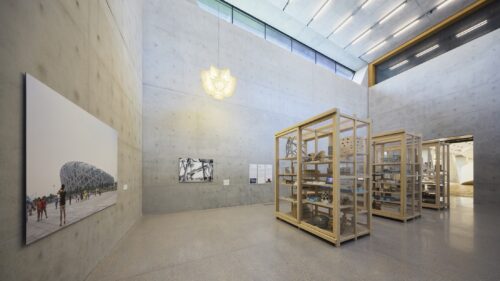
The presentation draws on the firm’s own working methods. The exhibits are housed in exact replicas of the wooden display cases that Herzog & de Meuron developed for their own cabinet in Basel, where models and working materials are archived. The exhibition is based on a donation of more than 200 objects to the M+ collection. »Herzog & de Meuron: In Focus« is on view at M+ in Hong Kong until January 10, 2027.
When Efficiency Defines Form
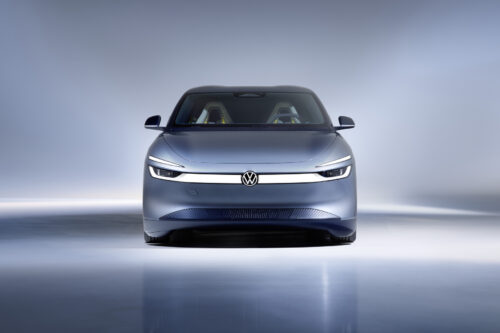
With the Mission Efficiency, Volkswagen presented a near-production concept vehicle in mid-September, whose form is consistently geared towards the lowest possible energy consumption. The 2+2-seater is based on the MEB+ platform and adopts central drive components from the new ID. Polo.
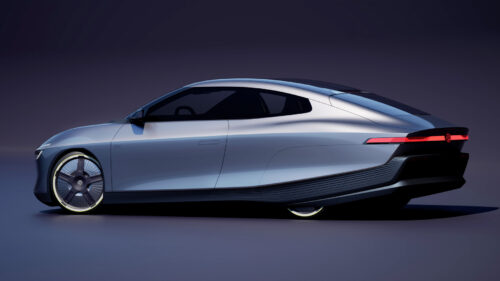
A drag coefficient of 0.158 determines the unusual appearance. The elongated body tapers toward the rear, the rear wheels are covered, and the underbody is almost completely closed. Specially developed deflectors guide the air past the wheels. Volkswagen thus states a new record for air resistance for the road-legal concept vehicle. Using largely near-production technology, Mission Efficiency investigates the influence that aerodynamics and body design can have on the energy requirements of an electric car.
The Return of the Roadster
In October, the newly reissued Cartier Roadster will arrive in boutiques. After 14 years, a model returns to the collection that Cartier introduced in 2002 and whose design is clearly influenced by the automobile.

For the new edition, the tonneau-shaped case was made slimmer and more strongly integrated into the lines of the bracelet. Characteristic elements remain: concentric circles on the dial evoke a speedometer, while the distinct shape around the crown and date magnifier continues to define the watch’s silhouette.
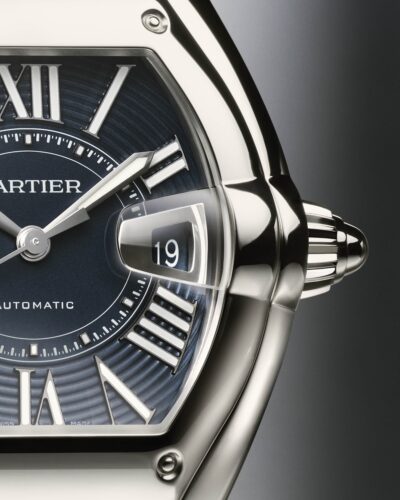
The Roadster appears in two sizes and in steel, yellow gold, and bicolor. The redesigned metal bracelet can be changed without tools via Cartier’s QuickSwitch system. The larger model is powered by the automatic caliber 1847 MC, while the smaller one features the likewise automatic 1899 MC. [Ed.]