

Founded in 2021 by Marzia Cerio and Marwann Frikach, the design studio COSEINCORSO creates furniture, objects and spaces that emerge from stories, places and materials—as translations of cultural memory into contemporary design. In this interview, Cerio and Frikach discuss how local history, artisanal processes and material origins shape their work, why authenticity begins with slowness and careful listening, and what role design can play when it seeks to preserve memories.
Chapter Coseincorso translates local histories into furniture, objects and accessories. How do you decide which stories are worth carrying forward through design?
Coseincorso We think a story earns its place when it carries something unresolved—something that hasn’t fully found its form yet. We’re drawn to places where history left a fracture, or that hold something hidden: a way of life interrupted, a knowledge almost lost, a landscape that changed so radically that the people living in it had to reinvent themselves entirely.
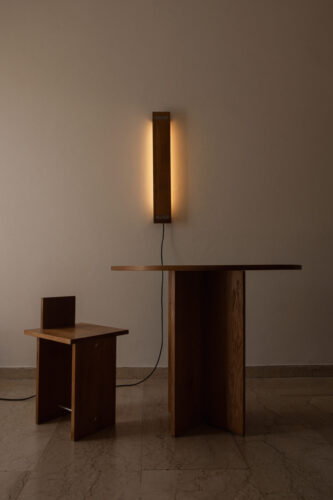
»The Memory Stool«, »The Axis Table« and »The Flare Lamp« (2026)
from the new Anàphora collection, handcrafted in Italy.
Our last collection, Anàphora, for example, was about Lake Fucino in Abruzzo: in the 19th century, an entire lake was drained by a prince’s ambition. The fishermen who had lived by its rhythms overnight became farmers. That loss—of water, of memory, of identity—is the kind of tension we look for.
Chapter Is there a particular moment or circumstance that usually sets a new project in motion for you?
Coseincorso It often starts with a small trip, and then the urgency to discover a story and translate it into something tangible arrives on its own. We began our studio during the pandemic, in a period of forced stillness that gave us time to look more carefully at the places we were already inhabiting. We discovered the béguinages of northern Europe—communities of women who invented a way of living that was both spiritual and economic at once. That isolation and that independent way of living felt deeply connected to us at that moment.
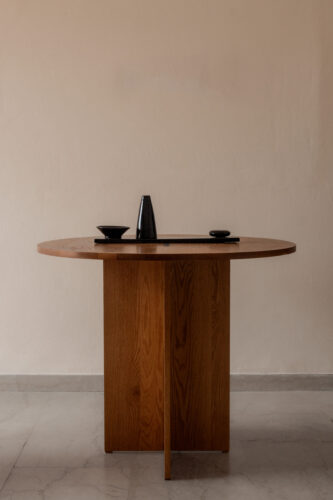
»The Axis Table«, 2026
With the Fucino, instead, we drove through what is now one of the most industrialized agricultural plains in central Italy. From the plain, you understand that a vast lake must have been there once. That disconnection between what you’re seeing and what you know must have existed—that’s what led us to translate the feeling into a narrative form.
Chapter You work closely with artisans and remain attentive to the origins of materials. What metaphysical role does this physical, hands-on process play in shaping an object?
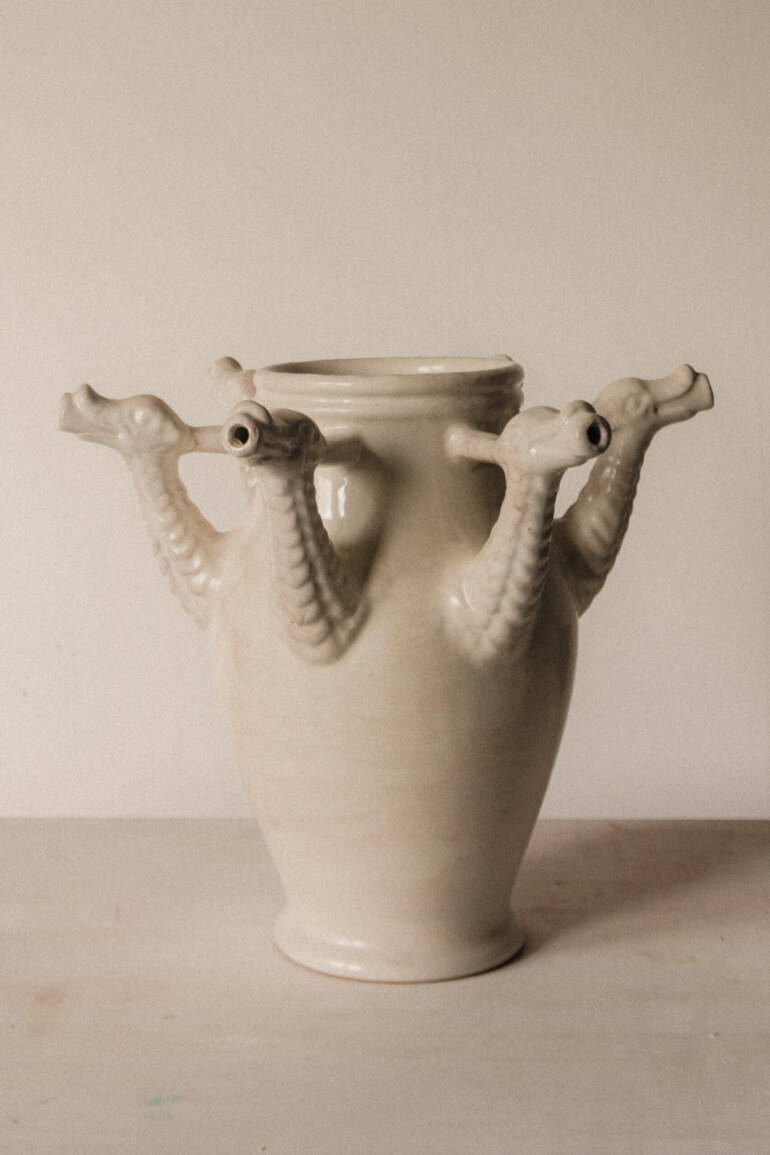
Coseincorso The hand is where intention becomes real. We always start with drawings and prototypes, then we work through the process together with the artisan. Castelli—a small mountain village in our region—was the pharmaceutical pottery capital of Renaissance Italy. They produced jars for apothecaries and kings, and their craftspeople are still faithfully reproducing those same gestures five centuries later. Working with those ceramists for our Apothecary collection was exactly what we’re after: the moment when making and meaning become the same thing, and the story lives inside the material rather than being attached to it from outside.
Chapter What do you believe is the most important mindset a designer needs in order to create work that feels authentic beyond mere aesthetic refinement?
Coseincorso For us, the starting point is never »what should this look like?« but »what is this place, this material, this practice actually asking of us?« Aesthetics emerge from that listening—and often translate into a genuine connection between us and our artisans.
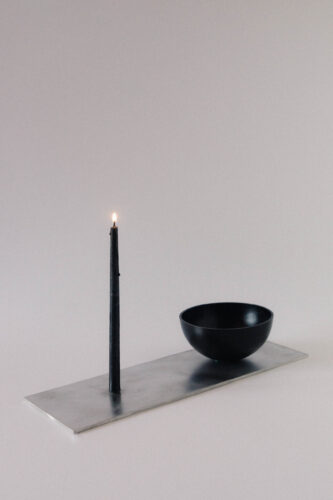
»The Ember Tray«, 2026; metal bowl and candle holder— »two elements / one ritual.«
We also think authenticity requires a kind of resistance to speed. We both have an introverted side that leads us to step back from time to time in order to work and reflect. In a world saturated with images and trends, clarity comes from withdrawing enough to hear what actually matters to you—not what the moment demands.
Chapter If design has the ability to preserve memories, places and gestures, what do you hope people encounter through your work in their own space?
Coseincorso We think of our work as existing at the intersection of museum and home, function and ritual. What we hope people feel is both the texture of the hand and a sense of poetry behind it—the sense that an object holds a past they can’t quite name. Not because we’ve explained it to them, but because the form itself carries it.
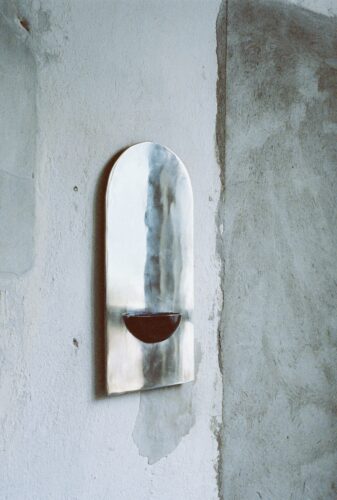
»The Mirror of Simple Souls« was our first object, and mirrors are at the heart of our practice—not only as a recurring form across our collections, but as a symbol of what we’re trying to do. Every piece asks you to look at yourself in relation to something larger, something older.
If someone lives alongside one of our pieces and occasionally wonders about it, that’s enough. Memory doesn’t have to be explicit to be felt. [Ed.]