

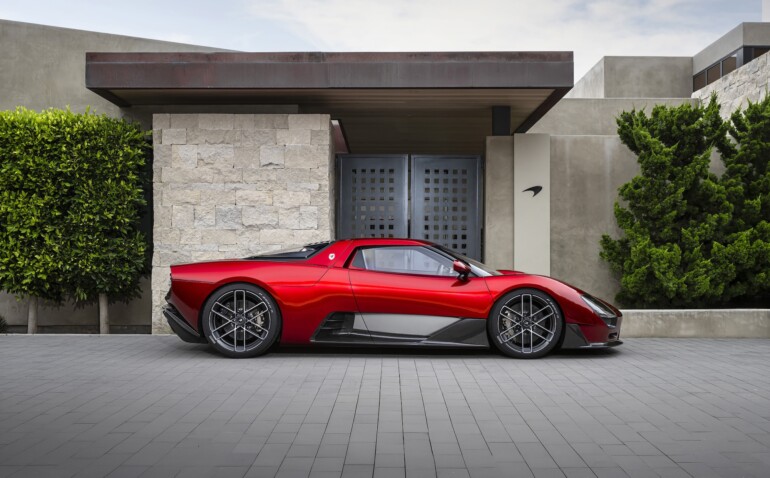
In 1969, Bruce McLaren set out to develop his own road-going sports car from a race car with the M6GT. The project remained unfinished. At Monterey Car Week 2026, the McL 6GT now picks up where that idea left off: exceptionally low and wide, with largely uninterrupted surfaces and a cockpit in which a manual shifter once again takes center stage. McLaren brings a design from the beginnings of its road-car history into the present and places it within the context of a broader transformation of the brand. After months of strategic restructuring, a new chapter is taking shape in design as well: since this spring, Chief Design Officer Kemal Curić has been responsible for its future direction. Chapter met him in Monterey to discuss the making of the McL 6GT and the future of McLaren design.
That McLaren should look so explicitly to its own history at this particular moment is significant. Yet the McL 6GT is by no means simply a retro exercise. It draws on the M6GT through low proportions, clean volumes and a strong emphasis on direct driver interaction, while reinterpreting those ideas in a contemporary context. In that sense, the concept reveals less about what future McLarens might look like than about the principles behind Curić’s approach to design: reduction, clarity and a close connection between driver and machine.
McLaren has, after all, been unusually quiet in recent months. Since its acquisition by CYVN Holdings and subsequent combination with British electric-vehicle company Forseven, the company has been undergoing a major reorganization. Among the changes announced is an expanded model range, although little has yet been revealed about what that portfolio will actually look like. Design, too, is entering an entirely new phase. Since this spring, Kemal Curić has led the design team as Chief Design Officer, overseeing the creative direction of McLaren’s future portfolio. After senior design roles at Lincoln and Ford Performance, he joined McLaren at the request of CEO Nick Collins, with whom he had already worked some 20 years ago.
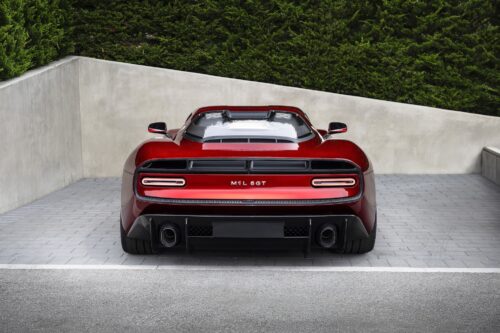
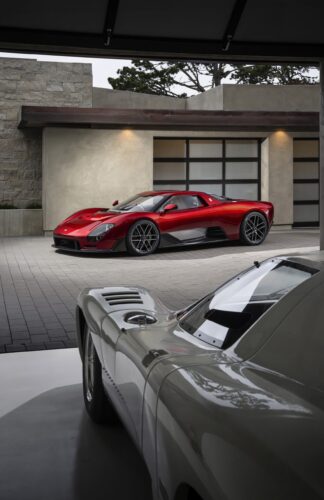
At Monterey Car Week 2026, some of the ideas behind Curić’s approach to McLaren design are becoming clearer for the first time. The McL 6GT Concept presented here is a clear statement of intent. What is particularly striking is how deliberately McLaren embraces an analogue driving experience: a V8, manual transmission and hydraulic steering deliberately return to an analogue form of driving that has become rare among contemporary supercars. From this, however, McLaren has developed a remarkably distinctive and compelling design: exceptionally low, with clean, almost uninterrupted volumes, a cabin set deep into the body and a rear that picks up the Kammback form of the original M6GT without slipping into retro design. Its analogue mechanics do not feel like nostalgic additions either; they are closely integrated with the car’s proportions, ergonomics and controls. McLaren itself describes the McL 6GT Concept as a signal of a future-facing approach.

Chapter met Kemal Curić at the world premiere of the McL 6GT. While the initial idea for the car predates his arrival at McLaren, Curić subsequently worked with the existing design team on its proportions, execution, interior and numerous details. In our conversation, he explains why knowing when to stop is often the hardest part of designing a car, why clay models remain indispensable despite VR and augmented reality, and what watchmaking has to do with the design of a McLaren interior.
Chapter: You joined McLaren in the spring of this year. How much of the McL 6GT Concept was already settled when you arrived, and where was there still room to move?
Kemal Curić: I was involved in the design of the whole car. But there’s an excellent design team at McLaren, and they already had an idea of what they wanted to do. Then I came in with editing, curating, proportion, execution and the interior. I had a lot of influence on the interior—everything around the driver, the tactile side, the mechanicals, the patterns, even the headlamps. I also worked very closely with the engineers to keep the nose very low. Extremely low, in fact. The height sits at the legal limit. But as I said, the idea started before I arrived, and then we executed it together as a team.
Chapter: Every car has one design detail a team keeps returning to, long after the rest has been decided. Where was it on this one, and what was the discussion about?
Kemal Curić: Actually, the whole car. But the hardest part is knowing when to stop. A good design team always wants to add more ideas, because there is never a lack of them. So I have to work out: does it add any functionality? Can we keep it pure, keep it close to the original idea? I would say that’s always the hardest part.
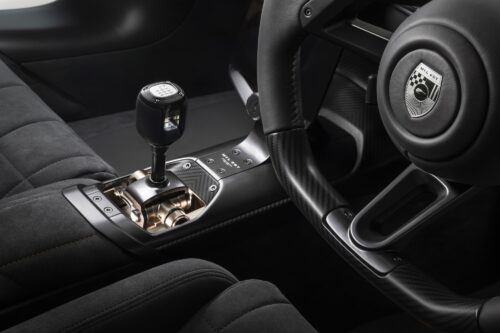
Chapter: Is there a design detail you expect almost no one to notice, but that matters particularly to you?
Kemal Curić: The analogue shifter—it’s a work of art. We went through so many iterations of it. Not just how it looks, but how it feels in your hand, and the craftsmanship behind it. In general, we were obsessed with the interior. Around the steering wheel, everything at your fingertips. We spent a great deal of time on things like that, so the car doesn’t just look great from the outside, but feels great on the inside as well. So that as a driver, you really feel engaged. And then there’s the use of VR and AR. Very, very useful, because you can try out a lot of iterations that way. How the air vents feel. How the digital connects with the analogue. In what order. Can I operate it directly when I’m driving at 150 mph? Things like that are very, very important.
Chapter: And yet there is still clay in your studio. What does clay show you that a VR headset cannot?
Kemal Curić: The touch and feel. It always starts with VR, then AR. You see the car in front of your eyes; you can walk around three or four versions of it. We have five or six headsets, and we all walk through the studio with no car there at all. Then we see it in augmented reality. That’s another level again. And then we decide: this is the car that goes into clay. Of course, you then find that it looks slightly different. It feels different. Especially with cars this emotional—and this is a very emotional car. It has to feel superb. In clay, you can see the tension in the surfaces. You can debate the rear haunch: five millimetres here, twenty millimetres there. Is there more muscle? Is the surface over-tensioned? Is that too much? We spend a lot of time on that in clay modelling, especially when you’re doing something this emotional.
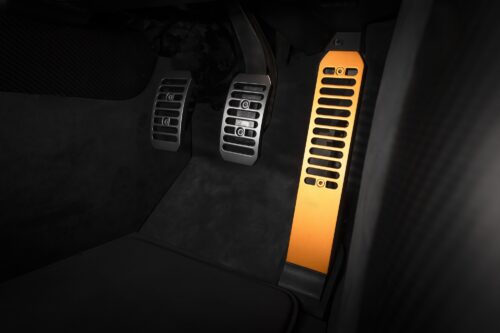
Chapter: We’re standing here at the House of McLaren in Pebble Beach, in the middle of a Car Week that trades heavily in nostalgia and provenance. While most established sports car manufacturers now reinterpret their history through explicit retro or heritage models, McLaren has largely stayed out of it. What does a week like this mean for a brand that rarely quotes its own past?
Kemal Curić: Well, it’s great—for me, it’s always emotional to understand which cars still speak to people 50 or 60 years later. Usually, those are the simplest, boldest—I would say the purest—forms, the ones we admire. The goal for McLaren is to create something very timeless and pure. The cars you’re describing, the ones you can draw with two or three lines, the ones you and I and probably all of us admire: when you reduce them to their essentials, they are actually quite simple and pure. And I think that is the boldness. That’s where I see McLaren: being really bold, having fewer elements, but then executing them to perfection. We’re hoping that a car of this type becomes one of the cultural icons of its period 30 or 40 years from now.
Chapter: So, 30 or 40 years from now, at an event like this one, what would tell someone that a car came from the “Curić era” at McLaren? What would be the markers?
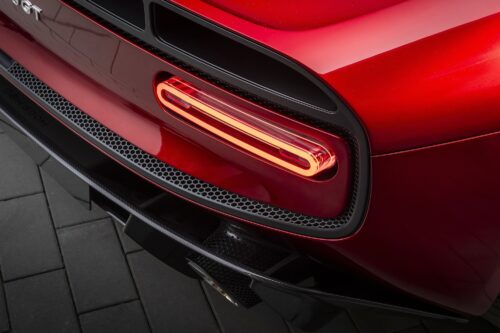
Kemal Curić: The marker for me would be clarity. The emotional aspect coming through. A purity of design that is very clear, intentional and has a timelessness to it. Not so much the graphics, because graphics can be repeated—I’m not talking about the headlamps and taillamps as such—those things are repeatable. It’s more about the ethos behind it. Everything is functional, everything is purposeful, everything has a reason. There are no empty calories, that’s the idea behind it. So I would say: the most emotional and most engaging vehicles. That would be my goal for McLaren.
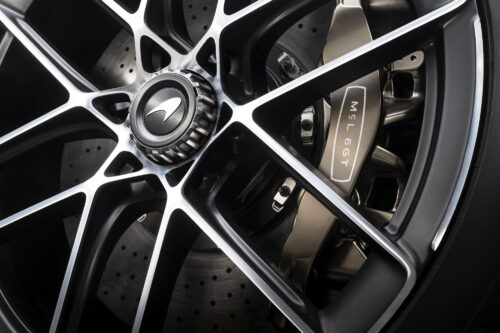
Chapter: I read that you collect watches and that watchmaking interests you. What can a car designer take from a discipline that has to resolve mechanics and proportion within a few millimetres? And where do automotive design and watch design actually meet?
Kemal Curić: For me, watches are an inspiration for the interior. Really, all the gauges, the whole tactile feel. For me, it is always about showcasing the engineering, the beauty. It’s not just about telling the time; it’s about showing the beauty of it, which again comes down to how you execute it. Some beautiful watches expose the mechanics, beautifully faceted. There’s something really fascinating about watches for me. I’m not going to mention which ones in particular, but there are some I obviously admire. How they remain relevant over time—that for me is really inspirational. I’m obsessed with watchmaking, with the details, with the way light travels through some of these watches. Look at the watch you are wearing right now: when you turn it into the light, you can tell somebody thought about it. How is it going to feel at night, in daylight? It also says a lot about you, which watch you wear, and I think that has something to do with the car as well.

Chapter: You grew up in Sarajevo. Is there something from there—buildings, cars, everyday objects—that still influences the way you look at design?
Kemal Curić: Absolutely. The brutalist architecture I grew up with in the eighties, mixed with what the Ottoman Empire left behind. It’s a wonderful mix in that city, and it’s all right out in the open—something I haven’t found in Germany or in the US. There are so many facets to it. You turn around and see something very modern, and something that has stood for hundreds of years. It’s unbelievable, it’s a very vibrant city. I get goosebumps talking about it. I haven’t been there in a long time, I’m sorry to say. It marked me, and that imprint is still there. Even now. You always see the modern and the old. They coexist. That’s a very beautiful thing. [CPS]