

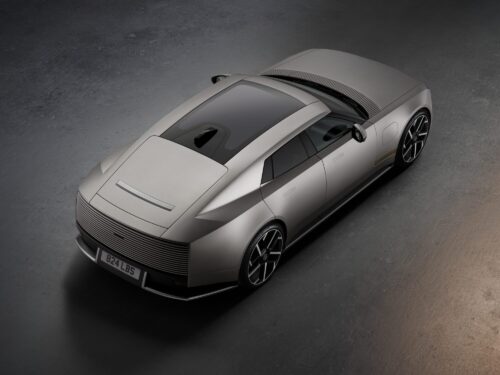
An extremely long bonnet, a cabin set far-back, a low roofline, and large, almost uninterrupted body surfaces: the proportions are at the heart of the new Jaguar Type 01. The four-door Grand Tourer, unveiled in New York, thus adopts familiar characteristics of the British brand, but interprets them in a fundamentally new design language. With a length of 5.24 meters and a height of only 1.40 meters, the Jaguar Type 01 appears unusually stretched, an impression reinforced by the 23-inch wheels.
At the end of 2024, Jaguar sparked a fierce public debate with a new visual identity and the »Copy Nothing« campaign. Shortly thereafter, the Type 00 followed at Miami Art Week. The two-seater study first revealed how Jaguar intended to translate its new design philosophy, »Exuberant Modernism«, and its desired repositioning as a luxury brand into design. With the Type 01, it is now clear that the design language presented back then was indeed more than an exaggerated culmination of a concept car: Jaguar has transferred many essential features into production.
Proportion at the Core
Particularly striking is the long hood. In classic Grand Tourers, such a proportion largely resulted from accommodating large engines. With the electric Type 01, this constructive necessity no longer exists. Nevertheless, Jaguar consciously opts for it, transforming a formerly technical requirement into a design element.
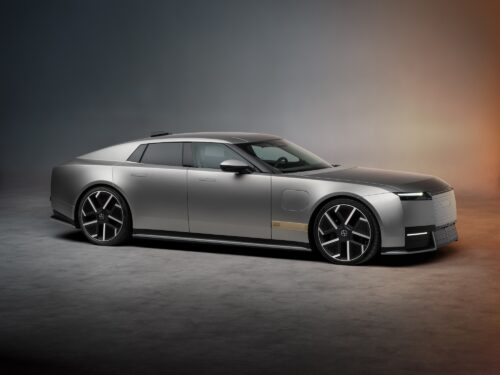
The extent of this decision is evident in the distance between the front axle and the front door edge. Jaguar refers to it as the »Luxury Gap«. In the Type 01, it measures 898 millimeters, accounting for approximately 17 percent of the total vehicle length. According to the manufacturer, this ratio is almost identical to that of the legendary E-Type. The XJS is also cited by Jaguar as a design reference point. The past thus serves, in a way, as a reference for proportion, while the surfaces and graphic elements point in a new direction.
This silhouette was made possible by the specially developed Jaguar Electric Architecture, or JEA. The construction was specifically tailored to the design requirements. Jaguar took an elaborate path to realize the originally intended form under the conditions of series production.
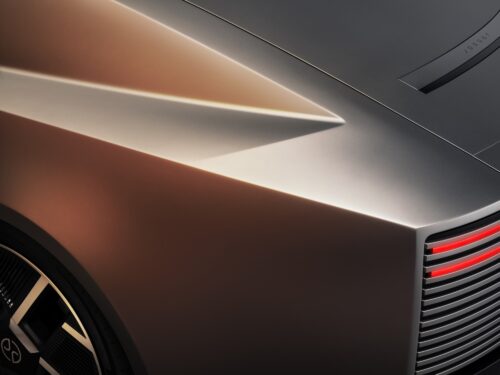
The extent of this ambition is demonstrated by a body panel internally named the »Impossible Panel«. This large aluminum sheet in the rear side area combines five different surfaces whose lines converge at one point. For its production, Jaguar developed a six-stage pressing process that operates with 2,500 tons of pressing force at the Halewood plant. According to the company, more than 1,500 hours were required to fine-tune this pressing process.
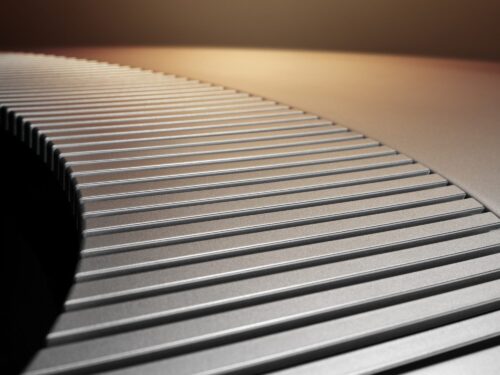
Intensive work was also done on the transitions between glass and bodywork. The frameless doors close directly against the body. A special folding technique allows seals and additional trim strips to be largely removed from the visible area.
A New Face
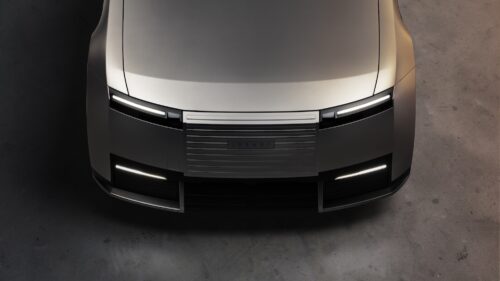
The altered design language is also particularly evident at the front and rear. Instead of a traditional grille, the horizontal »trikethrough« graphic defines the appearance. Four narrow lights form a new light signature. With a height of only 84 millimeters, the main headlights are the flattest ever on a Jaguar. »The front of Type 01 is all about presence,» explains Alexey Andreev, Exterior Design Lead at JLR. The new vehicle architecture made it possible to position the lights far out and high at the front to emphasize the vehicle’s width.
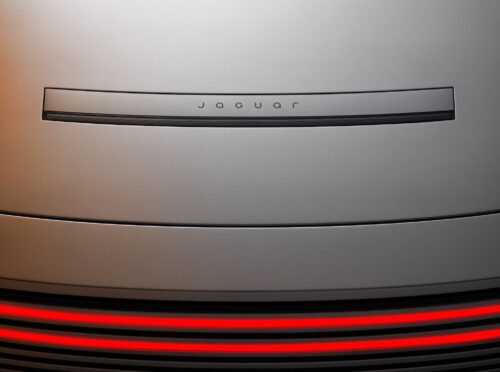
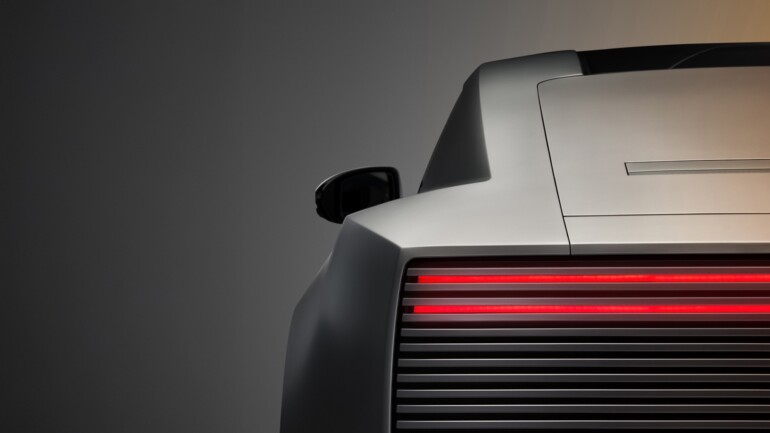
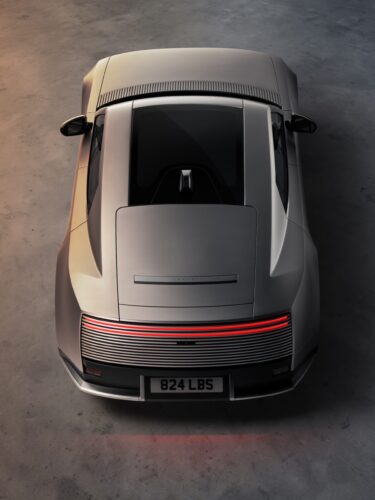
At the rear, the horizontal division continues. The taillights extend across the entire width and remain hidden when switched off. A special feature is the closed tailgate without a rear window. Together with the pronounced rear shoulders, this creates a large, coherent surface whose effect largely depends on the transitions between the individual body volumes.
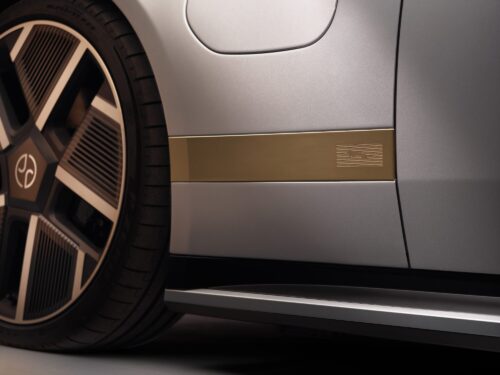
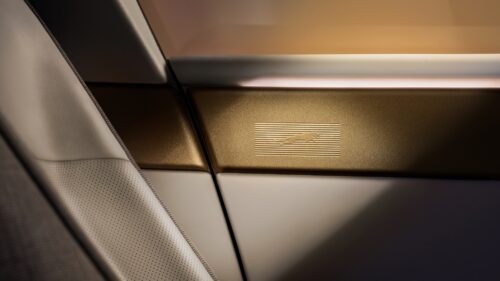
The leaping big cat remains a trademark but is used differently. On the exterior of the Jaguar Type 01, the Leaper is exclusively located on a side metal element, the so-called »Fender Ingot.« There, it is laser-engraved into a surface with a brass-like finish, and in the Design Vision version, into an anodized metal finish.
Aerodynamics were also adapted to the largely closed surfaces. Active air control elements at the front and a three-stage retractable rear spoiler remain hidden when not in use. After more than 7,000 wind tunnel tests, the Type 01 achieves a drag coefficient of 0.23, according to Jaguar. The aerodynamic requirements were thus met without abandoning the fundamental silhouette.
Four Seats Along an Axis
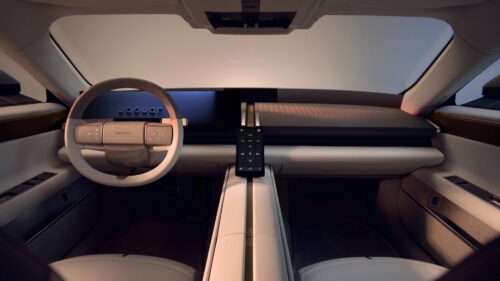
In the interior, the pronounced longitudinal orientation of the exterior is continued. A central structure runs through the entire cabin, dividing it into four individual seating areas. Elements of anodized aluminum with a brass-like finish accompany this central axis and continue along the upper door areas. »Our holistic design philosophy translates the vehicle’s exterior presence into a distinctive interior architecture,« explains Thomas Holden, Chief Interior Designer at Jaguar. The continuous central structure is an essential architectural element that emphasizes the length of the vehicle and assigns each occupant their own area.
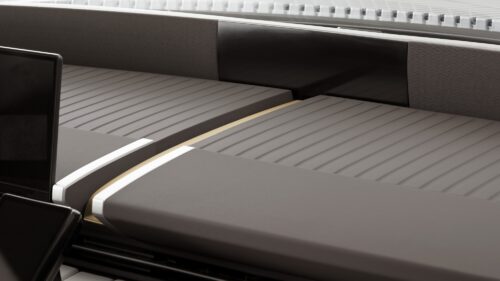
The material design is inspired by the layered hues of travertine. For the seat covers, a wool blend fabric from Kvadrat, leather, or NeoGrain from Ultrafabrics are available. The seats are also designed with few visible seams, thus reflecting the reduction of the body surfaces. Individual strong color accents initially remain hidden and only become visible when storage compartments are opened. The digital elements are also intended to interrupt the spatial design as little as possible. A 24-inch OLED display is located in front of the driver, while an additional seven-inch touchscreen handles frequently used functions. Further controls and ventilation openings remain hidden until needed.
From Vision to Production
The Type 01 thus also shows how closely Jaguar’s new design language is linked to technical development. The extraordinary proportions demanded a dedicated vehicle architecture, and the large body surfaces required elaborate manufacturing processes. Even details such as the transitions between glass and metal were specially developed to implement the original design as unchanged as possible.
This also gives the debate surrounding the Type 00 a different meaning in retrospect. When Jaguar presented the study in 2024, it was hardly possible to assess how much of the reorientation would flow into future vehicles. The Type 01 now answers this question with a design that actually retains many of the seemingly radical features of the concept. And many will likely attest: the provocation of 2024 has indeed arrived in series development. [CPS]