

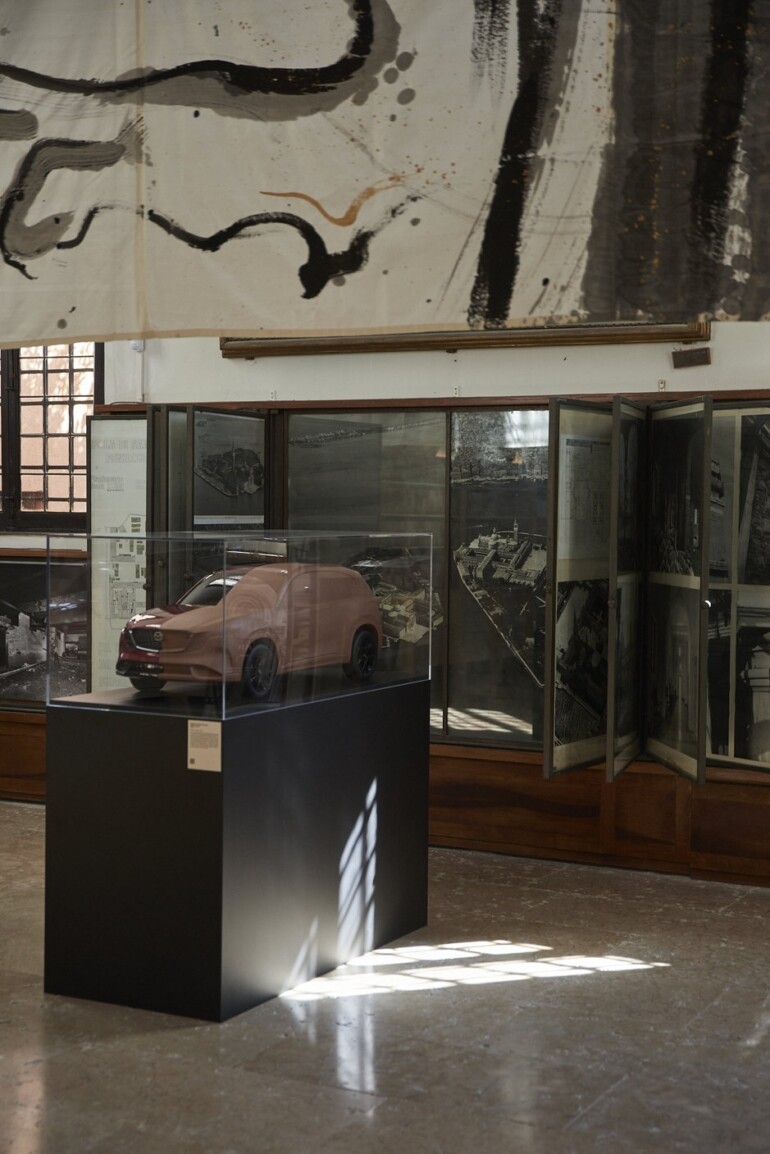
In his role as Brand Style Manager Europe, Raphaël Lesbats sees himself as a translator of Mazda’s multifaceted Kodo design philosophy, rooted in Japanese aesthetics. At this year’s edition of the Homo Faber Biennial: An Island of Light in Venice, he spoke with Chapter about Europe’s deep fascination with Japanese culture and the delicate task of communicating a consistent brand identity across every touchpoint. A conversation about the significance of cultural design principles and their translation into a contemporary brand identity.
Right at the beginning of our conversation, Raphaël Lesbats makes it clear that his role is not about a nostalgic return to traditional philosophies. However, especially in an age of information overload and almost unlimited design possibilities, the question arises as to whether traditional principles should regain greater importance.
Against this backdrop, we want to know from Lesbats whether culturally anchored design principles can serve as a benchmark for good design today, when knowledge is available almost without restriction. He contextualizes this particular moment in our time as follows: »Today, we have access to an almost unlimited amount of information, but what becomes increasingly rare is meaning, clarity, and intent. Our philosophies provide enduring principles that help us distinguish what is essential. They remind us that good design is not about adding more, but about creating something that resonates deeply and naturally with people. At Mazda, our Kodo design language is a compass. It guides us toward authenticity, helping us create products that feel emotionally meaningful and human, even in a rapidly changing world.«

In his role as Brand Style Manager Europe, the aforementioned compass could be equated with cultural sensitivity. When asked whether the European perspective changes Far Eastern (design) philosophies at their core or rather makes something universal about good design visible that transcends cultural boundaries, Lesbats clearly places his own role at the service of mediation. For him, the challenge is always: How can these Japanese principles be translated visually and emotionally so that they also reach a European audience? »My role is not to change the philosophy, but to translate it.« He points to the long-standing fascination with Japanese culture in Europe: »While our Kodo design language is rooted in Japanese aesthetics, Europe has long cultivated a strong fascination with Japanese culture. Whether through architecture, craftsmanship, gastronomy, design, fashion, or manga, many Europeans are already familiar with values that are central to our creative thinking: restraint, precision, respect for materials, and the beauty of simplicity.« For him, this cultural proximity creates an interesting dialogue. »People may not know the concepts of Ma or Kaicho by name, but they instinctively respond to what these principles express.«

For Lesbats, Kodo as a philosophy therefore extends far beyond vehicle design. It influences how an image is composed, how light and space are used, how rhythm is created, how stories are told, and ultimately, how Mazda consistently communicates its brand identity across all touchpoints. He cites a campaign for the Mazda CX-6e as an example, for which the team drew inspiration from film directors Yasujirō Ozu and Jean-Luc Godard, among others. »What interested us was the dialogue between these two cinematic worlds: Ozu’s sensitivity to space, stillness and observation, and Godard’s visual freedom and striking compositions. Although very different, both offer lessons in how emotions can be communicated through framing, rhythm and visual restraint.«

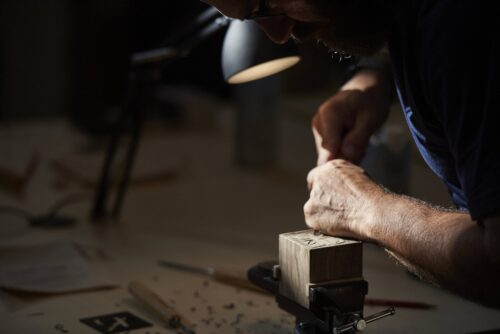
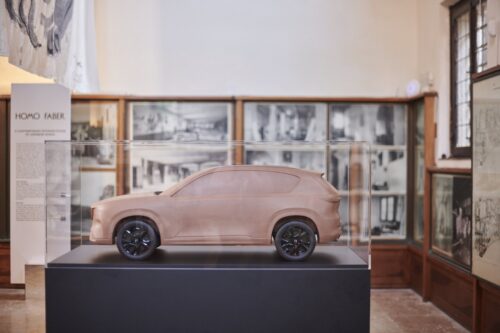
The fact that this approach extends far beyond the immediate context of automotive design is also demonstrated by Mazda’s involvement in this year’s Homo Faber Biennial: An Island of Light. As a supporter of the Biennale and Country Sponsor Japan of the Homo Faber Fellowship, the brand is committed to Japanese craftsmanship and the transfer of knowledge between masters and a younger generation. The encounter with traditional craftsmanship offers Mazda the opportunity to focus on those design principles that are also decisive for the brand’s vehicle design. Lesbats comments: »At first glance, the world of automotive design and the world of traditional craftsmanship may appear far apart. But they share the same foundation: a dedication to beauty, mastery of materials, attention to detail, and respect for the maker’s hand.« For him, Homo Faber c reates a special opportunity because it brings together some of the most talented craftspeople from all over the world. Combined with the special setting of Venice, he says, the exhibition thus becomes a place of exchange, inspiration, and dialogue between different creative disciplines. »For visitors, but also for us as designers, this encounter is incredibly valuable. It reminds us that regardless of the medium we work with, the pursuit of excellence is often guided by the same principles.«
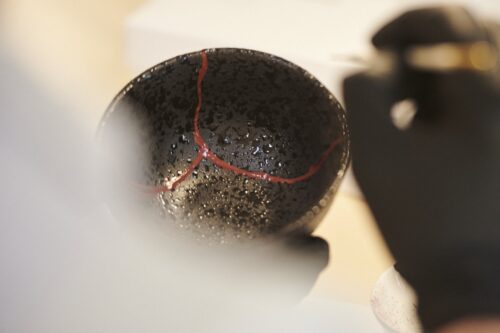
At Homo Faber, Mazda communicated its connection to Japanese craftsmanship through Kintsugi, a centuries-old Japanese tradition in which broken ceramics are put back together with gold and a great deal of patience. »It was an opportunity to show that behind every vehicle there is a long journey of craftsmanship, human sensitivity, and careful refinement, values that resonate deeply with the spirit of the Biennale.«
Alongside traditional principles and the transfer of artisanal knowledge, there are also the real, technologically highly complex developments of the modern automobile. Given the increasing pressure to think of vehicles as »computers on wheels,« we want to know how Mazda preserves the almost sculptural clarity of its Kodo design philosophy. Where is the line between meaningful innovation and visual noise? For Lesbats, technology should serve people without dominating their experience. »One of the challenges facing designers today is that technology constantly offers new possibilities, but not every possibility creates value,« he says, describing the challenge, and continues: »At Mazda, we try to start with the human experience and then determine which technologies genuinely enhance it.« For Lesbats, the clarity of the Kodo design language is based above all on design discipline. He describes the connection between simplicity and emotional impact as follows: »We seek simplicity because we believe clarity creates a stronger emotional connection.«
What does he think will endure in the long term? »What will endure, in my opinion, is not any particular screen or software feature. What will endure is the human desire for beauty, harmony, and intuitive interaction. These are timeless qualities that technology should help express, rather than replace.« It stands to reason that traditional Japanese principles such as Ma, Utsuroi, and Sori, which underpin Mazda’s Kodo design philosophy, could become even more important for future generations of designers.
Finally, we ask Lesbats what significance these design principles based on perception and emotion can have for a generation of designers who grew up in the digital age. His answer clearly focuses on quality rather than quantity: »Young designers today are surrounded by digital tools capable of generating almost infinite forms and solutions. In such an environment, the challenge is no longer the ability to create, but knowing what is worth creating. Japanese principles and philosophies provide a deeper understanding of rhythm, harmony, and emotion. They encourage designers to observe, reflect, and develop ideas that carry meaning rather than simply pursuing novelty.«
In the age of artificial intelligence and almost unlimited design possibilities, Lesbats therefore sees the importance of human perception and experience continuing to grow. In the future, the ability of designers to give ideas meaning will be decisive. He concludes by putting it in a nutshell: »For me, the true value of a designer will no longer be the ability to generate ideas, but the ability to give them meaning.« [DM]