


Text Max MONTRE
They tell different stories: the mechanical watch and the smartwatch. One invites dialogue and tells a story; the other offers advice. Both have their place.
It’s a cherished ritual that unfolds every morning: before heading to work, I pick up my wristwatch from the nightstand and wind it. I carefully turn the crown between my thumb and forefinger, feeling the delicate clicking of the movement’s gears as they tighten the mainspring. The energy I invest in this simple act — admittedly modest — will keep the watch running for the hours that follow.
Then there’s the distinctive sound of the winding mechanism. Clearly audible, yet neither loud nor intrusive. I hold the timepiece to my ear and listen to the movement ticking softly and steadily. A sound that can bring enthusiasts renewed pleasure every day. Perhaps this is the mechanical watch’s greatest advantage — its quietness. It offers a counterpoint to our noisy surroundings, so often dominated by screens, notifications, and white noise. The classic timepiece is perceived not as a device, but as a discreet everyday companion. It sends no push notifications; it communicates quietly. Rather than issuing instructions, it conveys the significance of the time we have. It doesn’t say »do this now« or »do that now«, but rather »I’m here — and I’ll show you how time passes«. In its most beautiful form, one might add.
Winding a manual watch is almost a meditative practice, a moment in which one can briefly forget oneself and one’s surroundings. There is so much more to this simple act. After all, isn’t the ritual of winding also a dialogue with the object itself, its cultural history, the craftsmanship behind it, and a centuries-old tradition?
The resistance of the crown, the sensation of reaching the point where the mainspring is »fully wound« — these are sensory impressions derived not from data, but from tactile experience. Even with automatic watches, something of this experience remains: the occasional need to set the watch, consciously correcting the time or date after days without wearing it. It is a small adjustment to reality. Mechanical watchmaking makes no claim to perfection; its appeal lies in its closeness to the human experience. A mechanical timepiece may run fast or slow, occasionally requiring a little more attention. And it is precisely this that makes it personal.
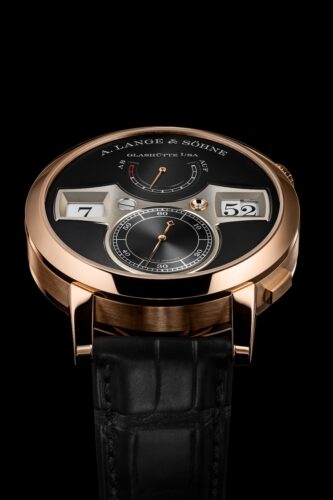
Mechanical and digital: the Zeitwerk by A. Lange & Söhne unites two worlds
The smartwatch, on the other hand, is a conversational partner with an agenda. Of course, it can also display the time and date, but it optimizes, reminds, measures, evaluates, and makes no mistakes. It is less a piece of jewelry than an interface, usually connected to a smartphone. Its dialogue with users is driven by data rather than culture. Both approaches, of course, have their place and raise fascinating questions that invite philosophical reflection.
For instance: Is the mechanical watch a storytelling machine? I believe it is. After all, it does more than tell time; it tells a story of gears, springs, friction, energy, and its gradual loss. Someone wearing an A. Lange & Söhne on their wrist sees more than just a watch hand. They see a choice: a commitment to craftsmanship, to a tradition that does not disappear simply because electronics and digitalization have made timekeeping more efficient. The value of a mechanical watch is therefore rarely purely functional. It is symbolic, historical, and, in a sense, social. A Cartier, for instance, is more than just a watch; it embodies a history of style. The Tank, the Santos… — their distinctive forms have become true icons. They speak a design language that many understand, even if they cannot decipher every detail. Chopard, meanwhile — depending on the model and context — combines watchmaking with the allure of jewelry and the sense of occasion. Like a necklace, such a watch is reserved for particularly special moments.
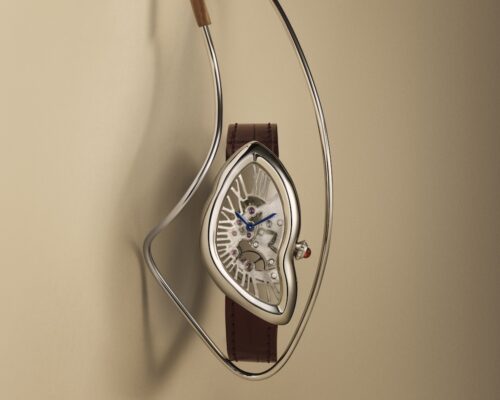
Cartier, as the »Watchmaker of Shapes«, conveys style history. The skeletonized Crash reaffirms this claim in 2026.
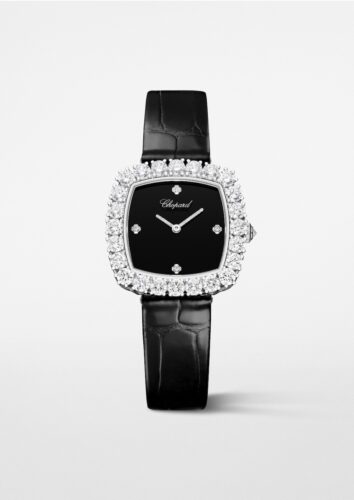
As part of Watches & Wonders 2026, Chopard presented the latest addition to the L’Heure du Diamant collection: a watch with a cushion-shaped case in 18-carat ethical white gold with a deep black onyx dial.
In any case, these are not gadgets that tell you: »You still need to walk 2,000 steps today to reach your daily goal.« And yet, they reveal something about the person wearing them. This is certainly true of Rolex — perhaps even more so than of any other luxury watch brand. The Geneva-based watchmaker has long since attained a status all its own. »Si à 50 ans on n’a pas une Rolex, on a quand même raté sa vie«, the French advertising pioneer Jacques Séguéla once declared: »If you don’t have a Rolex by the age of 50, you’ve failed in life.«
Rolex speaks a language understood around the world. The dialogue offered by a Submariner, a Daytona, or a Land-Dweller carries a dual message: on the inside, a promise of mechanical excellence and robustness; on the outside, a signal of belonging to a class of successful individuals who — in Séguéla’s terms — have made something of themselves. It is both a tool and a status symbol.
And it is a collector’s item: references, production years, and stories that accumulate around individual models like patina on metal. Collectors often speak of watches as though they were characters. A Submariner is more than just a diving watch; it has a biography: discovered, inherited, sold, bought back.
There is also a vocabulary all its own. »Pepsi«, »Hulk«, »Tropical«, or »Speedy« — these are all terms familiar to watch enthusiasts. They form a distinctive dialect that extends well beyond Rolex. After all, mechanical watches store meaning not on chips, but in stories.
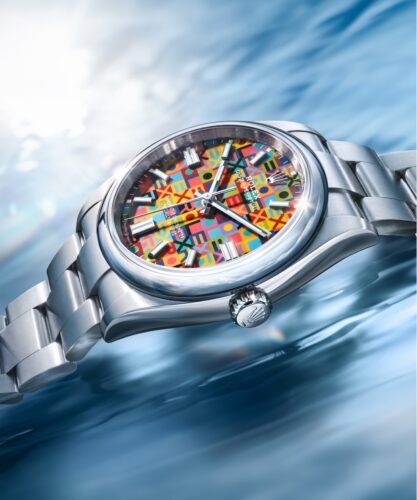
In 2026, Rolex enters a graphically and colorfully rich dialogue with its past.
The occasion is the 100th anniversary of the Oyster.
This brings us to a central point: mechanical watches invite a dialogue about time as an experience. They measure time — yes — but they do not reduce it to mere numbers. Their display is a metaphor — a circle that completes itself again and again. The second hand makes the passage of time visible. The date changes, offering a small reminder that another day has truly passed. Even complications — power reserve indicators, moon phases, chronographs — are less »features« than aesthetic ways of thinking about time. They create a stage on which time becomes not merely a number, but an event.
Digital watches and smartwatches, by contrast, speak a different language: that of optimization, as already suggested. In the best sense, they are not primarily timekeepers, but time managers. A smartwatch functions as a node in a virtual network of messaging, calendars, navigation, payments, and authentication. Its primary purpose is not to display time, but to connect it with actions. »Your next appointment is in 10 minutes.« »Your heart rate is elevated.« »You haven’t been active enough today.« This is a dialogue of constant feedback — a loop that, in turn, continuously establishes a standard against which we measure ourselves.
This feedback may be matter-of-fact, but it is by no means neutral. After all, data is never merely information; it is interpretation measured against a built-in standard. When a watch analyzes sleep cycles, sleep becomes something to be evaluated. When it visualizes physical activity through rings, movement becomes a daily obligation. This can certainly be helpful. For many people, the smartwatch is a tool for self-care: it encourages physical activity, detects irregular heart rhythms, reminds us to take breaks, and helps structure the day. But its dialogue is fundamentally different from that of a mechanical watch: it is not contemplative but, indeed, interventionist. It doesn’t ask: »How do you experience time?« Instead, it presses: »How do you use your time?«
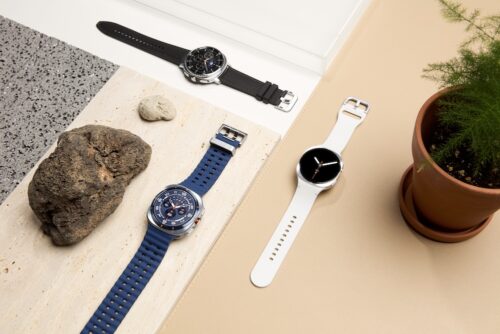
Better sleep, better fitness: Samsung’s Galaxy Watch 8 provides information and instructions — an active dialogue.
Samsung exemplifies this functional approach. The Galaxy smartwatch can be seen as a powerful extension of the smartphone, serving as a hub for health and communication. Smartwatches function as platforms that can be updated, expanded, and reconfigured. They also redefine the notion of status. Rather than being determined by the ownership of rare objects, status increasingly reflects the ability to navigate digital ecosystems, achieve efficiency, and embrace a »smart« lifestyle. Here, prestige means having everything under control, staying connected, monitoring oneself, and striving for continuous optimization.
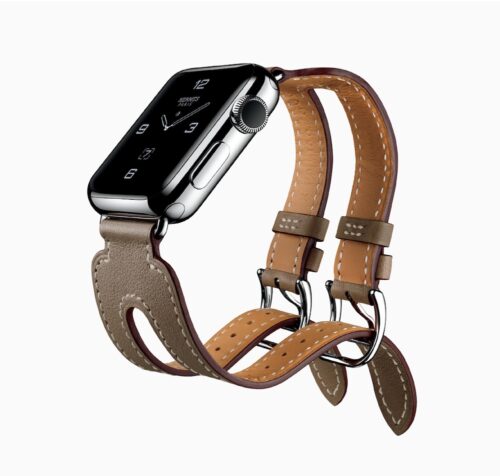
With the Apple Watch Hermès, the Maison transfers its design signature to a digital product.
Things become particularly fascinating where traditional watchmaking meets modern technology. TAG Heuer, for instance — best known for its chronographs — offers a smartwatch with its Connected model, as does Hublot. Hermès, meanwhile, takes a different approach through collaborations. The brand draws on its prestigious reputation to lend emotional depth to a digital product. The Hermès edition of a smartwatch can be seen as an attempt to introduce a cultural dimension into the data-driven dialogue: not just functionality, but style; not just an interface, but identity. The watch is intended not merely to measure, but to be something one can truly »wear«, without confining its wearer to a purely technological narrative.
Porsche Design occupies a fascinating space between these two worlds. The brand comes from a tradition in which design and engineering go hand in hand, with functionality also expressed through aesthetics. Whether mechanical or digital, Porsche Design demonstrates that an object becomes particularly appealing when its functionality simply »makes sense« — clear lines, innovative materials, and a certain cool consistency. From this perspective, the distinction between analog and digital is less a question of right or wrong. What matters is whether a watch embodies a convincing expression of technology.
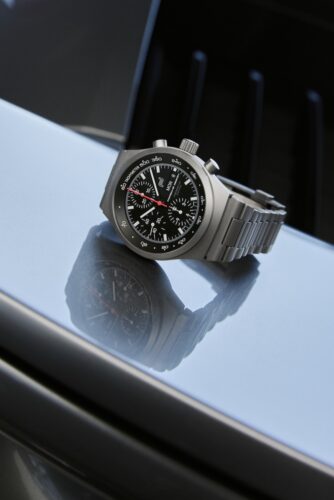
Chronograph 1 All Titanium: Clear lines, innovative materials, and a certain cool consistency — this is what Porsche Design watches convey.
Nevertheless, the difference remains palpable. The mechanical watch is not »up to date«; it is »out of time«. It belongs not to update cycles, but to generations. It can be serviced rather than upgraded, passed down rather than replaced. Its aging is not a defect, but part of its charm — scratches, patina, traces of a life lived. A digital watch, by contrast, ages like any other device — through its battery, compatibility, and software support. It follows a logic more closely tied to consumption. Even when expensive, it remains perpetually overshadowed by the next version.
And so, we are left with two distinct languages: mechanical watches help us experience time, while digital watches help us optimize it. The mechanical watch says: »Time is something you wear.« The smartwatch tells you: »Time is something you manage.« The mechanical watch makes no such demands. It does not seek to improve you; instead, it invites you to remember. Both approaches have their value — depending on the relationship we wish to have with our own time.
Looking back at the history of the wristwatch, we see that it, too, was originally intended primarily to keep track of time. Without precise timekeeping, the Industrial Revolution and the railway system would hardly have functioned as they did. This illustrates how the mechanical watch evolved from a simple gadget into an integral part of our culture.
Perhaps the key lies in recognizing that this is not a question of »better« or »worse«, but of two different ways of understanding human nature. The mechanical watch assumes that we derive meaning from objects, stories, rituals, and the knowledge that something will endure. The digital watch, on the other hand, is built on the idea that we can regulate ourselves through feedback loops, that health, performance, and organization can be measured — and therefore influenced. One relies on symbolism, the other on systems. Those who wear a mechanical timepiece by Rolex, Cartier, Chopard, or A. Lange & Söhne today often consciously choose a subtle form of communication — a conversation that unfolds quietly in the background, leaving room for tranquility and elegance. Those who wear a smartwatch, by contrast, opt for a dialogue that accompanies them like a coach: helpful, attentive, occasionally a little intrusive, often reassuring, and sometimes even carrying a hint of moral judgment. One type of watch is unlikely to replace the other entirely. Instead, we probably choose the form of communication that best suits our circumstances. On some days, the gentle ticking of a mechanical watch offers a welcome counterbalance to the frantic pace of digital life. On others, we need precisely what a smartwatch provides — a friendly reminder to get up, move around, and not forget anything important. Mechanical and digital watches are therefore not simply two distinct products, but two different ways of communicating with ourselves… about the passage of time and how we choose to shape it.
FIRST PUBLISHED IN CHAPTER №XIV »IN DIALOGUE« — SUMMER 2026