

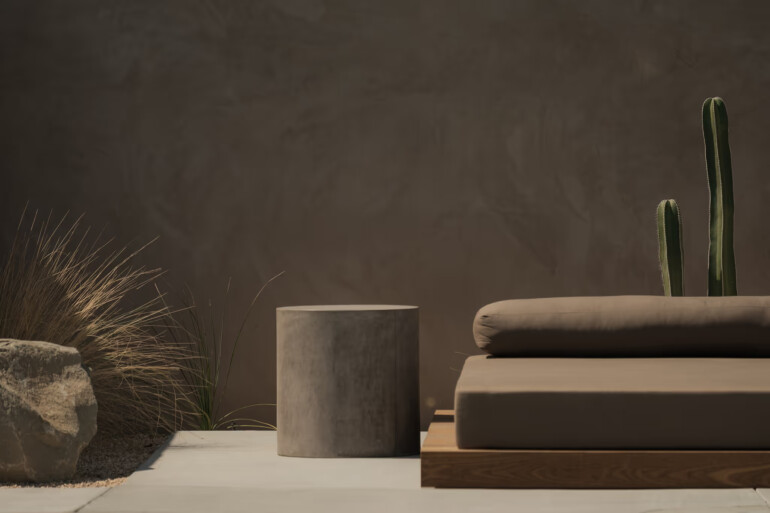
Metal-clad modules, pared-back interiors, and a material palette inspired by the Mojave Desert: the Reset Hotel near Joshua Tree National Park seeks a close connection to the landscape through restrained design. Ben Uyeda developed the architectural concept, while Gry Space shaped the interiors and visual identity.
At first, the pared-back architecture may evoke associations with a research station or a Mars colony. But for Emi Kitwaki and Jen Whitaker of Gry Space, the design of the Reset Hotel in the Mojave Desert was explicitly not about escapism. Instead, the reduced palette of elements was intended to sharpen awareness of the surrounding landscape. »For us, Reset was ultimately much more about becoming present in this landscape than escaping to another world.«
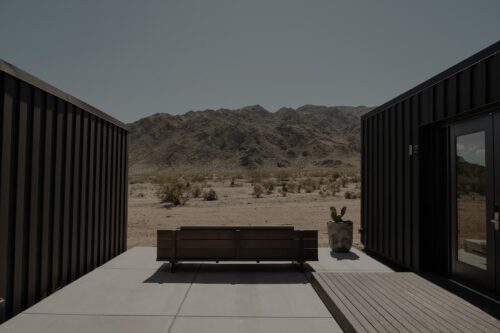
Gry Space likewise did not derive the pared-back interiors from the idea of a Mars colony. »The reduction of the interiors came from something broader«, Kitwaki and Whitaker explain. »We’re naturally drawn to spaces with enough emptiness to make you more aware of your surroundings, and of yourself. Rather than treating minimalism as an aesthetic, we used reduction as a way of heightening perception.«
Inspired by Shipping Containers
With the Reset Hotel, Ben Uyeda—who was responsible for the core design concept—says the project also became the first new hotel built in the area in 15 years. That the individual rooms, each with its own terrace, as well as the communal spaces, recall shipping containers is no coincidence. »I made a documentary series on building a shipping container house before to debunk a lot of myths about them. Over 20 million people watched the series and I got offers from investors to build more of what they already saw. I suggested other ideas but ultimately a tangible starting point with a complete example building was the most investable option«, Uyeda explains of the project’s origins.
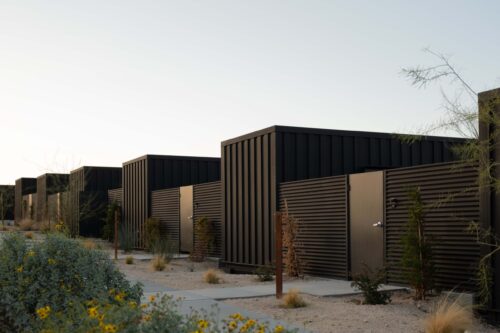
The modular layout of the complex emerged from a range of practical and spatial considerations, the architect and designer adds: »We thought about what was practical given the labor availability and construction timeline we wanted to achieve. We were building the foundations at the same time the modules were being constructed. The layout was derived from considering the views with the infrastructural requirements of the city state and county.«
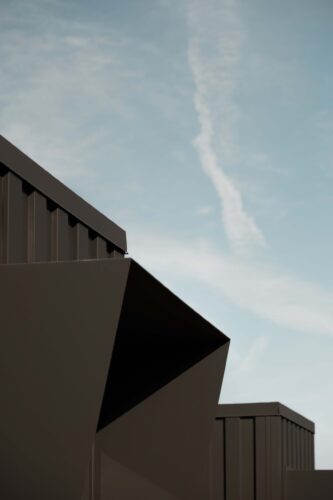
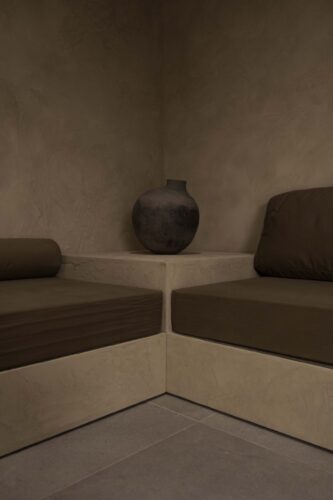
Uyeda not only developed the architectural concept, but also designed custom wooden furniture for all 65 rooms, including fold-down desks and built-in shelving. The oxidized-steel check-in counter, meanwhile, was hand-patinated by Gry Space. When selecting the materials, the desert served as their primary source of inspiration, Emi Kitwaki and Jen Whitaker note. »The desert landscape is defined by impermanence, constantly shifting through light, wind, erosion, and time. We wanted the material language of Reset to both honor that transience and hold a certain permanence against it. Stone, earth, oxidized steel, and lime plaster were chosen for their weight and elemental quality, but also for their capacity to age, weather, and evolve, allowing the architecture to develop a deeper visual language over time.«
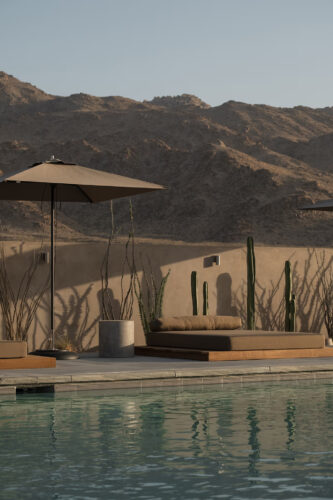
Through this reduction and material palette, the interior of the Reset Hotel becomes less a clearly separate realm than an extension of the surrounding landscape—»blurring the threshold between inside and out«. For Gry Space, however, bringing the landscape indoors did not mean literally reproducing the desert through imagery, furniture, or objects. »Instead, we looked at it atmospherically: the muted mineral tones, the dryness and roughness of the terrain, the intensity of the light, and the enormous presence of negative space. These qualities became embedded in the material and tonal language of the clubhouse units, pool, and room interiors, creating an interior that feels less like a representation of the desert and more like a continuation of it.«
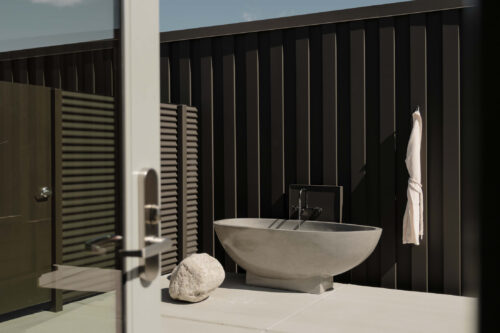
From Branding to Interior
They had been involved in the project from the very beginning, Emi Kitwaki and Jen Whitaker say, though initially in a somewhat different capacity: »We were originally brought on to develop the branding for Reset, a period we often refer to as our first date with the project. It became a way to understand how we worked together, and after the branding was complete, our role expanded into shaping the interior language. Ben and Adam (Note: Adam Wininger, co-founder of the Reset Hotel) had already established a strong architectural framework and relationship to the landscape. Rather than soften or disguise its rawness, we wanted to work in tension with it, introducing tactility, intimacy, and warmth while preserving the clarity of the original concept.«
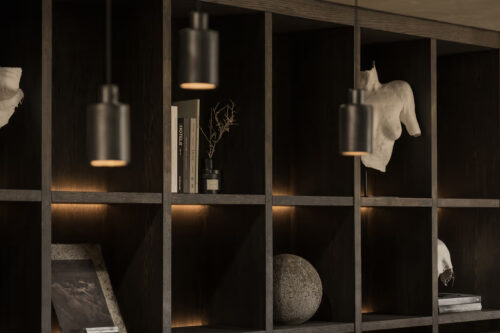
What began with the branding evolved into a collaboration in which architecture and interior design became increasingly intertwined. The question of what a space looks like repeatedly gave way to another: how its design shapes the perception of place. At the Reset Hotel, that question consistently leads back to the desert, which begins outside and remains present within. [SW]