

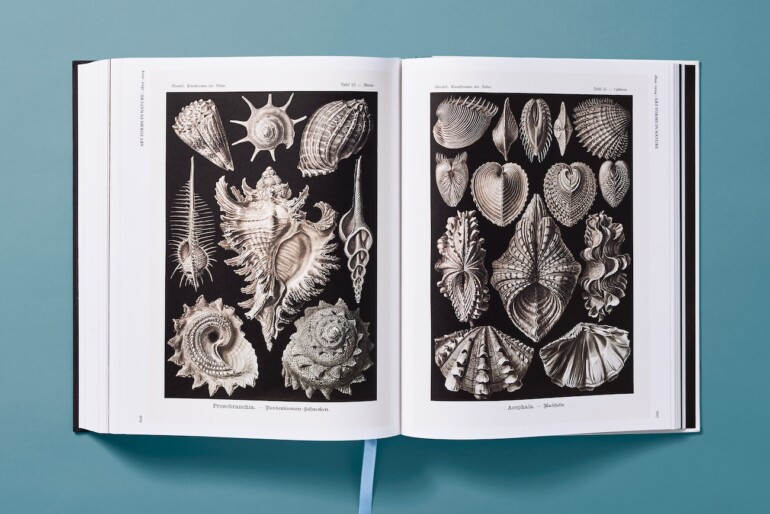
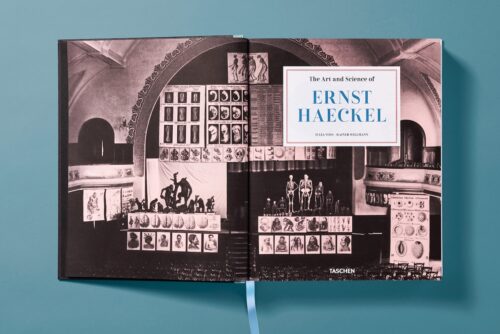
With images of delicate architectures, floating bodies of light and tissue, and enigmatic structures between organism and ornament, Ernst Haeckel (1834—1919), German zoologist, evolutionary biologist, natural philosopher, and draftsman, transformed scientific observation into a distinct visual language. The Art and Science of Ernst Haeckel, published by TASCHEN, assembles these visual worlds and traces their path from biological research into modern art.
»All true natural science is philosophy and all true philosophy is natural science,« Haeckel stated, thereby naming the ambitious philosophical and clear scientific claim that runs through his entire work. The logic of nature, which he understood as a coherent system whose forms emerge from evolution and kinship, was his preferred field of experimentation. In his introductory essay »Ernst Haeckel: Art Forms of Life,« zoologist and author Rainer Willmann describes Haeckel as a central figure of the 19th century who took up Darwin’s ideas, popularized them, and translated them into his own visually shaped worldview. His plates were meant to make connections comprehensible and visible and to trigger that »incredulous amazement at the beauty of natural objects« that Willmann describes as their lasting effect.
Born in Potsdam in 1834, Haeckel studied medicine and natural sciences, though it can be credibly claimed that his ambition hardly lay in a medical career. He scheduled his office hours from five to six in the morning, thus keeping the rest of the day free for zoological studies. A journey to Italy proved formative for him, where in 1859 he studied radiolarians in the Gulf of Messina. He drew the tiny single-celled organisms with their geometrically structured skeletons, as he wrote to his fiancée Anna Sethe, with »mathematical fidelity.« Already in these works, that connection of precision, systematics, and compositional sensibility emerged that would define his later plate works.
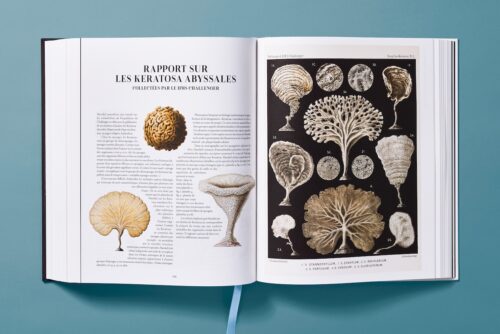
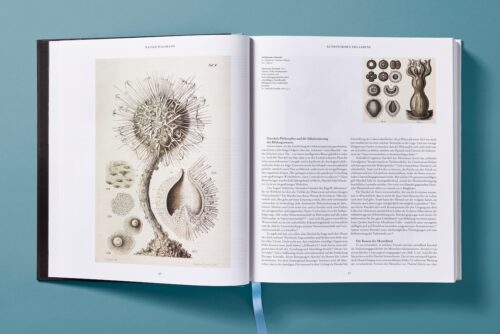
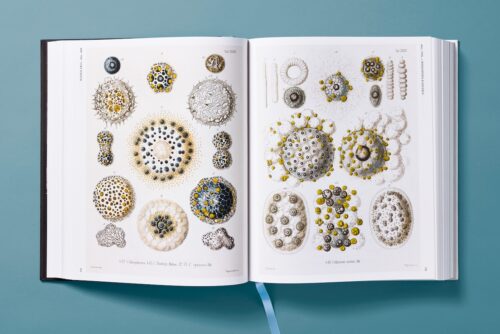
The 688-page volume guides readers through 450 reproductions from Haeckel’s monographs on said radiolarians, siphonophores, calcareous sponges, corals, medusae, and deep-sea organisms up to the Art Forms in Nature published between 1899 and 1904. The reproductions show his precise capture and deliberate ordering of structures. Symmetries are emphasized, bodies isolated, color values clarified, individual forms assembled into ornamental groups. Scientific illustration and artistic composition can hardly be separated. This keeps the images effective to this day, even where his research has been superseded.
In her essay »Ernst Haeckel and the Evolution of Modern Art,« Julia Voss traces the remarkable career of these motifs. Haeckel’s marine creatures, as she writes, left the book pages and found their way onto European facades, squares, stage curtains, and paintings. His forms were taken up by artists and designers such as René Binet, Émile Gallé, Gustav Klimt, Edvard Munch, Max Ernst, and Wassily Kandinsky—an unusually wide reach for scientific representations. On the internet, according to Voss, they ultimately went »viral.«
The proximity to Hilma af Klint (1862—1944) that Voss elaborates also gives Haeckel’s work an indirect contemporary relevance. The Swedish contemporary of Haeckel and pioneer of abstract painting remained largely unrecognized during her lifetime and is today celebrated as a groundbreaking artist of early abstraction. Currently, the Grand Palais in Paris is showing Hilma af Klint. Paintings for the Temple (1906—1915) , the first major solo exhibition of the Swedish artist in France. Voss brings both together through their shared interest in development, cell division, and the mutability of organic forms. While Haeckel understood the living as the result of a long evolutionary process, af Klint directed her gaze toward the futuristic potential of transformation and toward forms that might yet emerge.
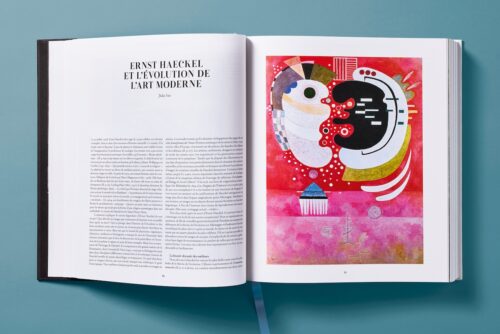
In her 1907 painting »Group IV, No. 9. The Ten Largest, Old Age,« a large-format tempera work on paper mounted on canvas, a sequence of growth, division, and transformation unfolds against a flesh-colored ground. Cell-like structures develop into two rotating figures. The proximity to Haeckel’s embryos and organic basic forms, according to Voss, lies less in direct appropriation than in a shared thinking in development, transformation, and inner laws.
As an object, too, the volume continues this idea of system. The binding of the hardcover with slipcase appears like a natural history plate: organisms float on a light ground, strange and precise. Inside, large-format image plates, historical photographs, manuscript pages, and essays alternate. Its physical presence corresponds to the ambition not to reduce the diversity of life to a famous motif.
Yet serious contradictions also belong to Haeckel’s story. Accordingly, the view of him as a scientist and interpretive thinker remains critical. Willmann names his scientific errors, his racist hierarchizations, and his later nationalist statements as facts and without embellishment. The brilliant observer was countered by a thinker with considerable blind spots. This recognition does not diminish the formal power of his work, but it does prevent purely aesthetic veneration.
The Art and Science of Ernst Haeckel shows a researcher who sought to understand nature through drawing and in doing so created images that extended far beyond biology and scientific illustration. Their visual radiance remains palpable to this day. The comprehensive publication from TASCHEN opens an archive of seeing, filled with beauty, knowledge, error, and afterlife [Ed.]
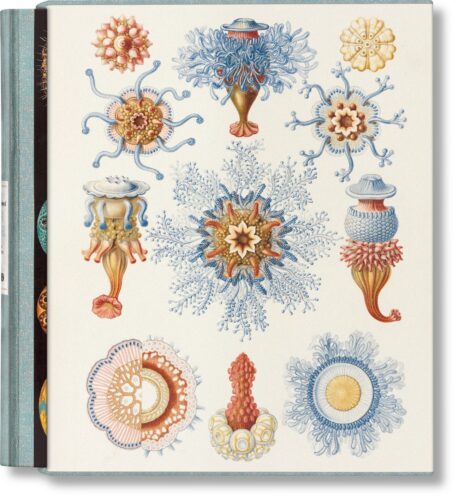
The Art and Science of Ernst Haeckel
Hardcover in slipcase, 24.3 x 30.4 cm, 688 pages
taschen.com