

Economic growth and the reduction of CO₂ emissions are often still seen as opposites. Polestar wants to pursue a different approach: The Swedish automaker is working to combine both developments and, with the Polestar 0 Project, develop a completely climate-neutral vehicle by 2035. Chapter visited the Mission 0 House in Gothenburg, where industry and science are working together on this endeavor, and also gained insights into Polestar‘s design studio, where sustainability is increasingly becoming part of the creative development process.
Sustainability is, of course, a term that’s quickly stated. More difficult is the daily work behind it: decisions about materials, supply chains, energy sources, and production processes. Especially in the automotive industry, this reveals whether a commitment goes beyond communication. Polestar is trying to make this level visible. The Swedish electric car manufacturer doesn’t just talk about goals but discloses where emissions can actually be reduced.

In the Polestar design studio, which opened in 2023, sustainability is a fundamental part of the creative development process.
Growth and climate impact should be decoupled from each other, explains CEO Michael Lohscheller. »If you don’t reduce emissions while growing, you’re consciously deciding against it. Electrification offers customers clear added value: lower operating costs, reduced emissions, and greater safety—while volatile crude oil prices and fuel scarcity are increasingly replacing range anxiety with pump anxiety. With the availability of clean energy, electric vehicles are becoming not only the sustainable choice but also the smarter and more reliable one.«

The design studio in Gothenburg is Polestar’s creative home and the place where the brand’s future models are created. Designers work closely here with the engineering and sustainability departments.
While Polestar has been very focused on numbers since the brand’s founding, it’s not exclusively on seconds, kilowatts, and newton-meters, but also on CO₂ emissions. »Our focus on performance doesn’t end with acceleration or charging speed. It equally encompasses performance in the context of sustainability. And in this regard, I’m pleased to say that we’re well positioned,« Lohscheller sums it up.
Translated into concrete numbers, this means: Since 2020, Europe’s only pure EV manufacturer has reduced its greenhouse gas emissions per vehicle sold by 31%, while annual sales simultaneously rose to over 60,000 vehicles. The reduction primarily results from Polestar’s focus since 2020 on increased use of renewable energy in battery production and manufacturing, as well as on the use of low-carbon materials. Last year, the increased production of the Polestar 4, the brand’s lowest-emission model to date, contributed significantly.

With the design studio and the Mission 0 House, Polestar has two central locations in Gothenburg for design and sustainability research.
The Swedish manufacturer’s stated goal is to develop a completely climate-neutral vehicle by 2035. Polestar 0 Project is the title of this ambitious endeavor, where zero doesn’t function as some kind of code word but actually means zero. To achieve climate neutrality, however, methods and production processes must first be developed that make it possible to manufacture every single part in the vehicle completely emission-free. Because this can’t be done alone, but only through the skillful pooling of knowledge, the Gothenburg-based automaker has started collaborations with companies whose goals point in the same direction. »The Polestar 0 Project holds immense potential. While large parts of the industry are investing in hybrid and combustion technologies, we’re focusing on solutions that completely avoid emissions. The innovations from this project demonstrate the power of collaboration and materials science—and how well positioned we are to drive the industry forward,« says Fredrika Klarén, Head of Sustainability at Polestar.

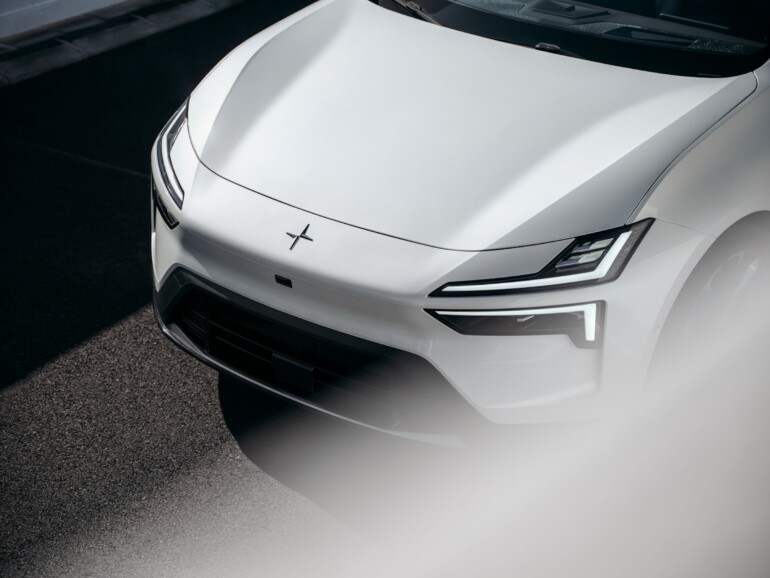
With the Polestar 4 SUV introduced in 2026, Polestar is expanding its model range—in line with its commitment to increasingly anchor sustainability in development and design.
Since 2025, Polestar’s climate research has been conducted at the Mission 0 House in Gothenburg, officially founded in 2025, where industry and science collaborate to eliminate emissions from particularly emission-intensive materials, products, and processes. Current collaboration includes five Swedish universities and six companies jointly researching and working on different solution approaches. Currently, the focus is on a large-scale pilot project for low-emission steel, research on battery materials, and the development of bio-based textile alternatives. Additionally, work is being done on technologies that could make it possible in the future to convert CO2 into new materials.

All these measures show that climate neutrality begins less with a single technological breakthrough than with a multitude of decisions consistently pursued over years. Ambitious or utopian? For Michael Lohscheller, the answer is clear: »Our aspiration is simple: to build the most sustainable vehicles in the world without compromising on performance or design.« [SW]