

Text Dzenana MUJADZIC
The tapestry, conceived as a practical object to warm floors, structure rooms, or insulate walls, has for centuries transcended its seemingly everyday purpose, assuming a second existence as a work of art. Within it, craftsmanship, visual language, and cultural memory condense into a compositional unity that extends far beyond its utilitarian function.
In the work of Jean Lurçat, the most influential textile artist of the 20th century, the tapestry likewise exceeds its original role: at once material and metaphor, surface and narrative space—a textile image poised between utility and aesthetic significance. In this dual role—as both handcrafted object and medium of symbolic imagination—lies the foundation upon which Lurçat built his radical renewal of tapestry.
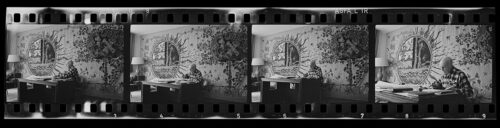
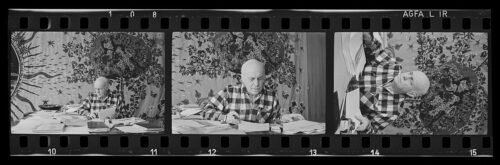
Born in Bruyères in 1892 and deceased in Saint-Paul-de-Vence in 1966, Jean Lurçat was active during his lifetime as a painter, ceramist, and tapestry weaver, among other things. Before dedicating himself entirely to art, he actually studied medicine at the Université de Nancy. However, after barely three years, he transferred to Victor Prouvé’s studio, also in Nancy, and subsequently continued his artistic education at the Académie Colarossi in Paris. From 1919 onwards, Lurçat increasingly emerged as an independent artist and began to establish himself as a painter and graphic artist in the French art scene.
Influenced by the decorative practices of the École de Nancy and his teacher Victor Prouvé, father of Jean Prouvé and a leading figure of this collective art movement, Lurçat came into early contact with the central principle of Art Nouveau, that art and craft are inextricably linked. However, his inclination towards the textile medium did not arise solely from this environment but was also—as many biographies emphasize—shaped by a personal experience: in 1917, his mother embroidered a small Gobelin tapestry based on one of his designs.

While works such as »Filles Vertes« (»Green Girls«, 1917) and »Soirée dans Grenade« (»Evening in Granada«, 1917), and later »Le Cirque« (»The Circus«, approx. 1922) and »Les Arbres« (»The Trees«, approx. 1924), demonstrate that he designed small-format, sometimes decorative tapestries early on and continuously created experimental textile works in parallel with his painting, which were executed in weaving and embroidery workshops, it was not until the 1930s that he primarily dedicated himself to tapestry weaving.
In the 1920s and early 1930s, Lurçat initially worked primarily as a painter, maintained a lively social life, and moved in circles of important personalities of his time, including Rainer Maria Rilke, Hermann Hesse, and Ferruccio Busoni. In the early 1920s, he met the French gallerist, collector, and art patron Marie Cuttoli, through whose initiative and support several small-format tapestries were already created based on his designs. Driven by the idea of dissolving the boundaries between fine and applied arts, Cuttoli presented innovative textile works alongside fine art in her gallery Myrbor in Paris. In line with her ambition to transfer modern art into textiles, she commissioned contemporary artists, including Picasso, Braque, Le Corbusier, and Léger, with designs that were subsequently realized as tapestries. As part of this project, in 1933, a tapestry based on a Lurçat design was produced for the first time in Aubusson, the traditional center of French tapestry weaving—the tapestry titled »L’Orage« (»The Storm«, 1933).
The execution of the work was still based on classical, painterly cartoons and without the new structure he later developed, but it marked the beginning of a fruitful collaboration with the traditional workshops in Aubusson—a collaboration that became the decisive prerequisite for the precise implementation of his conceptual and technical innovations in the following years.
IMMANENT SPARK
A first milestone on his now unstoppable path to becoming a central representative of modern tapestry art was his first major commission, »Illusions d’Icare« (»The Illusions of Icarus«, 1936), in 1936. The large-format work was commissioned by the French state and subsequently woven at the Manufacture des Gobelins, which has served as a state manufactory for the execution of tapestries for public buildings, museums, and state collections since the 17th century.
However, the decisive change of course in his work, which ultimately led to the revival and redefinition of tapestry as an independent, contemporary art form, was his encounter with the »Apocalypse of Angers« at the Château d’Angers in 1937, a 14th-century tapestry described on the official museum website of the Musée Jean Lurçat et de la Tapisserie Contemporaine as »déterminante« for his later textile work.
While tapestry had, for centuries since the Renaissance and Baroque, become a woven painting—characterized by designs in the form of illusionistic, painterly executed cartoons and nuanced color transitions—the textile clarity of the Middle Ages had largely been forgotten. With its clear contours, reduced colors, and great symbolic directness, Lurçat recognized in the medieval »Apocalypse of Angers« that tapestry does not have to be a painterly imitation, but can be an independent medium with a visual language developed from weaving techniques.
From this realization, that tapestry possesses its true strength in a visual language developed from weaving techniques, Lurçat derived his conceptual and technical reorientation: the radical reduction of the color palette, a numbered color code, and the abandonment of painterly designs in favor of strictly structured black-and-white cartoons, which gave clear instructions to the executing weavers and at the same time allowed him more control over the result. Thus, for the first time, tapestries were created that were no longer designed from the logic of painting, but again from their textile logic. Lurçat’s newly understood, profound view of textile material is described by Martine Mathias in the catalog for the exhibition Jean Lurçat — Master of French Modernism (Kunsthalle Talstraße, Halle/Saale, 2016) with the statement that it is above all the »intelligence of matter« that makes it possible to understand the quality of Lurçat’s tapestry weaving.
His artistic attitude, shaped by this idea of intelligent matter—a kind of energetic signature expressed in structures, rhythms, and forms—is based on the recognition and respect for the inherent life of the material, which he does not bypass but consciously reveals. This perspective, as Mathias notes, is rooted in his comprehensive humanistic education and his familiarity with ancient writings such as those of the Roman philosopher and poet Lucretius, whose De rerum natura (»On the Nature of Things«, 1st century BC) describes matter as a living reality permeated by inner forces. Mathias underscores this assumption with a quote that aptly summarizes Lurçat’s attitude: »Anyone who tries to subjugate the spirit of matter in wall tapestries behaves like a child.«
Following the inner logic of textiles, the tapestry thus becomes not merely a carrier of an image, but an organic medium in which this hidden energy becomes visible. For Lurçat, the threads form a poetic fabric in which the »spiritual« dimension of the world materializes. Already in the 1940s, works such as »La Grande Menace« (»The Great Threat«, 1940) and the eight-part, most symbolically dense group of works from the war years, »Constellations« (»Constellations«, approx. 1940-1945), make matter visually tangible as an energetic field, combining natural forms, signs, and rhythms into a metaphysical pictorial world.
DISSOLUTION OF THE WORLD
With the outbreak of the Second World War, global reality entered a phase of devastating political, social, and cultural upheavals, accompanied by the decomposition of all morality. Jean Lurçat, who had experienced the First World War as a soldier and survived it severely wounded, developed a lifelong sensitivity to the destructive forces of war. In the Second World War, in the Lot department—a region in southwestern France strongly influenced by the Resistance, where many intellectuals found refuge—he joined the circle of Resistance-affiliated artists such as Louis Aragon, Elsa Triolet, Jean Cassou, and Pierre Seghers, who opposed the Vichy regime and the occupation.
His tapestries from these years—such as »Les Vapeurs« (»The Vapors«, 1943), »Les Eaux« (»The Waters«, 1943), or »De natura solari rerum« (»On the Solar Nature of Things«, 1943), and later also »Liberté« (»Freedom«, 1945), »Avec la France dans les Bras« (»With France in its Arms«, 1945) and »La Naissance du Lansquenet« (»The Birth of the Landsknecht«, 1944)—process these experiences as moral-cosmic statements: powerful, often subversive depictions that accuse war, oppression, and collaboration, while also formulating a vision of human dignity, spiritual freedom, and renewal. In these works, man usually appears as a vulnerable but conscious being, embedded in a web of natural forces, cosmic signs, and political threat—a fragile figure exposed to the violence of war and yet remaining a bearer of human dignity and inner freedom.

As Martine Mathias emphasizes in the exhibition catalog Jean Lurçat — Master of French Modernism (Kunsthalle Talstraße, Halle/Saale, 2016), this depiction fundamentally shifts during this period, which shaped him both personally and artistically: the human figure gradually recedes until it completely disappears in many of his later works. Its place is taken by cosmic rhythms, plants, animals, stars, fire, and light—symbols of a broader world structure that increasingly interested Lurçat. This slow disappearance of the explicit human form from his works does not indicate indifference, but a shift in perspective. Man becomes a small part of a larger, energetic context, in which nature and cosmos themselves become the actual visual language.
A POETIC UNIVERSE
In Lurçat’s work, a development now becomes increasingly clear, culminating in an ethereal dimension. His modern interpretation of the aether—that fifth element quinta essentia postulated by Aristotle, whose physical reality has long been disproven, but whose poetic power endures—understands it as an immanent spark connecting nature, man, and cosmos.
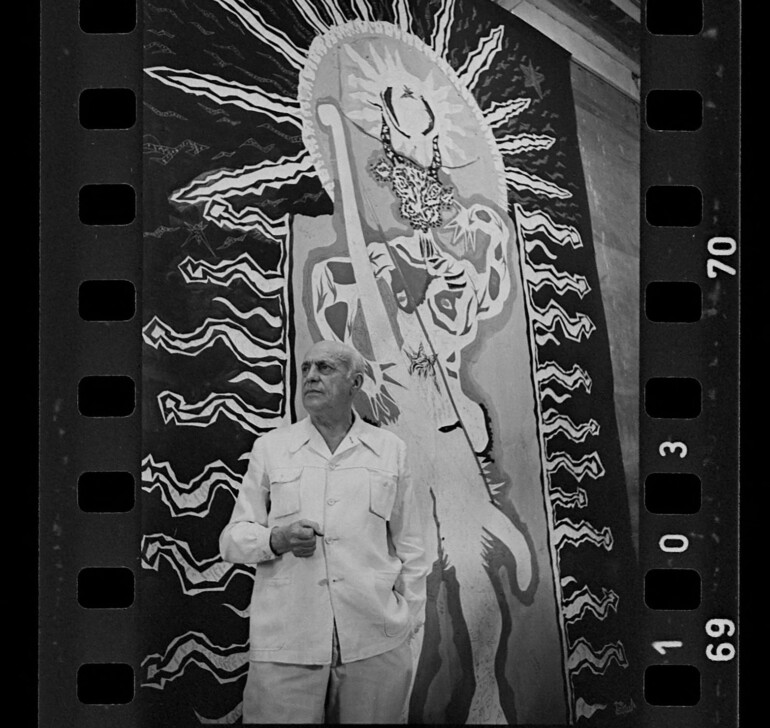
A symbolic language used in this sense, Mathias writes, appears from the mid-1950s onwards, for example, in the use of zodiac signs, which he integrated into his visual world as a metaphorical principle. Stars and constellations appear not as astronomical facts, but as signs of a deeper connection, as luminous nodes of a living structure useful for practical guidance and emotional orientation for humanity. As an example, she describes the ninth scene, »Poésie« (»Poetry«, 1961), from his monumental cycle »Chant du Monde« (»Song of the World«, 1957—1966), in which Lurçat depicts an archer, accompanied by the retinue of zodiac signs and a sun symbol with a human face—an ancient but still fruitful poetic method of shaping space and time through celestial signs.
In the first eight tapestries of the cycle, the cycle unfolds a narrative movement ranging from the primordial forces of the world to its threats: »Le Feu« (»The Fire«, 1957), »L’Eau« (»The Water«, 1958), »Les Arbres« (»The Trees«, 1958), and »Les Grands Champs« (»The Great Fields«, 1959) form the prelude to an elemental natural order, while »La Grande Menace« (»The Great Threat«, design 1940 / revised version 1959), »Les Illusions d’Icare« (»The Illusions of Icarus«, 1960), »La Conquête l’Espace« (»The Conquest of Space«, 1961), and »La Fin de Tout« (»The End of Everything«, 1962) illustrate the tensions, dangers, and upheavals of this world.
Lurçat calls the cycle, as Mathias notes, »table des matières d’une existence« (table of contents of an existence), and this, according to her, connects to his explicit will to »intellectually grasp the world and human destiny.« Created over a tireless creative period spanning almost a decade and woven in the traditional workshops of Aubusson, »Chant du Monde« is considered his magnum opus and comprises ten monumental tapestries with a total area of approximately 500 square meters, which are now preserved in the Musée Jean Lurçat et de la Tapisserie Contemporaine in Angers. His monumental masterpiece tells a modern, cosmic creation story in which the cosmos appears as a living organism permeated by inner forces—a universe of stars, plants, animals, radiations, and energy fields that, despite being threatened by war and destruction, still understands humanity as part of a larger, luminous order.
The tenth scene, »Ornamentos Sagrados« (»Sacred Ornaments«, 1966), was completed after his death, and what remains is the epochal (life’s) work of an exceptional artist, in which Jean Lurçat’s inner worldview, his tireless creative spirit, and his identity as an artist and human being of his time are not merely laid over the fabric, but inscribed into the intelligence of the fiber of his matter.
FIRST PUBLISHED IN CHAPTER №XIII »IDENTITY« — WINTER 2025/26