


Text and interview | Dzenana MUJADZIC
Jil Sander is considered one of the most visionary designers of our time. However, a truly comprehensive understanding of her work only emerges when one considers her creative attitude in its entirety, which seems to stem from a profound understanding of cultural multidimensionality: the interplay of ideal, formal, and social dimensions, the ability to grasp intermedial relations, and an agile approach to perspectives. As a consequence of this understanding, she dynamically translated her design attitude to fashion, graphic and product design, as well as to architecture, garden and landscape architecture—to name just a few disciplines.
Authenticity part of one’s personality, something innate that we should preserve, Jil Sander emphasizes right at the beginning of our conversation. An attribute that has fundamentally shaped the designer, born in 1943, and her work for almost six decades. She explains why some people find it easier to access this inherent human authenticity than others by saying that it manifests itself early in childhood but can be suppressed by education. She herself was fortunate that her parents allowed her to pursue her determined ideas.
And indeed, Heidemarie Jiline Sander, which is her birth name, seemed very determined in her ideas about life even at a young age. »Doubts only came to me during my school days, which were marked by strict teachers. But then it was already too late to deter me,« she tells us. In 1964, after graduating from the Textilingenieurschule Krefeld, she went to Los Angeles as an exchange student. At that time, this was an undoubtedly a self-confident decision, which—made by a 21-year-old woman—would have been considered unconventional. It is reasonable to assume that such steadfastness later also found expression in the integrity of her creative signature.
After returning to Hamburg, she initially worked as a fashion editor for various women’s magazines. This experience sharpened her visual sensitivity, but what she encountered »aligned with neither her understanding of proportion and material nor her idea of femininity, or her intuition for the seismographic shifts in the aesthetic needs of a rapidly changing society,« as stated in the catalogue for Sander’s first solo exhibition worldwide »Jil Sander. Present« in the MAK – Museum für Angewandte Kunst Frankfurt (2017/18). In 1968, she decided to open her first boutique in the Pöseldorf district of Hamburg. She initially sells selected ready-to-wear—a then new concept that democratized fashion with a strong design focus, away from the exclusivity of haute couture. But Sander decides early on to expand the offering with her own collection in a limited capacity. She probably did not yet suspect that her personal vision of a new way of dressing would set new standards.
MODERNITY AS AN ATTITUDE
When we ask her about the origin of her creative drive and the moment when she realized that she herself had become a formative force in the cultural landscape, both her sense of culture-shaping tendencies and her capacity for self-reflection become clear: »I was not alone in my ideas, I only applied the modern vision that prevailed in contemporary architecture and product design to fashion,« Sander clarifies, initially situating temporality and her own role within a broader context, as if she wanted to pay tribute to those who came before her. If one wants to understand this statement as an expression of modesty, then this does not indicate a failure to recognize one’s own influence, but rather a matter of proper perspective. According to the designer, the driving force of modernization was palpable everywhere, pointing to the omnipresent atmosphere of optimism of the 1960s. She drew not only inspiration for her own work from this, but also a strong awareness of material, sculptural design and the need to develop innovative fabrics. »In my hometown of Hamburg, the British tailoring tradition was still very present, so I was familiar with outstanding fabric and craftsmanship. I simply modernized them to achieve interesting new effects,« explains Sander.
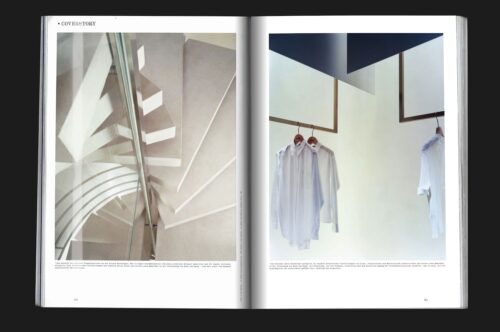
Left: The Paris flagship store on Avenue Montaigne, designed in close collaboration between architect Michael Gabellini and Jil Sander, closely reflected her aesthetic vision and set new standards for the relationship between fashion and space—for instance through a spiral staircase inspired by the Bauhaus; Right: The importance the designer places on technology, proportion, and the creative use of three-dimensionality also initially led her toward architecture; Showroom San Francisco.
It is precisely this idea of modernization that has always driven Sander. But a focus on the future and a positive engagement with modernity are no longer highly valued, says Sander, and explains:
»I am an advocate of modernity, an attitude that is rarely discussed today. By that I don’t mean a fixed style, but the need to optimize things according to the state of the art and a contemporary aesthetic.«
This personal drive for continuous development already shaped her vision as a young fashion designer. While in the Paris of the 1960s the classic, ladylike image of women in Parisian couture still dominated, Sander preferred to look forward. With her designs, she sought to spare women from having a traditional idea of femininity imposed on them. According to Sander, it was always about a commitment to the present and an understatement that creates attention and respect. The personality, she emphasizes, must not be overshadowed by clothing and she adds personally: »As a businesswoman, I was my own test case, it was important to me that I be taken seriously as a negotiating partner.« And she was: The fact that in 1989 she was the first woman to take her own company public on the Frankfurt Stock Exchange is certainly a demonstration of this conviction.
A clear sense of direction also determined the strategic decisions she made over the course of her career. In 1999, she enters into a joint venture with Prada, but leaves the company she founded shortly thereafter. In the following years, she returns several times to reassume creative leadership before finally retiring in 2013 for private reasons. Since 2021, the »Jil Sander« brand has been owned by the Italian fashion group OTB after several changes of ownership.
PERSPECTIVE IN A NEW CONTEXT
Regardless of the development of the eponymous company over the decades, Jil Sander’s own attitude to design remained uncompromising. Her vision of clothing as an expression of personality and a focus on the present is reflected in her fundamental rejection of the routine and the predictable. As an advocate of a new approach to the familiar, it becomes clear why Sander vehemently rejects everything that is predictable and formulaic. »My design has no formula,« she clarifies. Calculability is even a particularly sensitive issue to which she reacts strongly. »When things become too familiar and predictable, they are overdue for a revision in the spirit of the times. I am very sensitive to that. Design is also the risk of trying out something uncertain. Collections are suggestions, they have to dare to be relevant. For me, it was a great appeal to clear the table in the studio four times a year and start from scratch.« For Sander, design work is always an exploration of possibilities that have not yet been explored. »This bet on the future requires alert, attentive senses, a quality that no artificial intelligence can replace,« she adds.
With this last remark, Sander touches on the fundamental difference between lifeless formulas and the pulsating intuition in the creative process. »Formulas belong to the what has been exhausted, which fashion and design must go beyond. I am far too closely engaged, very tactile and equipped with an ultra-critical eye,« she emphasizes and also refers to a philosophical reading:
»You only need to read Karl Popper to understand that truths and formulas are always provisional.«
One believes her when she says: »I have a strong educational instinct, I never dictate, but try to convince.« Through personal persuasion, she has gathered a team around her that understands and embodies her idea. »This requires ongoing dialogue and a shared understanding of quality criteria,« she elaborates the continuous exchange that ensures that Sander’s artistic expression is preserved in the execution, whether in campaign photography or in the design of her now-iconic perfume bottles.

A masterpiece of craftsmanship: the flacon for her fragrances Woman Pure and Man Pure from 1979, designed in collaboration with Peter Schmidt, follows a formal language inspired by modern architecture and art. Weeks of experimentation in Italian glassblowing workshops were required to render the sharp edges of the double cube unbreakable.
Her uncompromising commitment to preserving her own integrity is likely one of the reasons for Sander’s continued relevance as a designer. Integrity, she emphasizes, is all that designers, artists, and architects truly possess. She equates the loss of one’s own signature with a loss of meaning—a statement that reflects respect for cultural heritage and a deep understanding of its continuation. When asked about the relationship between artistic expression and personal growth, Sander responds: »Many find it difficult, in the face of the great, often depressing challenges, to maintain the initiative and engage their creative imagination. But we need visions to convey confidence,« Sander moves away from the actual question in her answer, but the message remains unmistakable.
A SENSUAL EXPERIENCE
When speaking of Jil Sander’s work, following a linear chronology does not seem especially fitting. This is largely because everything she creates centers on a conceptual core with a claim of timeless relevance. The urge to categorize her work is nevertheless difficult to shake off—which raises the question of whether she believes that her vision of modernity demands more explanation today than it once did?
»Explanations alone are not enough. People have to try on my designs to understand what I’m getting at. Because sensual experience is a powerful argument,« she responds matter-of-factly.
According to Sander, the aesthetic instinct is also shaped through sensory experience. A culturally stimulating environment can play a significant role in the early development of taste, she says, at the same time, she cautions against defining the concept of »good taste« too rigidly—because an overly fixed understanding can either dull the senses and intuition or sharpen them.
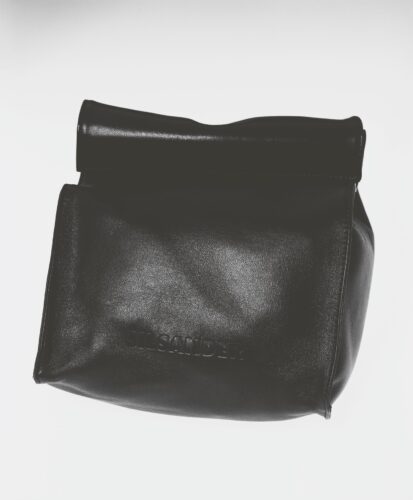
»Explanations achieve nothing—sensual experience is a powerful argument,« says Sander; Campaign image, 1998.
What the senses first absorb is later shaped by experience. Taste is not something rigid, but unfolds and changes with experience—if this process fails to unfold, one easily loses touch with the present. »I’m not saying that the spirit of the times is always right. Beyond formulas, there exists a sensitivity to proportions, material innovation, fresh harmonies and balances that characterizes successful design and creates new classics,« she adds critically.
REFINING CLASSICS
The designer’s most recent collaboration with the heritage brand Thonet also resonates with this sensibility—a company whose role in furniture design of the 19th and 20th centuries continues to have an impact to this day through figures such as Le Corbusier, Mies van der Rohe or Marcel Breuer. A cornerstone of design culture which Sander encountered as early as her school years: »The aesthetics of the Bauhaus in architecture, in objects, in graphics were very present in my youth and had a profound influence on me.«
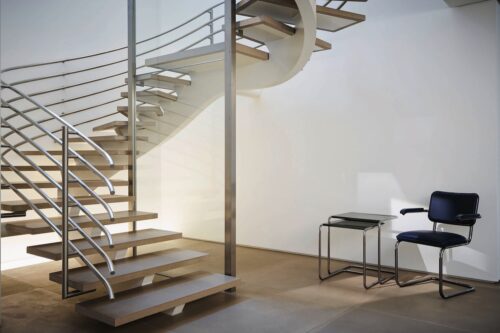
New interpretation of Marcel Breuer’s cantilever model S 64, shot at the Jil Sander showroom in Hamburg.
In Breuer’s late-1920s tubular steel classic, she finds her own design principles in a new form and on a new scale: harmonious proportions, thoughtful three-dimensionality, understatement, and dynamic elegance. It therefore comes as little surprise that the new interpretation for the JS. THONET Signature Collection seems more like a visually contemporary homage to Breuer’s iconic design. »His construction and basic structure are convincing and deserve a contemporary appreciation,« says Sander. Following the principle »why fix something when it’s not broken,« she focuses on subtle refinement. The cantilever chair looks as if it has only been thoroughly polished, says Sander—despite the redesign, it is immediately recognizable. Jil Sander references the lacquer of Steinway grand pianos, the leather upholstery of elegant English cars and the matte nickel silver of architectural elements—a metal alloy she had previously used in the interior design of her flagship stores—as sources of inspiration for her new interpretation of the S 64 model.
ON A LARGE SCALE
The importance Sander places on technology, proportion and the creative use of three-dimensionality not only informs this collaboration, but also initially drew her to architecture. For the design of her first flagship store at 50 Avenue Montaigne in Paris in 1993, she commissioned the American architect Michael Gabellini. The concept, developed in close collaboration with Sander, precisely reflected her ideas on light, proportion, and materiality and set new standards for the relationship between fashion and space.
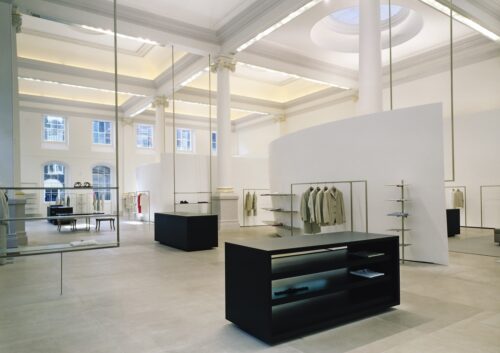
The Jil Sander flagship store in London.
In the exhibition catalogue »Jil Sander. Present«, curated by Matthias Werner K, it reads: »When designing the interior, Jil Sander resists the temptation to completely dissolve emptiness.« In this context, we ask about the importance she places on the purely visual experience of a space:
»I have great respect for spaces experienced primarily through their visual presence in a memorable way and that you don’t forget. They intensify our sense of being alive and make architecture an art form in its own right.«
She sees emptiness in the room as an opportunity—and one senses the fearlessness with which Sander has consistently approached new possibilities—as a space for self-assured individuality. A defining feature of the interior design are the »flying walls« and the atmospheric lighting inspired by the work of the artist James Turrell, resulting in a floating, almost immaterial spatial effect. Matthias Werner K remarks: »For Jil Sander, shaping the walls through varying degrees of brightness is more fascinating than an expressive play of light and shadow.« He views the gentleness of light as a medium of light as ideally suited to conveying the designer’s intentions.
ABSENCE AS A MESSAGE
The idea of structuring through light also arises in our interview—but in connection with art. One of the earliest lasting impressions on her came from the work of the painter Robert Ryman (1930 – 2019), says Sander. He is best known for his largely monochrome, restrained paintings, which vary subtly in texture, technique and support material and create structured surfaces through the irregular application of paint, making the presence of light tangible. »His white paintings confirmed my skepticism about strong colors. He has shown that you can also paint white on white without being boring.« She understands that effect does not require a pronounced graphic rhythm.

A video installation created for the exhibition »Jil Sander. Present« at the Museum Angewandte Kunst, Frankfurt (2017/18), offers a poetic glimpse behind the private garden walls of Jil Sander’s home on Lake Plön, not far from her hometown. Here, nature is presented as an intuitive space that renders the present moment—so central to the designer—more tangible.
It is the interplay of light and shadow that makes a space compelling for Sander—she even draws parallels between successful spaces and a garden. »Even in inspiring spaces, nature can be felt through its sense of proportion and, not least, through the direction of light and shadow,« she observes. Sander’s private garden on Lake Plön in northern Germany can be seen as a contemporary interpretation of the traditional English garden of Sissinghurst Castle in Kent—the historic garden created from 1930 onward by writer Vita Sackville-West. A video installation created for the exhibition »Jil Sander. Present« at the MAK – Museum Angewandte Kunst Frankfurt, offers a poetic glimpse behind the garden walls. Here, nature appears as an intuitive space that renders the present moment—so central to Sander—more tangible.

For Sander, the interplay of light and shadow gives a space its appeal, and she draws parallels between successful spaces and gardens, where nature becomes tangible through proportion and the use of light. Her private garden can be read as a contemporary interpretation of the garden at Sissinghurst Castle in Kent.
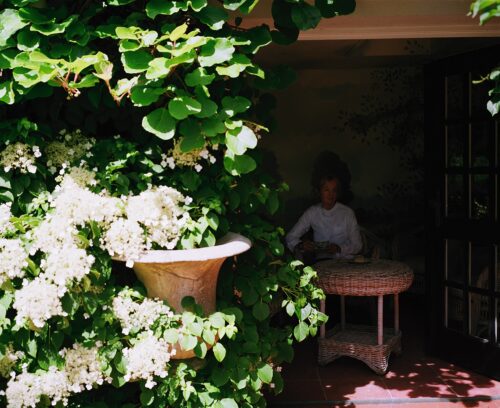
The exhibition catalogue accompanying the show contains the following description: »In an English-style landscape, there are four square rooms, framed by hedges. One is dedicated to roses, one to an apple orchard, the next to berry bushes, plants for cutting, and a kitchen garden. But the fourth room remained empty: a square lawn—Jil Sander’s homage to the cultivation of emptiness in East Asian traditions, which finds its most pronounced expression in Zen temple gardens. These austere, spiritual spaces made of rough stones, gravel, and moss are dedicated to meditation. Far removed from Western notions of paradise, they are intended to foster an acclimatization to nothingness.« Against this backdrop, it may be surprising when she explains in our conversation that any worldview is, by definition, a limitation—and she is therefore reluctant to commit to it. She qualifies this idea with a personal distinction:
»When I sometimes recognize aspects of myself in Zen thought or even in astrological ideas, it is something playful, and I forget it immediately. But I subscribe to the gentleness valued across many spiritual traditions.«
PRESENT
Jil Sander’s »worldview« seems to have always aligned with an open system of possibilities—worldviews are provisional, certainties fleeting, and theories vulnerable. Her work, often described as timeless, as it moves within her and works through her—reflected, present, open to the new. To engage with this work meaningfully, it requires intellectual flexibility—the willingness to make conceptual and mental leaps through times, contexts, and meanings; after all, we have encountered her work in its numerous aspects for almost six decades, again and again on new levels—always on equal terms with the present. At the end of our interview, she briefly engages in a thought experiment, which she frames as a playful possibility rather than a certainty:
»Perhaps time does not move linearly or in circles, but as a spiral. We do not know where it leads.«
COVERSTORY CHAPTER №XII »SIMPLICITY« — SUMMER 2025