Long shaped by imperial splendour and the opulent legacy of the fin de siècle, Vienna is currently experiencing a renewed relevance within creative circles. Particularly compelling is the modern, dynamic spirit of the turn of the twentieth century. With its permanent exhibition »Vienna 1900—Birth of Modernism,« the Leopold Museum highlights the striking contemporary resonance of this period in the city’s art and design history—a facet that is receiving increasing attention today, beyond any sense of historical weightiness.
Since its opening in 2001, the Leopold Museum has played a pivotal role in bringing the forward-looking, experimental spirit of Vienna’s turn of the century to life—not as a singular, archived moment consigned to the past, but as an enduring cultural point of reference. Founded by the Austrian art collector, ophthalmologist, and patron Rudolf Leopold (1925–2010), the museum remains consistently devoted to the art and culture of around 1900. With its extensive collection—including major works by Egon Schiele, Gustav Klimt, and Oskar Kokoschka—it has established itself as one of the leading institutions dedicated to the presentation of Viennese Modernism.
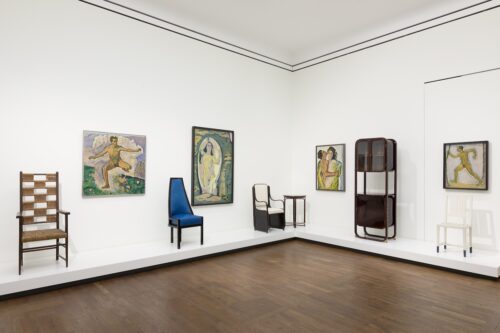
By continually reimagining its permanent exhibition, »Vienna 1900—Birth of Modernism,« the museum repeatedly succeeds in framing the aesthetic, social, and design impulses of the era within a contemporary context, offering ever-new perspectives. On display are masterpieces from the Leopold Museum’s collection alongside significant national and international long-term loans, through which the radical energy of the past resonates and the emergence of modernity around 1900 appears remarkably relevant today.
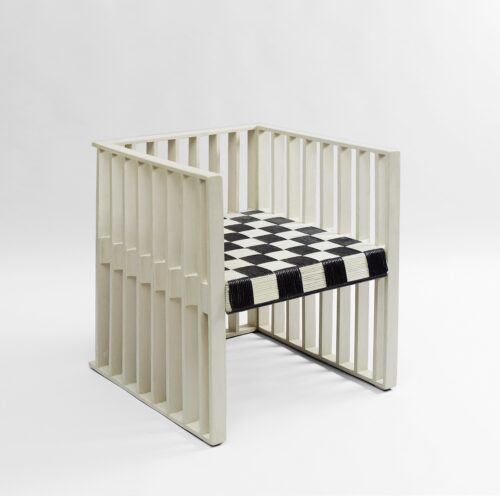
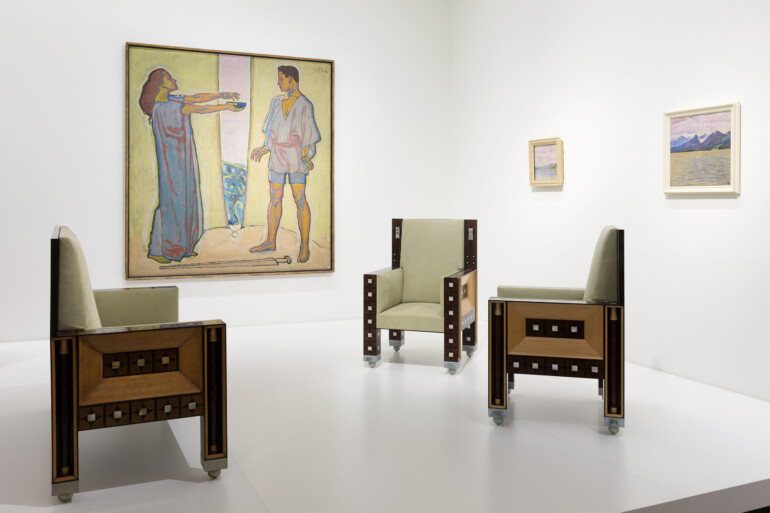
Armchair for the Purkersdorf Sanatorium by Koloman Moser;
Executed by: Prag-Rudniker, workshop: Jakob Soulek (carpenter), 1903
How this formative turning point found expression is explored in the exhibition catalogue, which characterizes the heterogeneous milieu of the Danube metropolis as a »central engine of a turbulent movement of renewal«—one that created fertile ground for an extraordinary concentration of cultural achievement. Names such as Klimt, Freud, and Loos have long stood, requiring little explanation, as synonymous with groundbreaking innovations across a wide spectrum of modern disciplines. Vienna’s multilayered identity, shaped by movements such as the Secession and the Wiener Werkstätte, continues to inform contemporary debates on craftsmanship, materiality, and the role of art in society.
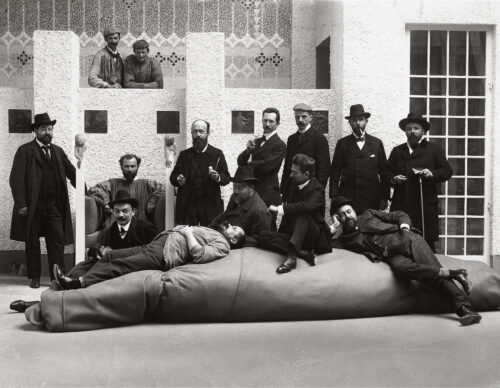
The world-famous group portrait of the artists participating in the 14th Exhibition of the Vienna Secession, including Gustav Klimt, Koloman Moser, Josef Hoffmann and Carl Moll, photographed by Moriz Nähr, 1902
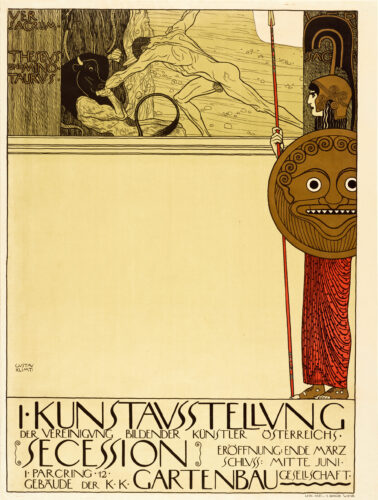
»Ver Sacrum. Theseus and Minotaur.« — poster by Gustav Klimt for the 1st Art Exhibition of the Association of Austrian Artists, Secession. Condition before censorship, 1898
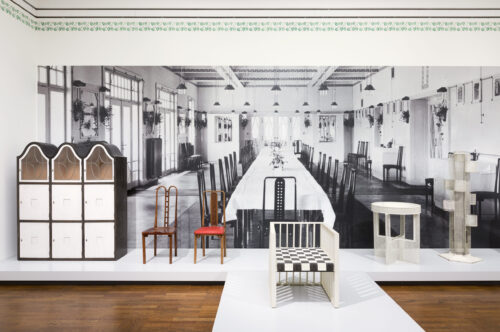
The applied arts played a central role in realizing the idea of the Gesamtkunstwerk—a term denoting the aspiration to infuse all areas of life with art, which in the age of social media might most closely correspond to the overused word »curate«. The distinction, however, lies in the ambition to create an aesthetically and conceptually self-contained whole, one that transcends dull replicability and fleeting immediacy—the logic of the »copy-and-paste-taste«.
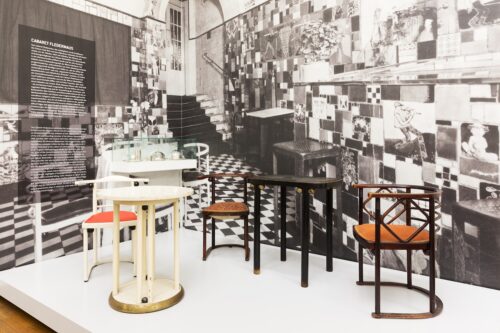
In this context, the attentive and discerning eye will have noticed that the »Hoffmann Chair«—a label commonly applied regardless of the specific model—has, in many a carefully curated feed, been reduced to a conspicuously deployed prop, intended to signal stylistic confidence, mask mediocrity, and assert distinction »from the rest«. Yet it is worth noting, positively, that furniture from the turn of the century continues to strike a chord today, capable of evoking the atmosphere of that vibrant era—which is precisely where the exhibition’s true strength resides.
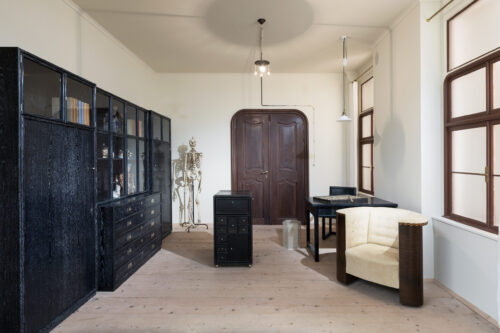
»Vienna 1900—Birth of Modernism« lays bare the foundations from which many of today’s trends and debates first emerged. Rather than concentrating on singular iconic figures, the presentation opens up a perspective on the complexity of an era in transition, whose energy continues to resonate to this day.
In keeping with this understanding of modernity as an enduring impulse that extends beyond Vienna, the Leopold Museum is also presenting a comprehensive retrospective, »GUSTAVE COURBET—Realist and Rebel« (19.02.2026—21.06.2026). With Courbet, the focus shifts to an artist who—much like the protagonists of Vienna’s turn of the century—challenged conventions and insisted upon artistic autonomy. The exhibition thus consistently aligns with the museum’s programmatic aim of revealing moments of upheaval in art history as living, ongoing impulses. [Ed.]
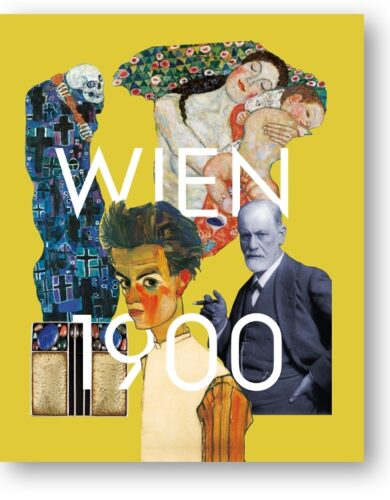
Vienna 1900. Birth of Modernism
560 pages 23.5 x 28 cm
1000 illustrations
leopoldmuseum.org