

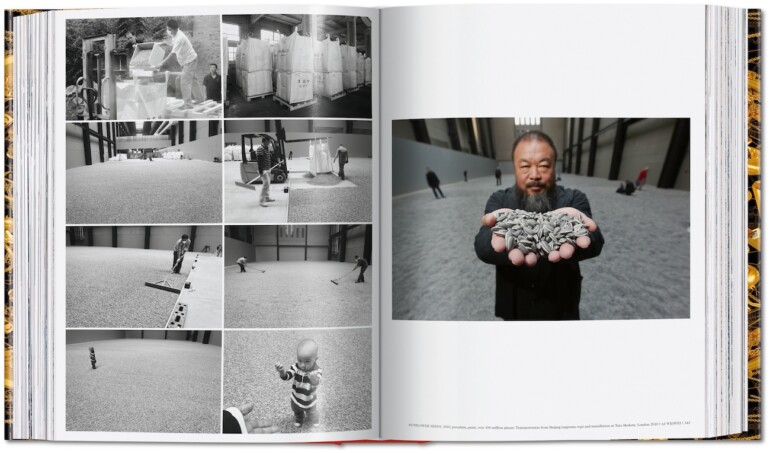
Hardly any contemporary artist embodies the intersection of art, political activism, and global public discourse as strongly as Ai Weiwei. The monograph »Ai Weiwei. Updated Edition,« published by TASCHEN, has now been comprehensively revised with a focus on the most recent decade of his artistic and political work—continuing the documentation of a practice that spans more than forty years and has established him as one of the most prolific and engaged artists of our time.
The book brings together essays, documentary image series, and archival material that collectively form a multifaceted portrait of the Chinese artist, whose work moves between conceptual art, architecture, political engagement, and personal experience.
The first analytical entry point is provided by Uli Sigg’s essay »An Outsized Appetite for Risk«. The Swiss collector and long-time observer of the Chinese art scene describes Ai Weiwei as an artist who consciously takes risks—both aesthetically and politically. Sigg traces how, from his early years in New York’s East Village to his internationally renowned installations, Ai Weiwei developed a practice in which art is understood as a social situation. Projects such as »Fairytale« at Documenta 12, for which 1,001 people from China were invited to Kassel, demonstrate how Ai Weiwei turns encounters between people, cultures, and political realities into the very material of his art.
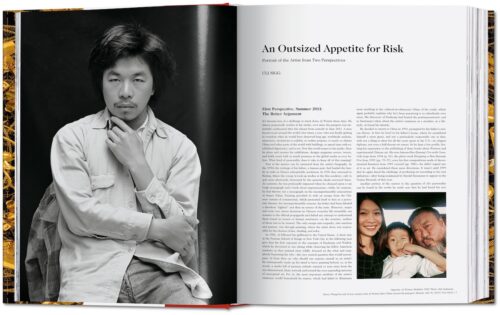
The book is supported by insightful essayistic approaches and a chronological chapter structure that traces Ai Weiwei’s development over several decades: from the years 1983–1993 in New York to his return to Beijing (1993–1999) and the political and artistic projects of the 2000s. These stages mark biographical phases as well as the increasing intertwining of art, public debate, and political reality in Ai Weiwei’s work.
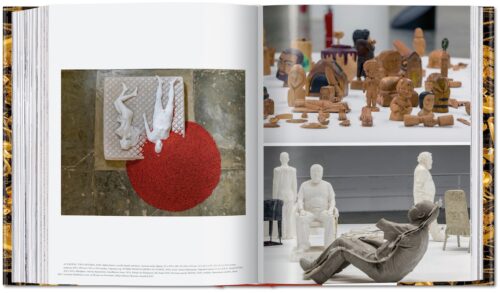
This historical contextualization is followed by Roger M. Buergel’s essay »The Mediator’s Ways«, which interprets Ai Weiwei’s practice from an art-historical perspective. Buergel describes the artist as a mediator between cultural systems, historical materials, and political contexts. One example is the installation »Template«, shown at Documenta 12 in Kassel in 2007. The structure, built from historical door and window frames, partially collapsed during a storm—an event Ai Weiwei did not view as a failure, but accepted as part of the work. For Buergel, this reveals a central principle of Ai Weiwei’s practice: art remains an open process that includes chance, time, and social dynamics.
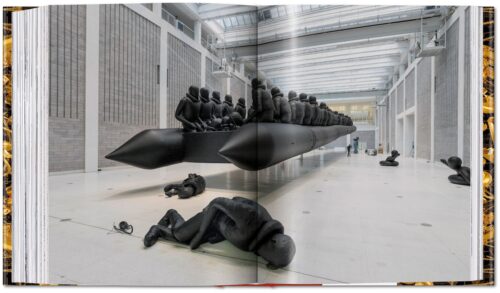
The later chapters of the volume follow Ai Weiwei’s work through the politically charged years after 2008—from his investigation into the victims of the Sichuan earthquake to his detention in 2011 and the international exhibitions and film projects that followed. At this point, Alfred Weidinger’s essay »Against the Walls—Ai Weiwei and the Right to Visibility« comes into focus, concentrating primarily on works from the 2010s onward. Weidinger shows how, after his imprisonment, Ai Weiwei developed a new phase in his practice in which questions of visibility, control, and the public sphere became central. Projects such as »@Large« on Alcatraz, installations like »Law of the Journey«, or the large-scale intervention »Good Fences Make Good Neighbors« in New York demonstrate how Ai Weiwei translates global issues such as migration, surveillance, and political freedom into spatial and visual structures.
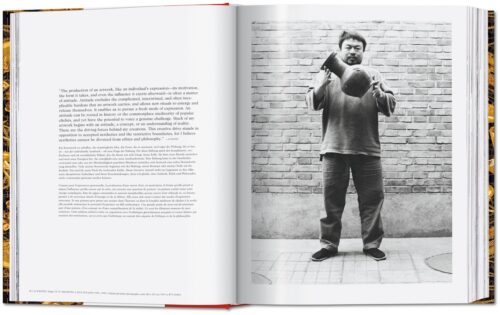
Weidinger particularly emphasizes how Ai Weiwei integrates new media and digital platforms into his artistic practice. Photography, film, and social media become instruments through which political reality is documented and simultaneously reflected upon artistically. Works such as the film »Human Flow« or image series from refugee camps show how closely personal observation, documentary practice, and political intervention are intertwined.
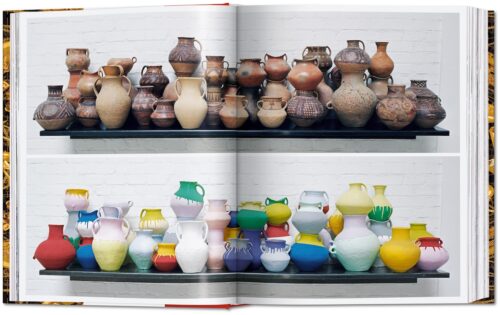
What emerges is a publication from the house of TASCHEN, oversized not only in its physical form but also in its scope and intellectual depth. Moving beyond the framework of a conventionally closed monograph, it presents itself as a complex portrait of an artist while leaving space for a future in which his work continues to evolve—biographically, art-historically, and politically. A book that, with foresight, makes Ai Weiwei’s positions visible: art as a medium through which individual experience, historical memory, and global conflicts come into view. [Ed.]
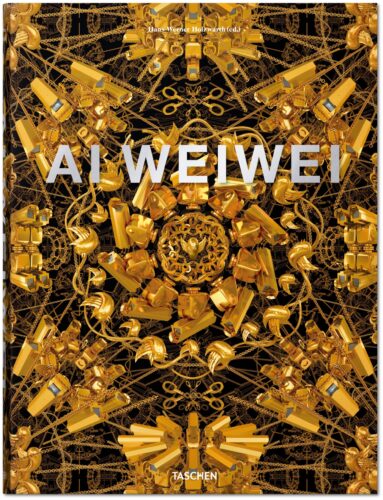
Ai Weiwei. Updated Edition
25 x 33.4 cm, 4.03 kg, 736 pages
taschen.com