

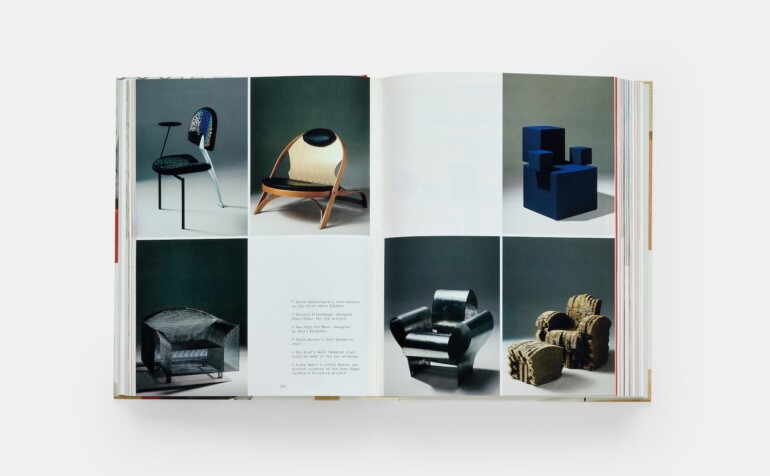
For decades, Swiss furniture manufacturer Vitra has played a significant role in the development and dissemination of modern design. Yet its evolution was not the result of a linear, carefully orchestrated branding strategy, but of entrepreneurial decisions, cultural curiosity, and long-term convictions. What began as a shopfitting company was gradually transformed by Willi and Erika Fehlbaum into an internationally operating furniture manufacturer. The chronicle »Vitra – Anatomy of a Design Company,« published by Phaidon, traces this trajectory through previously unpublished conversations and extensive archival material.
THE BEGINNING
A pivotal moment in Vitra’s early history was Willi Fehlbaum’s encounter with the designs of Charles and Ray Eames in the 1950s. During a trip to New York, he discovered the innovative fiberglass chairs in the Herman Miller showroom and was particularly struck by the technical ingenuity of the “shock mount” connection. Herman Miller, one of the leading American furniture manufacturers of postwar modernism, held the international production rights to these designs. Fehlbaum therefore approached the company to establish a licensing agreement for Europe. Vitra subsequently began manufacturing and distributing selected designs by Charles and Ray Eames, as well as George Nelson, across the European market.
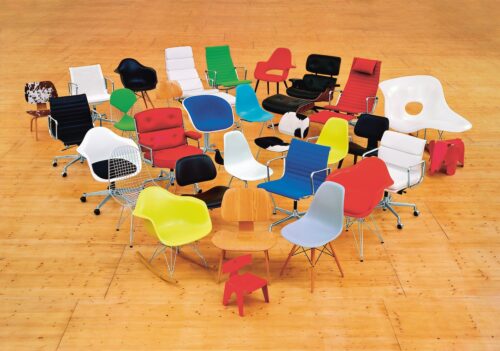
In continuous production: The complete range of designs by Charles and Ray Eames.
Nelson, a key figure in American Mid-Century Modern, had served as Design Director at Herman Miller since 1945, shaping the company’s design direction for decades. In this role, he helped define its program and worked closely with designers such as Charles and Ray Eames and Isamu Noguchi. For Vitra, the partnership with Herman Miller marked a decisive transition from a regional enterprise to an internationally operating design manufacturer.
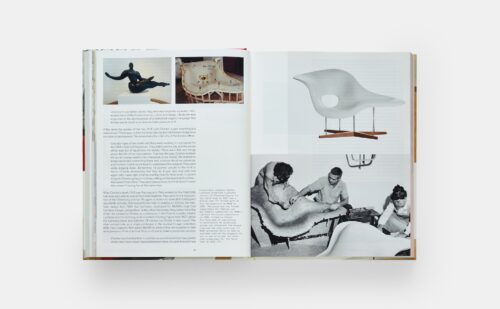
After the partnership with Herman Miller was amicably concluded in 1984, Vitra secured the rights to manufacture and distribute the designs of Charles and Ray Eames, George Nelson, and Alexander Girard in Europe and the Middle East. Girard—an architect and designer known for his distinctive use of color, textiles, and graphic expression—shaped the emotional and visual dimension of American modernism as head of Herman Miller’s textile division from the 1950s onward.
With the acquisition of these rights, Vitra entered a new phase, increasingly positioning itself as an independent brand and refining its identity beyond that of a licensed producer.
THE NEW BEGINNING
A devastating fire in 1981, which destroyed large parts of the factory in Weil am Rhein, paradoxically marked a new beginning for the company. In its aftermath, the Vitra Campus began to take shape—an ensemble of buildings by internationally renowned architects that reached an early milestone in 1989 with the opening of Frank Gehry’s Vitra Design Museum. From the outset, the museum was conceived not as a conventional corporate showcase, but as an independent institution, deliberately distancing itself from purely brand-driven exhibition formats. Collection-building, research, and public education became integral to the company’s identity.
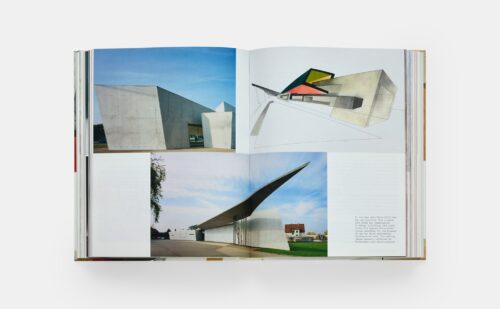
In the days when Vitra still had its own volunteer fire brigade, Zaha Hadid was commissioned to design a building that would house the fire engines and also provide social facilities for the firefighters.
In parallel, Vitra developed new content-driven formats. With the Vitra Edition—featuring contributions by designers such as Frank Gehry, Shiro Kuramata, and Ron Arad—the company positioned design explicitly as a cultural practice. The collaboration with Jean Prouvé not only led to the reintroduction of historic pieces such as the 1930 Cité chair—now the oldest design still in production in the collection—but also prompted a renewed engagement with the constructive principles of the 20th century. Later projects, including the Joyn system (2002) by Ronan and Erwan Bouroullec, inspired by the communal farmhouse table, reflected Vitra’s responsiveness to evolving workplace dynamics and broader societal shifts.
THE TRANSFORMATION
With the founders’ children joining the company’s leadership, Vitra entered another phase of transformation. Rolf Fehlbaum, son of Willi and Erika Fehlbaum and a defining figure at the company’s helm since the 1970s, further shaped Vitra’s strategic and cultural direction and initiated the Vitra Design Museum in 1989. His daughter, Nora Fehlbaum, later assumed the role of CEO, representing a new generation of leadership. The acquisition of Artek is described in the book as a strategically significant step; at the same time, it signals a new priority: »our generation’s fingerprint is the environmental strategy.« Sustainability thus became an explicit part of the company’s mission, alongside a broader outreach and the development of new digital formats.
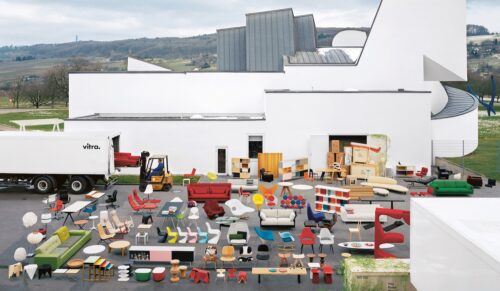
The complete Vitra product range, presented outside Frank Gehry’s museum building in 2007.
Particularly striking is the book’s reflection on collection-building and cultural responsibility. Rolf Fehlbaum emphasizes that museums often preserve innovative and even radical designs—even when some of these pieces were initially dismissed as »flops« in the marketplace. The collection is conceived as a living organism, sustained by significant archives such as those of Charles and Ray Eames, Jean Prouvé, and Verner Panton.
THE VITRA WORLD
Last but not least, the book explores the company’s visual identity in depth. A brand, it argues, is not the result of artificial image-making but evolves organically from its inherent values and actions. In keeping with this view, Vitra has long combined product development with content-driven formats such as the »Workspirit«publication series, which brings together interviews, architecture, and design. The »Atlas of Furniture Design,« published in 2019 and spanning more than 1,000 pages, further exemplifies this connection between research, design, and narrative—significantly privileging images over text.
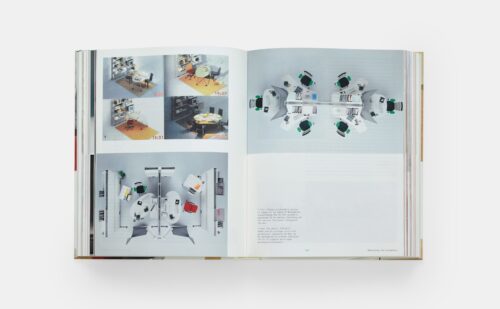
Vitra – Anatomy of a Design Company is therefore far more than a corporate history. Numerous historically significant archival images, newly edited documents, and personal testimonies trace Vitra’s evolution from a regional enterprise to an internationally connected design brand. Spanning 410 pages and featuring 300 color and 100 black-and-white illustrations, the publication interweaves industrial, architectural, and cultural history into a multifaceted panorama of modern design as seen through the lens of Vitra. [Ed.]
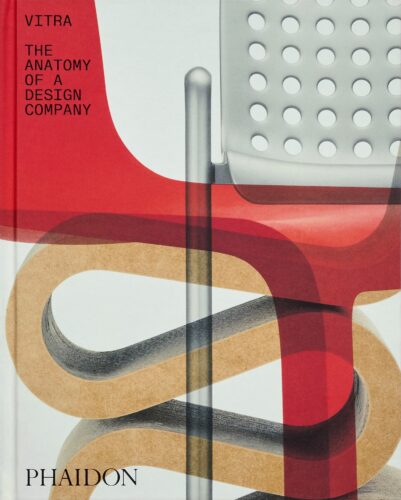
Vitra – The Anatomy of a Design Company
Published by Phaidon
Hardcover, 270mm x 215mm, 401 pages
vitra.com