

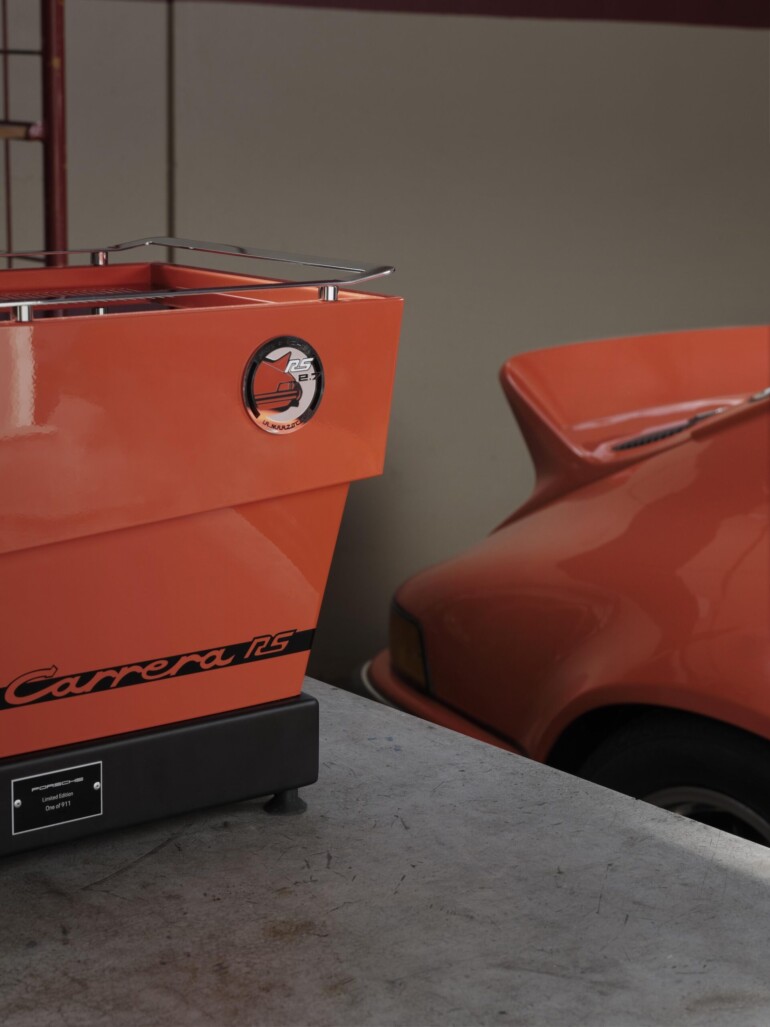
The legendary »ducktail« of the Porsche 911 Carrera RS 2.7 took shape in millimeter increments inside the wind tunnel. More than half a century later, the result of this aerodynamic fine-tuning serves as the inspiration for a considerably more mundane construction: the cup rail of an espresso machine. It can be found on a special edition of the Linea Micra espresso machine, around which Porsche and La Marzocco has now unveiled an entire collection. It adopts signature design hallmarks of the 911 Carrera RS 2.7 and is intended as a tribute to Porsche’s intimate blend of engineering and design. Just how much of the classic sports car truly resides within, however, only becomes evident when looking back at the original’s history.
»Driven to the race and back home again«
The story of that legendary 911 Carrera RS 2.7 began in 1972 with the ambition to evolve the 911 for track and rally racing. The result was Germany’s fastest production car at the time and the first production model featuring front and rear spoilers. Above all, that distinctive rear spoiler was destined to permanently influence the styling of high-performance road cars.
Weight reduction also played a decisive role during the development of the 911 Carrera RS 2.7. This was particularly evident in the lightweight Sport version, whose interior was stripped down to the bare essentials. Rear seats and even carpeting were omitted as options, while lightweight bucket seats replaced comparatively heavier sports seats. Even the Porsche crest on the front hood was initially just a sticker. With a curb weight of 960 kilograms, the Sport weighed 115 kilograms less than the Touring specification.
Yet despite all the focus on motorsport, the 911 Carrera RS 2.7 was fully intended for everyday driving: »Driven to the race and back home again,« as Porsche’s contemporary advertising promised. And its success was remarkable: initially, a production run of just 500 units was planned, but by late November 1972—scarcely weeks after its debut at the Paris Motor Show—all scheduled cars were sold. In total, 1,580 examples were ultimately built.
An Edge Reshapes the Silhouette
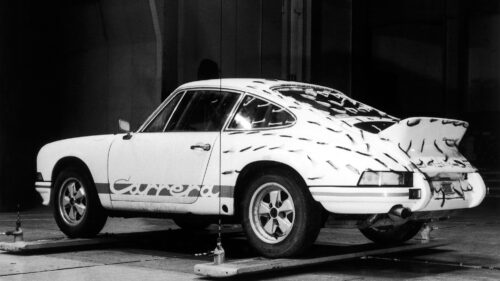
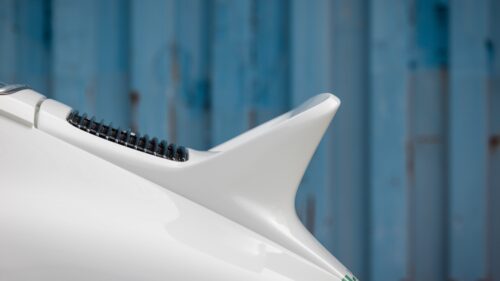
To optimize aerodynamics, the key objective was reducing lift at the front and rear axles. Pursuing this goal, the responsible engineers and designers developed a rear spoiler that—per the design brief—still needed to preserve the sleek, cohesive silhouette of the 911. Any modification to the sloping rear had to integrate seamlessly into the existing bodywork.
»During testing, we discovered that a taller spoiler allowed us to increase top speed because aerodynamic drag was reduced,« recalled Peter Falk, then head of series vehicle testing. The developers raised the tear-off edge millimeter by millimeter using sheet metal until drag began to climb again. The profile they finally settled on reduced lift and channeled additional cooling air to the rear engine. The later-iconic »ducktail« was the direct fruit of these tests.
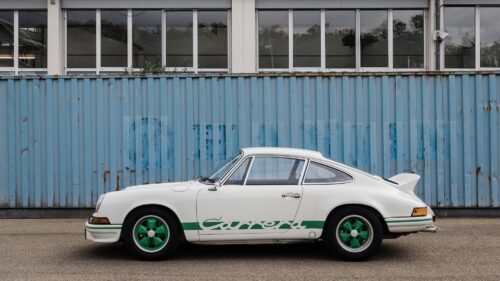
Carrera on the Flank
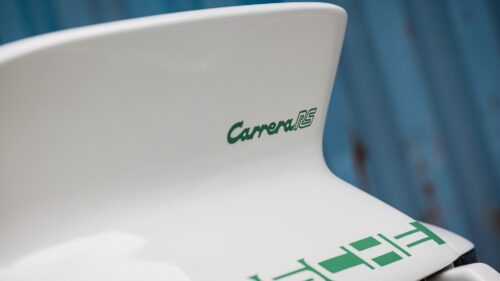
The RS 2.7 was the first 911 to carry the »Carrera« moniker. Within the brand, it already had a storied past: it commemorated Porsche’s triumphs at the Carrera Panamericana and had previously graced high-performance iterations of the 356. On the new flagship 911, the name earned prominent real estate between the wheel arches. The lateral lettering made its motorsport lineage instantly apparent—the »RS« badge on the rear spoiler stood for »Rennsport« (racing sport).
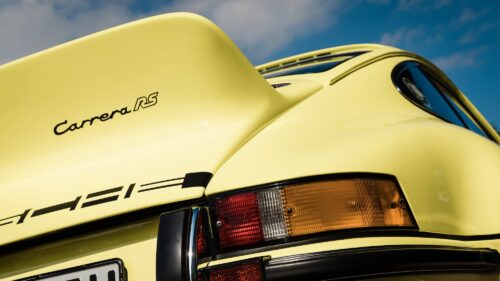
A strikingly bold color palette also contributed to the graphic impact. On white cars, for instance, blue or green lettering could be ordered alongside color-matched wheels, while bold exterior finishes such as Signal Yellow or Blood Orange were also made available. Together with the distinctive rear spoiler and widened rear wheel arches, these colors and decals forged the unmistakable appearance of the 911 Carrera RS 2.7.
A Tribute for the Kitchen
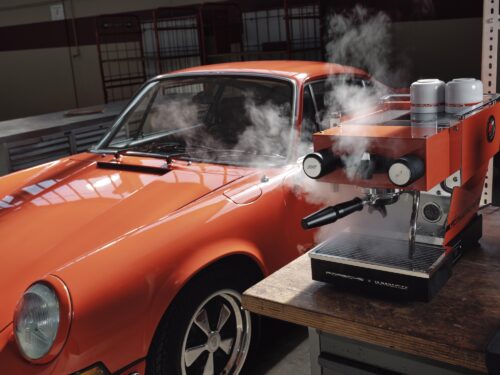
Building upon the design and heritage of the 911 Carrera RS 2.7, Porsche and La Marzocco —the espresso machine maker founded in Florence in 1927—have introduced their second joint collection, unveiled in late October at the Porsche Museum in Zuffenhausen. Taking center stage is the Linea Micra espresso machine, which debuts in three historic Porsche colorways: Grand Prix White—Green, Blood Orange—Black, and Grand Prix White—Blue.
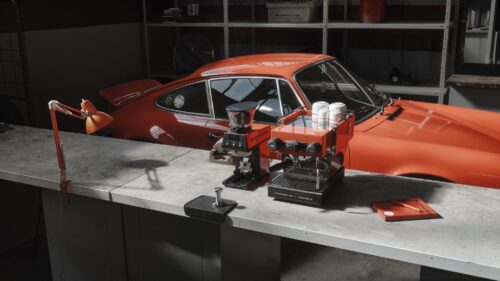
A »Carrera RS« script and the historic Porsche crest complete the look. Black handles feature laser-engraved »RS« and »2.7« badges, while the analog pressure gauges are finished with red and green indicators. The most unique homage, however, sits atop the cup-warming tray: its railing is modeled after the iconic »ducktail« spoiler.
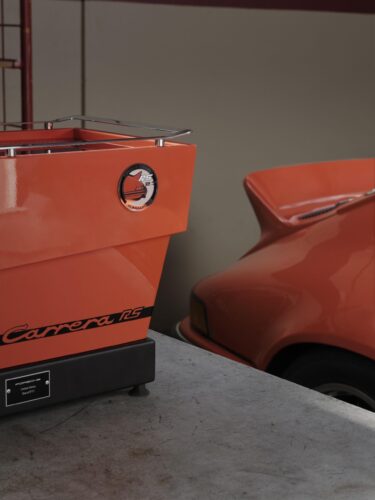
Alongside the Linea Micra, the collection includes the color-coordinated Pico coffee grinder, handcrafted espresso and cappuccino cups, and various accessories such as barista towels, coasters, and coffee canisters. The collection has been available since October 30, 2026. [RED]