

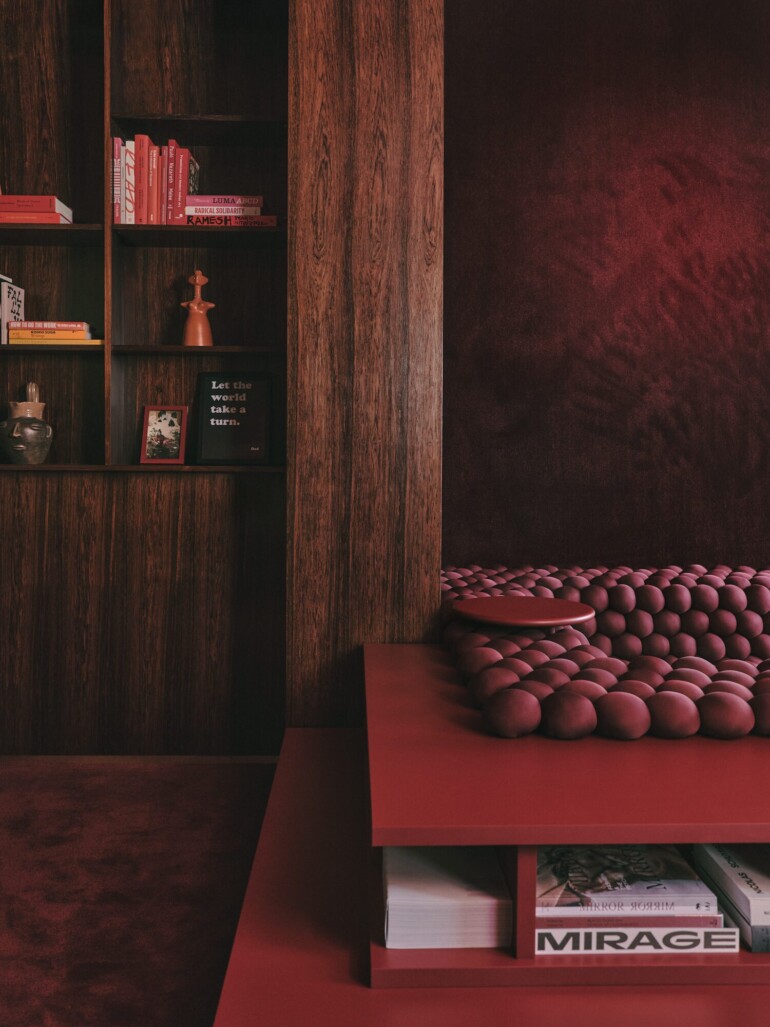
Whether designing a bar in London or a 24-metre-long sofa in Riyadh, Ariel André, founder of the multidisciplinary studio GOLEM, always begins with sensory experiences and human needs. »Amoreba«, a sofa-like landscape that adapts to different bodies, habits and ways of coming together, is among the projects that have brought him international attention. In conversation with Chapter, Ariel André, who previously worked as an architect at renowned architecture firms, discusses why he founded GOLEM, why he believes a »soft revolution« is needed and why he rejects standardised sofas.
Chapter What inspired you to create GOLEM? Was there a specific experience that led to it, or was it more of an accumulation of experiences?
Ariel André Since I was 9 years old, I have wanted to »be a designer« and make chairs, tables and spoons. When I was 10, I met Pierre Paulin in a café in Paris and told him about the chairs and spoons and tables I wanted to design and drew some for him. After telling me my drawings were all very bad because, at 10, I did not yet know how people lived their lives, he told me it was a good thing that I had started at this young age, because the sooner the better. And then he told me I should be an architect because then I could design the house, the chair inside the house, the table next to the chair and the spoon on the table.
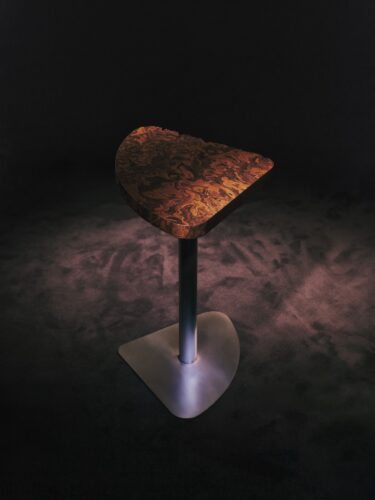
That’s what led me to architecture. Then, growing up in a highly standardized built environment like Paris, I became increasingly frustrated by how narrow those norms could be, and by the very real physical and emotional discomfort I saw in people who fell just a little too far outside them. That naturally pushed me toward reversing the starting point, allowing architecture to emerge from the different bodies, habits and lives it is meant to serve.
Chapter In an interview, you said the following about your project »Dive«: »Bodies shape the furniture, not the other way around.« Does that apply to your work as a whole? If yes, why is that important for you and your work?
Ariel André Oh, thank you for this question! It is not only important, it is fundamental. »Bodies shape furniture«, but what are bodies? They are people. Everything that I do, whether it’s a cultural institution in Riyadh, a cocktail bar in London or a Biennial in Bukhara, Uzbekistan, starts with people. I design at eye level.
And because we live in a world full of things, saturated with things, we as designers have a tremendous responsibility when we add more things to the world. Some designers’ responses focus on materials and sustainability. While these still matter to me, my main focus is use. Uses are the expression of a culture in the built world. Cultures evolve, and therefore we need to update our designs to serve them and the people to whom they belong. Even more importantly, what interests me is serving cultures that are overlooked by design in its contemporary sense. They are overlooked either because designers are too estranged from them, because they are too novel, or because they have consciously disregarded them. I design for subcultures, the foreign, the non-standard, the too small, the too big, the too tall, the young, the old. In other words: »fuck the Modulor«.
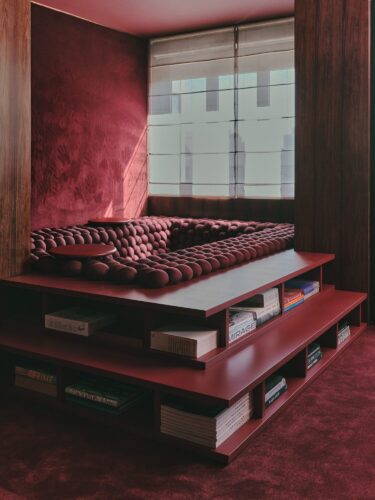
And by starting from different standpoints, drawing on overlooked perspectives and marginal aesthetics, I design spaces and objects that differ from established conventions and norms, resulting in designs that are inherently transformative. Therefore, my innovation and my aesthetics are not a goal but a consequence. For example, the shape of the 24-metre-long sofa in Riyadh comes from a social intention before an aesthetic one: to create a space where the different bodies and cultural habits shaping Saudi society could gather simultaneously. Someone accustomed to sitting cross-legged close to the floor, someone perched upright on a stool, someone who wants to recline, or someone whose clothing and sense of modesty make a more enveloping seat, where the legs are less exposed, more comfortable. The slithering shape of the 24-metre-long bolster, starting from the floor and rising to become an enveloping backrest, is the consequence of this intention.
Chapter How do you prevent a clear vision from becoming a rigid dogma?
Ariel André By avoiding systems like the plague. Whenever, in the studio, I see someone trying to apply a fixed pattern to a project, a rigid grid for example, it generally takes me only a few minutes to show them where they are going to hit a wall: a door that won’t open, a dimension that makes no sense, a piece of furniture that won’t fit.
There are basically two kinds of systematic projects. Those that discreetly negotiate with reality, where the system ends up being more present in the discourse than in the building itself, and those that pursue the system obsessively to the very end, even at the cost of failure. In the first category, an example would be Shigeru Ban’s so-called »structural cardboard structures« that still require a thick layer of plastic polymer resin. The latter can produce wonderfully absurd situations. At Le Corbusier’s Cité Frugès in Pessac, for instance, the rigid 5 × 5-metre module proved poorly suited to the ways people actually wanted to live as well as to the local climate. Residents progressively altered them, closing ribbon windows, covering terraces and transforming the houses to make them work for everyday life. Basically, we reinvent the wheel a little each time. It is great for the project, but considerably more expensive in grey matter, which is great for staying alive.
Chapter How do your initial ideas and visions for projects come about?
Ariel André In line with this thought process, it is almost never the first idea that ends up becoming the project. I always start by drafting many, many options and putting everything on paper that comes to my mind. The final result is the outcome of a long process of formal and intellectual development. Our methodology is based on an exhaustive exploration of forms and concepts. We test dozens of different approaches in real situations, and eventually one of them starts to impose itself, develops further, and crystallizes through the act of construction.
Chapter Are there other aspects and approaches that run through most of your projects?
Ariel André I would not say that I have a specific style. But the more distance I get from my own work, the more I start to see recurring patterns. Spheres, ellipses and curves, I guess, because they feel welcoming, and because they feed this fantasy of becoming so small that you could curl up comfortably in the hollow of a molecule. Soft, bouncy and plush materials, because a caress feels better than a slap – at least to me! And probably sensuality in general. I like architecture and objects that engage the body as a whole. I see my practice as experiential, I design things you want to touch, lean against, sink into, smell, or move around. And there are also recurring things I avoid, for example constraining forms that dictate how bodies should move and behave in space.
Chapter Could you explain why sensuality plays such a crucial role?
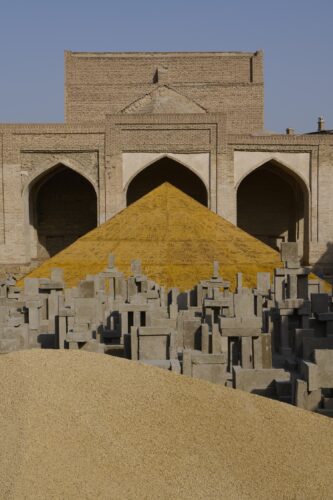
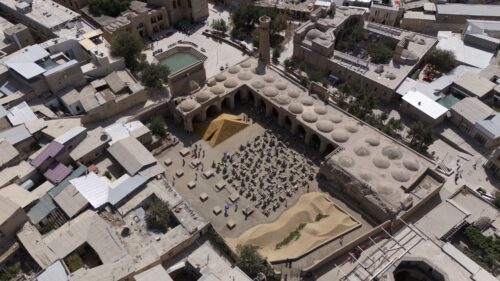
Ariel André It’s always there, in one way or another. To address people the way I do in architecture, I address bodies and engage senses that are not always at the center of architecture and design. For the kiosks I designed at the entrance of the Biennial in Bukhara, I addressed people who cannot see architecture, either because they don’t look at a building as »architecture« or because they simply cannot see at all. Therefore, I made architecture that is intended to be smelled before it is seen. The cones inspired by the spice markets along the Silk Road are all covered with actual spices. The red is paprika, the green is dill and the pink is clover flowers. I address the senses and I seek to give them pleasure, and sensuality is, after all, the pleasure of the senses, so it is always there.
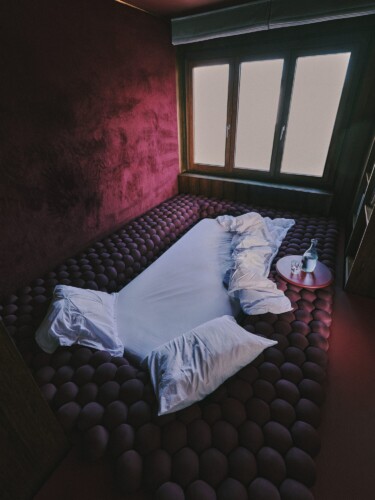
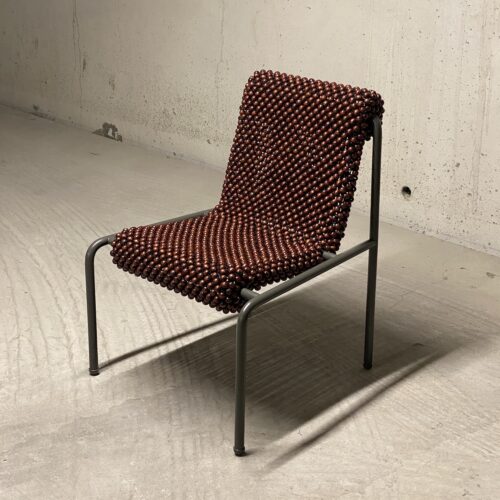
And sometimes it is more literal. For »Amoreba«, I sized the balls in a way that makes them fit perfectly into the palm of a hand, so that your hands naturally grasp them when you lounge in it, and I developed a mix of upholstery padding that mimics the bounciness of human bodies. Here, sensuality is the mortar that binds the pieces together.
Chapter Are there too many spaces or pieces of furniture that dictate a certain way of life instead of adapting to different lifestyles?
Ariel André Modernism in general, both its architecture and its furniture. Its paternalistic vision of the world, where a top-down authority is embodied by the masculine figure of the architect, holding a hard, sharp ruler in his hand and drawing on paper what he knows to be good for the people whose way of life he is crafting. But if I had to point to one object in particular, for me the modern sofa is one of the most problematic. I hate sofas, they force bodies to line up in a row, all facing the same direction, usually towards a TV set. They prescribe a posture, a social arrangement and ultimately a way of living crafted with a traditional nuclear family in mind.
Chapter What role does intuition play for you and your work?
Ariel André I see intuition – when fruitful – as the autonomous manifestation of the sum of knowledge one has accumulated over a lifetime. And I see my intuition as what Álvaro Siza puts into his notion of »the memory of the hand«. He draws compulsively what he sees around him, and when he later draws something new, his hand remembers. What he has absorbed resurfaces intuitively, anchoring each project within a very precise continuum, his own, shaped by Portuguese and Mediterranean architecture.
I do something similar with people, with others. I observe and register oddities, happy accidents, moments of pleasure and comfort: the dampened sound I hear when I rest my head on my lover’s lap, the peaceful expression of a child curled up in the arms of their caretaker, the way an uncle moves his chair a few centimeters every hour to follow the shadow cast by the neighboring building, the sound of relief a pregnant woman makes when she finally finds somewhere to sit in a Parisian museum, the sensual slither of a snake comfortably moving over lichen in an environment it makes its own. All of this eventually manifests intuitively in my forms, materials, colors and choices. My intuition is a kind of semiology of life in the urban realm, an accumulation of tiny signs, gestures and sensations that I absorb and later translate into design.
Chapter Is there a revolutionary power in softness that is far too rarely recognized?
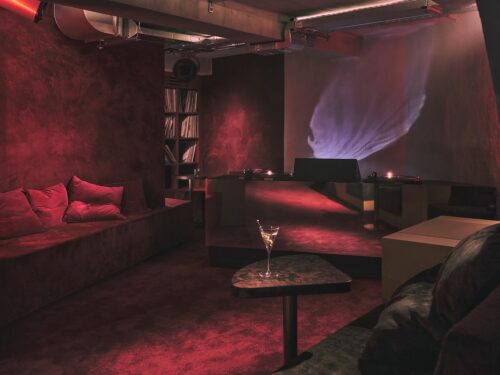
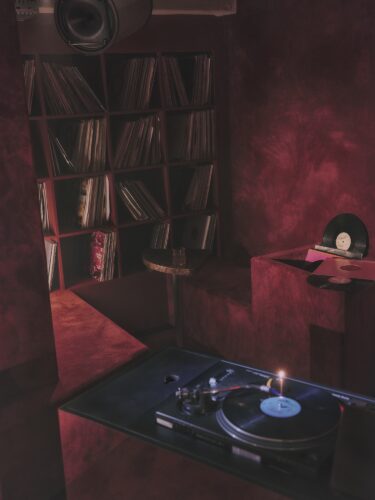
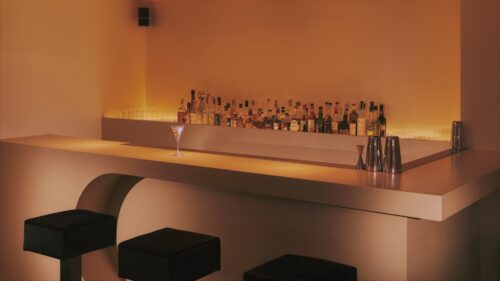
Ariel André In a way, what I defend might not be revolutionary (yet), but it is for sure subversive. The softness and, even more importantly, the looseness of »Dive«’s pillows were intended to break away from London’s over-tensed, over-finished upholstery, more appealing to the Instagram algorithm than designed for people’s comfort.
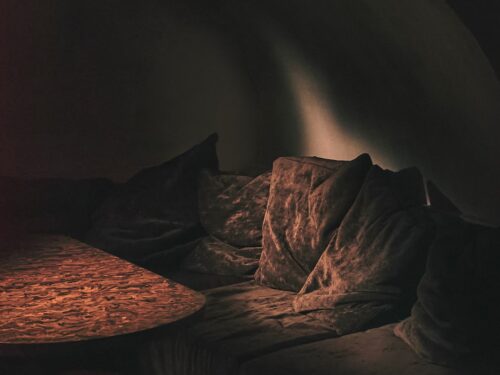
The fact that people can grab the pillows and rearrange them however they want in a cocktail bar in Marylebone is, in its own way, subversive. And that was confirmed by the feedback from the bargoers themselves. One day the owner found that some clients had taken a 7-metre-long bolster and had woven it into a sofa which is now part of the furniture of the bar. The users pushed the concept even further than I had intended: a design made by the people, literally. But let’s make it a Soft Revolution! [SW]