

Text Sarah Wetzlmayr | Production & Creative Direction Dzenana MUJADZIC | Production Assistant Miri MARIJANOVIC | Photography ROBERT RIEGER | Makeup & Hair SABINE REITER | Head of Styling Emilia TERESA, Stylist Anillo SÜRÜN | Aetna.Club | AETNA.CLUB
Interior styling, in Colin King’s case, may be understood as a matter of intuition, quiet and a certain degree of friction—the point at which a room begins to feel as though everything is in its right place. That does not mean things have to remain there forever. For the New York-based interior stylist and product designer, what matters are the relationships between objects: an arrangement that retains its coherence even as it changes. His approach might be seen as a flexible network of connections and fine lines, within which life is allowed to unfold. And has to. A portrait of a designer whose creative process is guided by intuition.
»Everything I do is instinctual. When I try to describe my process to people, I’m like, it’s not a process, it’s a feeling«, King, who describes himself as a »rearranger« and »quiet adjuster«, tells us at the beginning of our meeting. Although his orderly, harmonious and at times minimalist interiors might suggest otherwise, King emphasizes his affinity for the unpredictable—and his fondness for moments of surprise: »I love being surprised. But I feel like when you get to see as much as I do, it’s hard to be surprised.« Indeed, Colin King, one of the most sought-after creatives in his field, has seen a great deal—including numerous homes of prominent figures that he has designed and furnished. In parallel, he has made a name for himself in recent years not only as a set stylist for photo productions, but also through collaborations with global interior brands. For the former professional dancer, nature and art remain his most important sources of inspiration. »Art fed my soul. Bratwurst handled the rest,« he typed into his phone as an Instagram caption at the end of his trip through Europe.

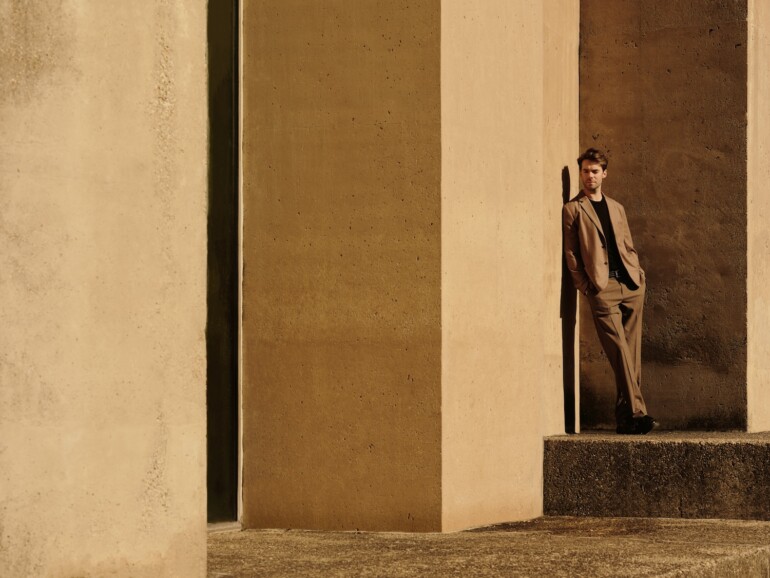
For the cover shoot, we meet Colin King inside the Wotruba Church, a brutalist structure built in the mid-1970s on the outskirts of Vienna. His slender fingers trace the building’s rough concrete surfaces as he tells us that he served as an altar boy during his childhood in Ohio. What stayed with him from that time, he says, was above all an appreciation for ritual. A sensitivity to processes and arrangements now shapes his work as well. As one of the world’s most renowned interior stylists, he understands that everything has its place — and that it is worth trusting one’s intuition and remaining present in the moment. The same applies to saying »yes« at the right time, as he explains in our conversation. For a period, however, he pursued this approach in a rather extreme way. »I kind of live my life in extremes. I’m either saying yes to everything or no to everything. I’m extremely visible or extremely hidden. I think my whole life is just going to be about moderation and finding that middle ground.« After a brief pause, he continues: »At the same time it happens quite often that the things that I almost said no to end up being really special. They surprise me. And then the things I said yes to because I thought that they are going to be amazing tend to be the ones that never work out or don’t meet my expectations.«
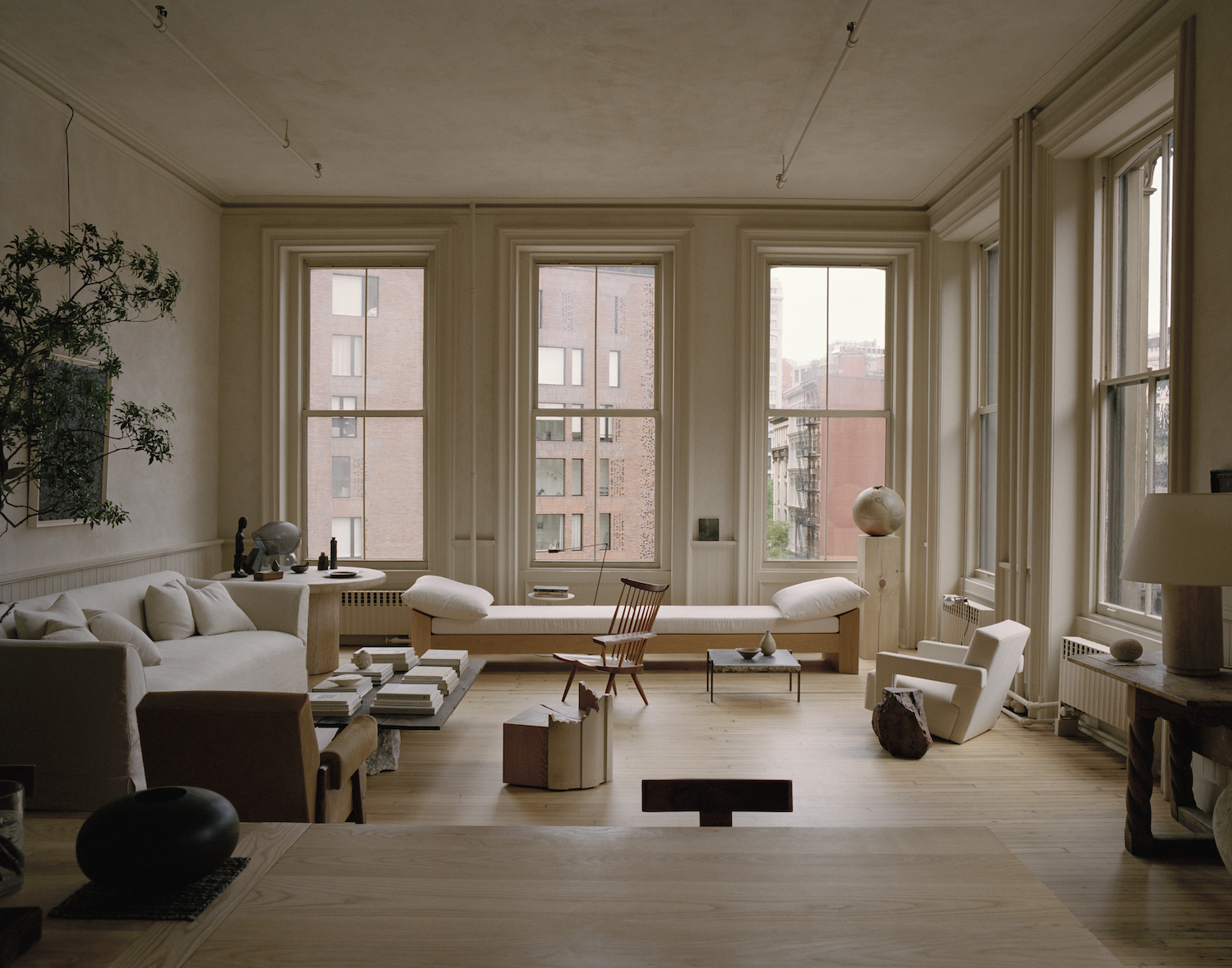
King’s frequently portrayed Tribeca apartment became a creative exploratory space for the interior stylist over the years, shaping his identity and sharpening his aesthetic eye.
Expectations, King suggests, are a subject in themselves. Ideally, he says, one should have none at all and simply surrender to uncertainty. In a city like New York, he adds with a laugh, there is hardly any other way. Colin King, however, grew up on a farm in Ohio before deciding, as a young adult, to move to New York to study classical dance. He worked as a personal trainer, including with Gwyneth Paltrow and Victoria Beckham, and found his way into styling almost by accident—long before he even realized that stylist was a profession. The fact that he had no experience in the field may have been his greatest »superpower«, he explains. Even today, he continues to work against allowing the many experiences he has since accumulated—and the expectations that often come with them—to get in the way of his intuition. »Experience can definitely hinder intuition. But if I relied on what had worked in another home or on another set, I wouldn’t be able to listen to what the particular home wants from me. But that’s what it’s all about. A big part of my job is listening. I think that in the end it’s about balance because it’s also helpful to know the things that don’t work. Which flowers don’t photograph well, for instance. Of course, people often come up to me who have seen something I’ve done and want exactly the same thing for their house. I can only ever reply that I’m happy to help them achieve that particular feeling, but it won’t look exactly the same.«
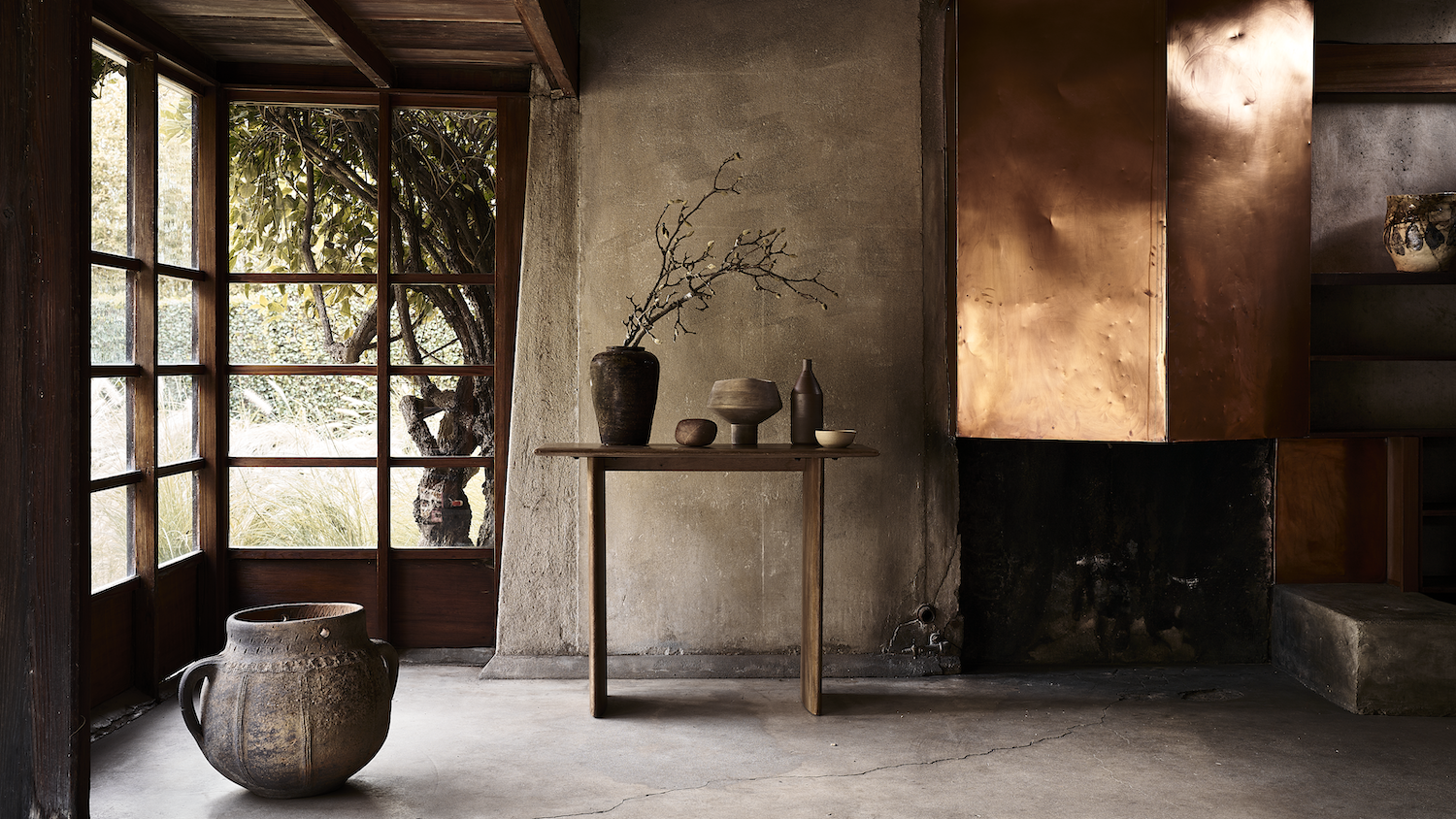
In 2023, West Elm, in collaboration with Colin King, launched a 41-piece capsule collection of furniture, textiles, and accessories — photographed at the Schindler House on the occasion of the 100th anniversary of the architectural icon built by Rudolph Schindler.
What he means by this becomes clear when leafing through »Arranging Things«, the book he published in 2023. Not only does it offer numerous insights into the breadth of his aesthetic approach, it also outlines the parameters and influences that shape his work. He reflects on the importance of light and shadow, on nature as a source of inspiration, and on the value of resisting the urge to fill every apparent void. The book reveals the full range of his creative practice—including a selection of sets he designed for editorial shoots in international magazines as well as projects created for renowned design brands. Alongside editorials, brand collaborations and the design of private homes, Colin King—who now also runs his own studio in New York—serves as Artistic Director-at-Large at Beni Rugs, designs objects for the Danish design house Audo, creates textiles for the Australian brand Cultiver, and develops capsule collections for companies such as West Elm and Zara Home.
EVERYTHING FALLS INTO PLACE
Colin King works without a fixed formula. Despite the precision his profession requires, he is not concerned with predictability—what matters more are liveliness and a degree of unpredictability that he consciously allows. For the New Yorker by choice, this trust that everything has its place replaces the idea of perfection: he trusts the moment in which moving a vase or an object transforms a room from quiet unease into comfort—»everything falls into place«, as the English phrase aptly puts it. »I think that there is something beautiful about not chasing things and letting them come to you. And trusting that they will come to you. It’s rarely the end result that makes me feel the most reward, it’s usually the process leading up to that. There is a similarity to dancing when that happens. When I am not thinking of anything, my phone on Do-Not-Disturb and I am dancing around the room, letting the objects draw me to where they want to be and who they want to be with«, Colin King notes in a calm voice.

For the cover shoot, we meet Colin King in the Wotruba Church, built in the mid-seventies on the outskirts of Vienna — photographed by Robert Rieger.
In his own life, however, King also consciously seeks out moments of productive unease and discomfort. This was also the case when he moved out of his much-photographed loft in Tribeca. »I don’t think it’s about constantly reinventing yourself, but I do think it’s important to keep developing and to step out of your comfort zone again and again«, he says. In Colin King’s case, and in the context of his move, the latter is to be understood not only metaphorically, but quite literally. He sold almost all of the objects that had been in his former apartment. Tabula rasa was the stated aim, yet the emptier the loft became, the more paralyzing the undertaking felt. »I put my identity into this apartment and I really built something there. I built my career there, I built this point of view. And when I left that space, I not only started questioning who I am, but also what I like. I felt like that point of view was faltering a bit, and I didn’t really actually know what I liked anymore.«
At first, it sounds rather paradoxical, yet for him the desire for unease and a certain degree of »weirdness« went hand in hand with a search for quiet. The wish to press pause for a brief moment and truly breathe became increasingly present. »It wasn’t exactly intentional at first. But over time, the stillness became its own kind of studio. A place where ideas could stretch out. Where I wasn’t styling to fit someone else’s frame. I was learning how to sit within my own«, Colin King writes in his second Substack entry.
PERCEIVING INSTEAD OF HOLDING ON
Colin King published the first text on September 9 of this year. »The Last Layer« is the title of the collection of personal essays, which King himself describes as an »interior monologue «. »Less polished. More personal. Slightly less concerned with whether you think I’m a genius. Slightly more concerned with whether the candle is off-center in a meaningful way.« So far, he has published a new text every Tuesday. The title of the blog refers to the part of the styling process that King enjoys most, because it is the layer where most of the emotion resides. Or, put another way, the layer that ultimately carries the story. He puts it like this: »This Substack is named after the part of design I care about most: the final 10 percent. The instinct. The pause. The slightly off-center object that changes the mood of the room. And maybe your day«.
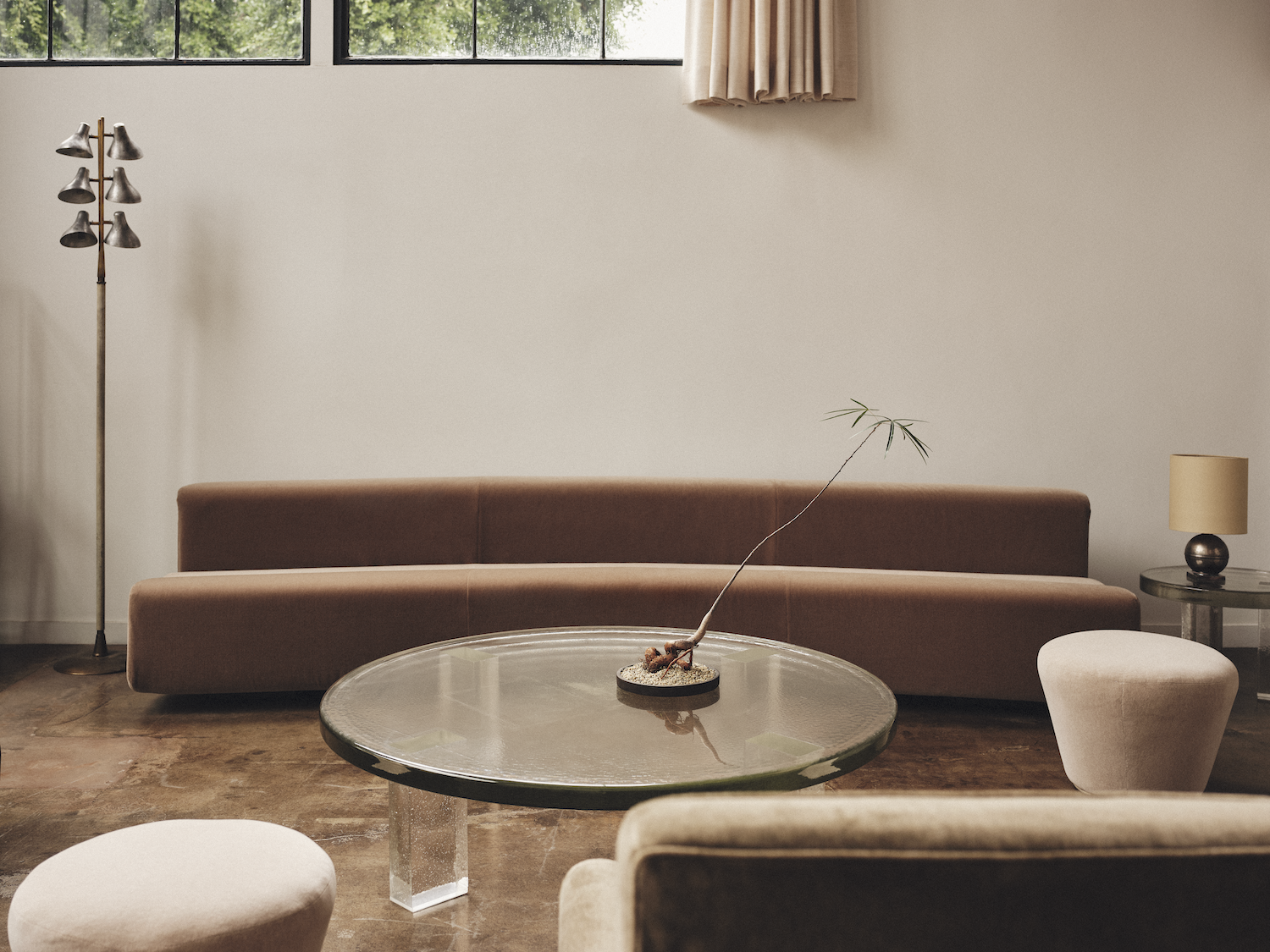
Minimalistically staged earth tones — and a deliberately off-center, delicate plant, showcasing Colin King’s preference for »off-centered objects«; styling for the Seventh House gallery in Los Angeles.
In conversation with Chapter, he emphasizes that composition plays a central role in this—allowing objects and things to enter into a dialogue with one another. »When things are not in relationship to each other, I don’t find them quite interesting. When they’re not living harmoniously, or even with tension, it doesn’t move me. I have no emotion. I almost feel like there’s something wrong. Sometimes I feel like I don’t like an object, but when I see it in connection with another object, I change my mind.« For this reason, he also enjoys working with existing pieces owned by his clients. »I learn from the things I didn’t choose myself.«
Examples of the importance of dialogue between several objects can also be found in »Arranging Things«. One image of the kitchen in his former New York apartment, for instance, shows the possibilities that emerge around the extractor hood and stove. Or that bookshelves do not always—and certainly not exclusively—have to be used for books. If the connection is not immediately apparent, it can be worth stepping away for a moment and then looking again »with fresh eyes«.

And while Colin King’s work is, of course, concerned with finding answers to design questions, he refuses to subordinate beauty to mere functionality. As he emphasizes several times in conversation, this by no means excludes the imperfect or the unpredictable—quite the opposite. In the past, he says, he has heard criticism far more often for his supposed aversion to color than for his play with irregularities. »50 Shades of Beige« are simply preferable to him to making things loud in terms of color. Anyone who meets Colin King, however, will quickly notice that the key to a certain lightness may also lie in not taking oneself entirely seriously at all times. His writing, too, offers numerous examples of this. Among them is his wry self-description as a »spokesperson for furniture moving pads«. What is certain is that behind the many layers of the »recovering people pleaser«, which include absolute professionalism, lies a core of self-irony. His mischievous laugh, which escapes him again and again, also suggests that there may be more impishness—and more color—to him than one might assume at first glance.
EVOLUTION OR REVOLUTION?
At the end of our conversation, one term keeps resurfacing: »stylist«—a professional title that, at times, does not quite do justice to his work. »I find it interesting that many people feel that the term has something diminutive or dismissive about it«, Colin King says. »I almost took pride in being a stylist, because for me, styling was so much more than shopping or placing objects, it was art direction and thought, creative direction and collaboration with all of these amazing creatives and photographers. And it really felt like I was composing, almost painting and just creating art. I really wanted to reclaim it and redefine that term. Now I feel like I’ve gotten a little looser, because I think that we’re all just creative people finding our own voices. I think I’ll always be multidisciplinary and always be doing a little bit of everything. It feels like being a hummingbird going to different orchards and flowerbeds. I am just jumping around and listening to what calls me. I don’t sit around waiting for someone to tell me who or what I am.«
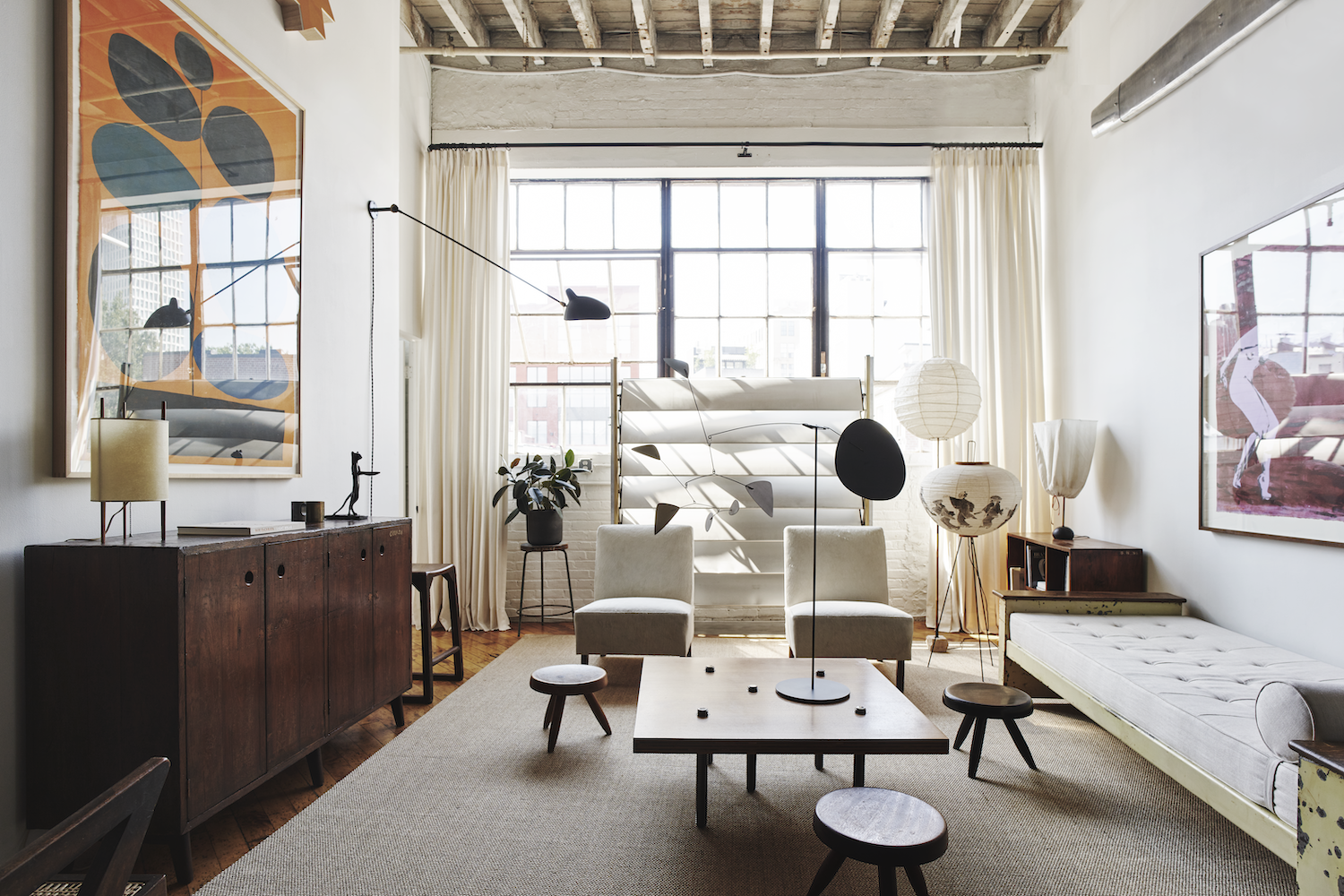
Isamu Noguchi, Charlotte Perriand, and Jean Prouvé; styling in the apartment of
Jeffrey Graetsch, founder of the Raisonné gallery in New York.
That had not always been the case, he adds. As in dance, his work as a stylist is also about letting go. Colin King pauses for a moment before beginning to explain: »I find so many parallels with where I’m at now and my life as a dancer because ultimately dancing is about trusting your body and trusting that you know the steps you practiced in rehearsal. And then there is this moment where you do have to let go because if you’re too controlled, people will notice and it’s actually not that interesting to watch. There were only a few moments of joy I experienced when I was dancing, because it was so hard for me to let go and just be in the steps without thinking about the steps. I think as creatives, it’s like the longest journey from the head to the heart, but that’s where we have to be operating from, because otherwise there’s a dishonesty in the work because it feels too controlled, too contrived.«
One question remains: which of the two terms might better describe his career so far—evolution or revolution? Those who follow Colin King’s work would probably first choose the former. But is there not also a quiet revolt in the love of tablecloths that seem, at first glance, too short? One that is not loud or heavy-handed, but corresponds instead to the softness that his interiors also radiate? And that can also be found in his movements and in the way he speaks? The answer is probably »yes«. Perhaps, however, this kind of categorization does not matter all that much. What matters more is the feeling that everything, somewhere, has its place.
FIRST PUBLISHED IN CHAPTER №XIII »IDENTITY« — WINTER 2025/26