

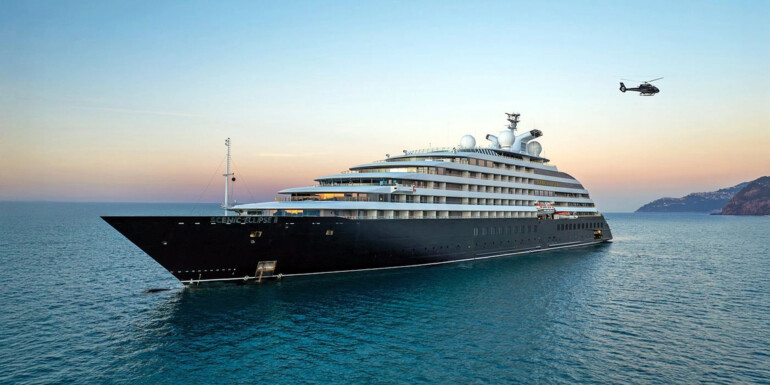
At the end of July, the Scenic Eclipse II anchored off the Old Royal Naval College in Greenwich for the first time. Four days later, she made her inaugural call at Hamburg’s Cruise Center HafenCity. Two first calls within a single week, connected by a journey aboard a ship whose idea of luxury is defined less by what it adds than by what it leaves out. Chapter went aboard Scenic Eclipse II to explore how loudly luxury is allowed to speak for itself.
When the Venetian painter Giovanni Antonio Canal, known as Canaletto, painted the Thames at Greenwich around 1750, he worked on behalf of collectors who were less interested in the depiction of the river than in their own belonging to what it represented: a symbol of rising commercial power, seen through a Venetian eye. Whoever appeared in these paintings or owned them belonged. Almost three centuries later, Scenic, the Australian luxury travel and cruise company, has revisited this idea, commissioning British painter Tai Shan Schierenberg to create a new version of the Greenwich view—this time with Scenic Eclipse II in the picture. A ship Scenic describes as an »ultra-luxury Discovery Yacht«. The result is a tondo 120 centimeters in diameter; the circular format is derived from the ship’s portholes and navigation instruments.
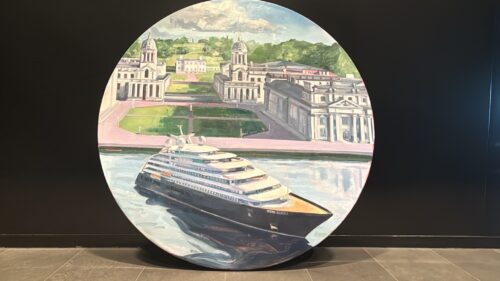
The painting was unveiled on July 31, 2026, when the yacht docked in London for the first time, in front of the very complex that had become Canaletto’s subject. Schierenberg describes his task as a portrait rather than a veduta: »Like a portrait, the yacht has its own personality. Its designers have poured so much thought into every line and every curve that you feel a responsibility to do right by their work.« The lines Schierenberg speaks of belong to a ship 168 meters long and 21.5 meters wide, which was launched in June 2022 at the 3. Maj shipyard in Rijeka, built by Scenic’s own MKM Yachts. She is the sister ship of the Scenic Eclipse, commissioned in 2019, and continues the exterior design language developed by Oliver Design from Getxo in the Basque Country together with the Scenic team and the engineering firm Foreship. For the second hull, the design was revised based on feedback from guests and crew, with changes including the Senses Spa as well as the pool and outdoor area on Deck 10.
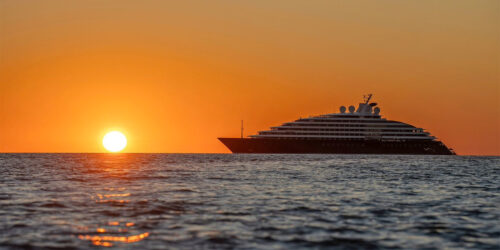
The hull is reinforced according to Polar Class 6, and a dynamic positioning system keeps the ship in place without dropping an anchor. 114 suites, each with a veranda or terrace, a maximum of 228 guests (200 in Antarctica) plus roughly the same number of crew members. On the helideck are two Airbus H130-T2 helicopters, and in the hull is the Scenic Neptune II, a Triton submersible for up to eight guests plus a pilot.
This lineup also raises the question of category, which the generic name »Discovery Yacht« chosen by Scenic identifies rather than answers: too small for the economics of a cruise ship, too large for the logic of a private yacht. The Scenic Eclipse II has thus established itself between the two. And that comes at a price. First in construction: Scenic does not mention any sums, but nearly 200 million euros are reported. More importantly, however, the cost is built into the ship itself—in the form of space that cannot be sold.
Against Full Occupancy
»Go on three cruise ships and you’ll notice very quickly: pictures, interiors, carpets all look alike,« explains Tom Götter, who, as Vice President Hotel Operations—Ocean at the Scenic Group, is responsible for the operation of both Eclipse yachts and the Emerald ships that also belong to the fleet. »The basic principle of Glen and Karen Moroney (Editor’s note: the Australian founders and owners of the Scenic Group), was: We don’t actually want to be like the rest.« Sentences of this kind are, of course, common in the industry. What is unusual is that here they can be verified by measurements.
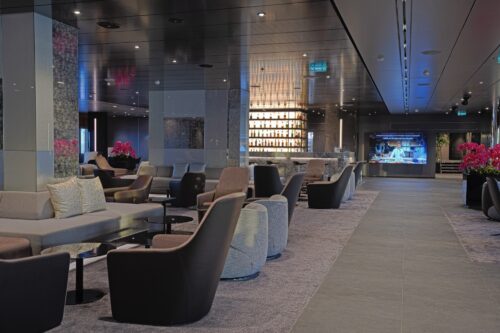
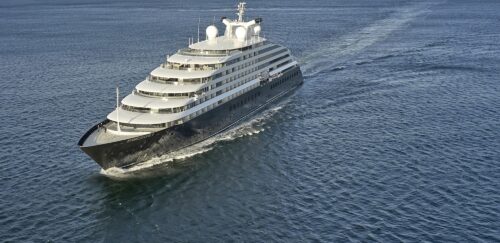
The usual width of a passenger corridor is about ninety centimeters. On board the Scenic Eclipse II, the corridors are significantly wider, and every additional centimeter is taken from the area where interior cabins could be carved out. The lobby is also unusually generously dimensioned for a ship of this size and works with significantly more ceiling height than usual—space that would normally be invested in another deck and thus in more paying guests. The aforementioned ratio of guests to crew members is also fundamentally a decision against economic efficiency and capacity utilization. »You could also just say: standard ceiling height, one floor on top, and we have more guests on board,« says Götter. »We didn’t want to do that.« Whether you call that understatement or a carefully calculated form of scarcity is hard to distinguish from the outside. It is probably both.
Individual decisions
Karen Moroney, co-owner and Director of Project Design, is responsible for the interiors. What is striking about her work is less a recognizable style than a very individual—and probably enormously elaborate—procurement concept: no general contractor equipping a ship from a catalog, but a series of individual decisions. B&B Italia, Walter Knoll, Tom Dixon, Jonathan Browning for the lighting. In the Spa Suites, there is a generous bathtub designed by Philippe Starck.
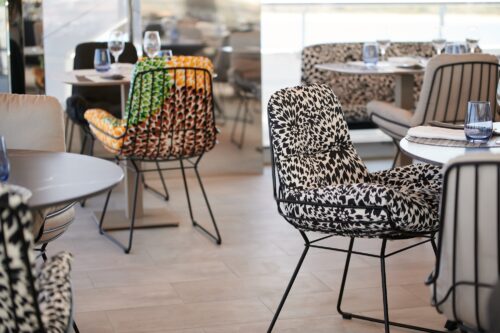
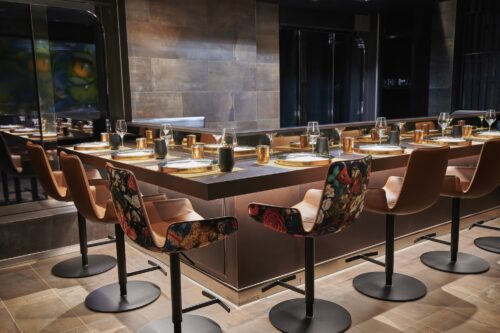
»When Karen is on board and walks through the ship with me, she can tell me the lumen count for every lamp. Why the light falls where it does, where the reflections are, what material it is, which manufacturers have come together here,« reports Tom Götter. Nothing is off the shelf, he says, but rather »micro-decisions—who makes the sofa, different suppliers everywhere.« For the sushi bar in Koko’s, a chair from the Lemgo-based manufacturer Freifrau was upholstered in a collaboration with Missoni. According to Götter, Karen Moroney spoke with both houses and brought them together. That is exactly where the real effort lies: such pieces cannot be reordered.
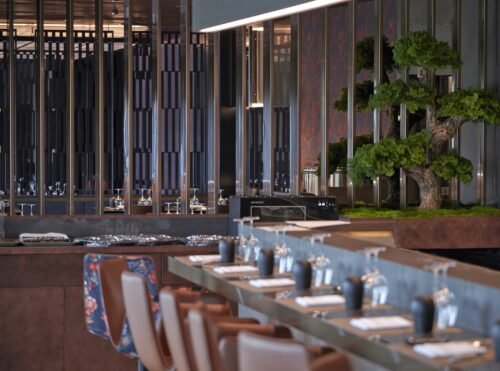
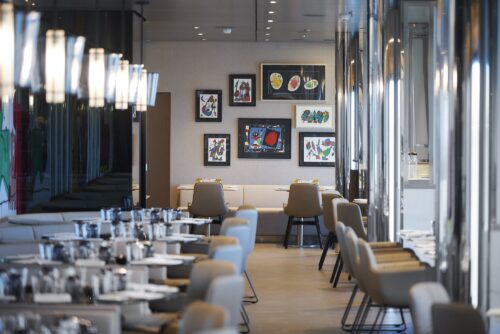
Also the art on board is not merely decorative. Selected by Karen Moroney, it includes specially commissioned works, while many of the pieces reveal themselves only gradually. In the main restaurant Elements, for example, works by Joan Miró hang without comment—almost like in a private apartment whose owner does not need to explain the collection.
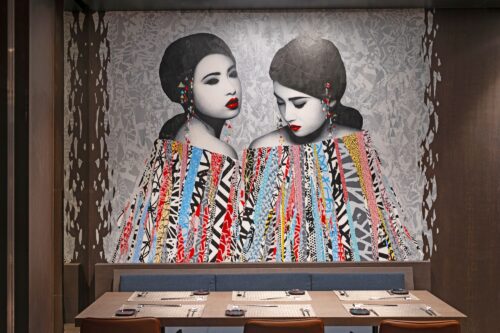
In Koko’s, large-format female portraits in collage, stencil, and spray techniques dominate, Geisha motifs by the British artist Carl Hush, who already worked for the first Eclipse. Götter remembers their creation: an artist who came on board with trash bags full of paper scraps, put on heavy metal, and worked until sixty or seventy crew members were standing in the corner watching. »Why are you standing so far away?« he asked. The process was thus not shielded but declared an operational event. The result now hangs on the wall, equally unlabeled.
flip-flop hospitality
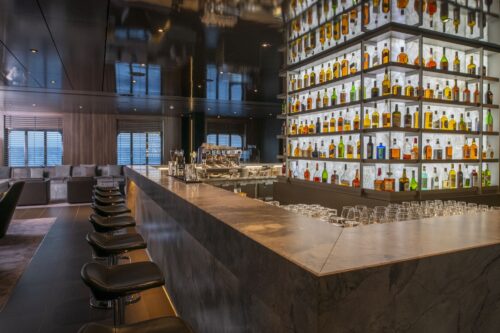
The fact that almost nothing on board carries a price has a banal reason at first: the journey is priced on an all-inclusive basis, with exceptions reserved for some vintage wines and champagnes. This only becomes interesting through the effect on the selection. Usually, an inclusive concept leads to a downward standardization. Here, the calculation works in reverse: because the menu does not list numbers, a social dynamic that Götter identifies precisely is eliminated. »Everyone knows—if there are three wines on the menu, hardly anyone wants to take the cheapest one because it feels wrong.« What remains, he calls »flip-flop hospitality«: »You have to be able to offer everything, but let the guest decide—whether jeans or corduroy trousers, whether Lumière or Sushi Bar.«
The thought extends beyond gastronomy. A visit to the bridge costs an average of around $150 in the industry; on the Scenic Eclipse II it is open. »You can take the $150. Or you open the bridge and give every cadet the opportunity to pass on their passion.« This is certainly also a business thesis—loyalty as a long-term investment—but it has its limit where the effort becomes too great: helicopter flights and dives with the Neptune II continue to be charged separately. What remains is the restraint in communication, the principle that one discovers the Freifrau chair, the Hush, or the Starck tub by chance rather than being told about them. Is that intentional? »One hundred percent,« answers Tom Götter.
This contradiction should not be smoothed over. A luxury that does not display its proof of origin only works for those who recognize it anyway. Understatement does not dispense with distinction, it simply makes it more subtle. And those who do not read the signs still pay for them.
Premieres
On August 1, Scenic Eclipse II sailed down the Thames, via Ostend, and finally into the German Bight. On the afternoon of August 3, the Scenic Eclipse II sailed up the Elbe from Cuxhaven, past the Landungsbrücken and the Elbphilharmonie, and docked at the Cruise Center HafenCity—also a maiden call. The following day, the Hamburg port plaque was presented, and in the evening, the departure took place under water fountains towards the Kiel Canal. Copenhagen, Binz, Gdynia, Visby, Mariehamn, and Stockholm followed.
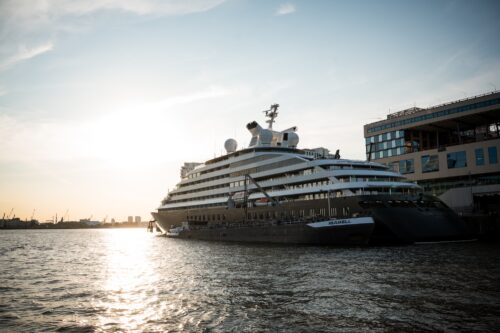
In Hamburg, there was a plaque and the fire department; in Greenwich, the arrival was celebrated with an oil painting. What connects the place and the ship beyond the backdrop was, incidentally, wonderfully explained by Schierenberg with his painting. Greenwich Hospital was founded in 1694 as a home for disabled sailors of the Royal Navy and became the Royal Naval College in 1873. In English, the word Hospital still carries hospitality in its root. »Greenwich Hospital was originally created as a place of hospitality before becoming a place of learning and discovery—and Scenic Eclipse II is also a place of hospitality, built around exploration and discovery.« [CPS]