


Mit Mauro Porcini ernannte Samsung Electronics vergangenes Jahr erstmals in seiner Unternehmensgeschichte einen Chief Design Officer. Mit dem erfahrenen italienischen Designer, der zuvor bereits Design auf höchster Ebene bei PepsiCo und 3M verantwortete, erhält Gestaltung in dem Konzern fortan ein neues Gewicht. In einem Unternehmen, das lange vor allem über Technologie, Ingenieurskunst und Skalierung definiert wurde, rückt Design damit in eine zentrale Rolle: Es soll künftig mitprägen, wie Technologie verstanden, erlebt und im Alltag verankert wird. Im Rahmen der Milan Design Week 2026 und der von Samsung präsentierten Ausstellung »Design is an Act of Love« sprach Porcini mit Chapter über die Rolle von Design auf Führungsebene, über Ausdruck und Bedeutung in der Tech-Welt sowie über die Frage, wie ein Unternehmen dieser Größe gestalterische Kohärenz über sehr unterschiedliche Produktkategorien hinweg herstellen will.
Chapter Samsung comes from a strong technology culture. What changes in a company like this when design is embedded at board level?
Mauro Porcini When design sits at the board level, it evolves from being a powerful capability into a strategic driver that shapes decisions from the very beginning. It influences not only what we create, but why we create it. Technology has always been a fundamental strength for Samsung, driving performance, scale, and innovation. Design complements that strength by bringing meaning, context, and human relevance into the equation. At that level, design helps align innovation with people’s real lives—emotionally, culturally, and functionally. It also creates greater coherence. Across a company as large and diverse as Samsung, design becomes the connective tissue that links strategy, product, and experience into one consistent vision.
Chapter Technology is currently developing at enormous speed. Why does the tech world so much more rarely succeed in giving that development a distinct design expression?
Mauro Porcini Speed often favors efficiency over intention. When technology evolves quickly, there is a natural tendency to focus on capability—what it can do—rather than on meaning, what it should do for people. This often leads to convergence: products start to look and feel the same. Distinct design expression requires time, reflection, and a strong point of view. It requires the courage to interpret technology, not just apply it. Without that, innovation risks becoming invisible: powerful, but indistinguishable.
Chapter In this context, you have also repeatedly suggested that technology needs to become more expressive again. How would such a shift become visible in the design strategy of a company like Samsung?
Mauro Porcini For us, this shift takes shape through what we call »Expressive Design«. It is a move away from neutrality and uniformity, towards diversity, identity, and emotional connection. Not as decoration, but as meaning, embedded into a dynamic balance between form and function. We often say that »form and function follow meaning.« In other words, every design decision begins with what matters to people, their needs, their aspirations, their individuality. At Samsung, this is not an abstract idea. It has been unfolding over the past few years through a series of distinctive projects—TVs like The Frame and The Serif, or foldable smartphones such as the Galaxy Fold, which reimagined both the role and the form of technology. Today, we are taking this to the next level, evolving from individual expressions into a coherent, scalable design strategy. You can see it in more recent work showcased at Milan Design Week, like the 130-inch Micro RGB presented in two very distinct design expressions, or the S95H, which explores a unique approach, potentially customizable over time. What emerges is a different idea of consistency: not uniformity, but coherence across diversity and emotions. Technology, in this sense, becomes something you don’t just use, but something you relate to. Something that can reflect who you are, and adapt to the way you live.
Chapter How is Samsung’s design team structured today, and what capabilities does a company of this scale need in order to think design consistently across such different product categories?
Mauro Porcini Samsung has a design organizations of about 1,500 designers, with teams across multiple continents and product categories—from mobile and wearables to TVs and audio devices to digital appliances. But scale alone is not enough. We have an organization with a central corporate team and a series of other teams aligned to the business units, where industrial design, user experience, experience design, design innovation and design strategy work together under a shared philosophy and vision. At the same time, each category retains the flexibility to respond to its specific context. To make this work, you need not only great designers, but also strong capabilities in design research, storytelling, and culture building. Design becomes a language that everyone in the organization can understand and contribute to.
Chapter What is the first thing that tells you a design is good: its form, its use and effect in everyday life, or the meaning a product acquires for people … or something else?
Mauro Porcini For me, it always starts with meaning. A product can be beautiful and functional, but if it doesn’t resonate with people—if it doesn’t improve their lives or connect with their emotions—it remains incomplete. Good design is when form, function, and meaning come together seamlessly. You don’t notice them as separate elements anymore—you just feel that it »makes sense.« And often, the strongest signal is emotional. When people feel something—delight, comfort, pride, connection—you know the design is working.
Chapter Looking back at your work across different global companies, what is, for you, the actual task of design?
Mauro Porcini Design is an act of love. At its core, the task of design is to take care of people—understanding their needs, respecting their differences, and creating solutions that improve their lives. It sits at the intersection of business and technology, but its true role is to humanize both. To transform innovation into something meaningful, accessible, and emotionally relevant. If we do our job well, design doesn’t just solve problems, it creates possibilities. It helps people become a better version of themselves.
Chapter At Milan Design Week 2026, Samsung is psenting an exhibition titled »Design is an Act of Love.« Why is that precisely the right title for the brand at this moment?
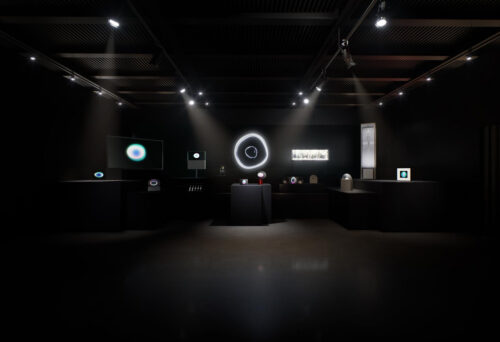
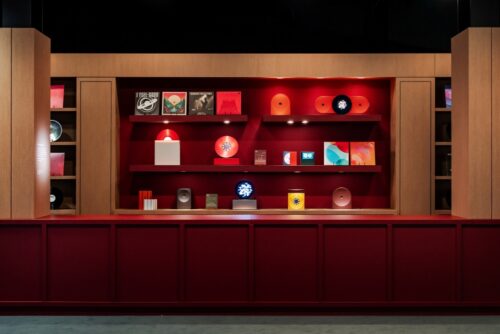
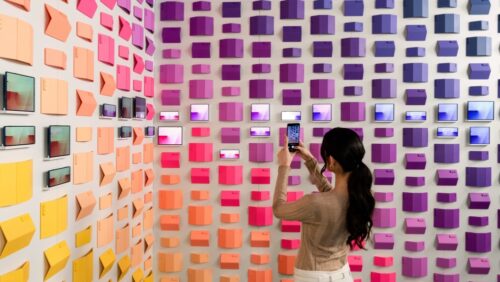
Mauro Porcini Because we are at a moment where technology is becoming incredibly powerful, and at the same time, risks becoming increasingly distant from people. Artificial intelligence, automation, and connected ecosystems are transforming our lives. But to transform them for the better they need intention and purpose. »Design is an Act of Love« is our way of making something very clear: technology is not the end, but the means. It must remain at the service of humanity, at the service of people. It is also how we frame the impact we want to create: helping people live longer, live better, live loud, and live on. Four simple ideas that reflect health and safety, time and quality of life, self-expression, and the preservation of memories and connections. It is a call to bring empathy, care, and responsibility back to the center of innovation. And ultimately, it reflects who we are becoming as a design organization, and the kind of future we want to help shape.
Chapter The exhibition brings together concept pieces and products already on the market. Why was it important for you to show both side by side?
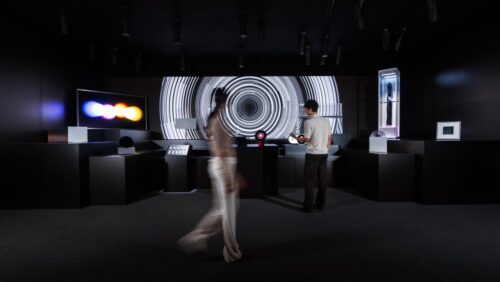
Mauro Porcini Because innovation is a continuum. Concepts represent exploration, the questions we are asking, the directions we are investigating. Products represent commitment, ideas that have matured and are already impacting people’s lives. By showing them together, we invite people into the process, not just the outcome. You can see how ideas evolve, how thinking translates into reality. It makes innovation more transparent, more human, and, hopefully, more inspiring.
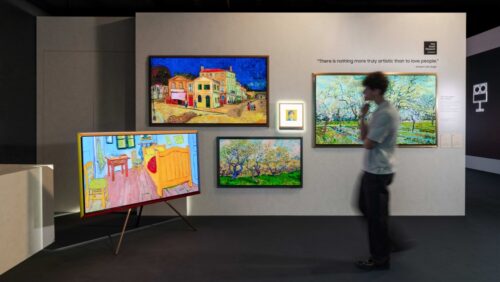
Chapter Samsung presents very different product categories in Milan, from foldables and wearables to screens, audio and kitchen environments. What holds all of this together from a design point of view?
Mauro Porcini What holds everything together is a shared philosophy. Across all categories, we are guided by the same belief: technology should elevate people’s lives and amplify human potential. This translates into a common design approach, human-centered, expressive, and meaning-driven. And into a consistent framework of outcomes: helping people live longer, live better, live loud, and live on. Each product may look different, behave differently, and serve different needs. And in that they reflect human diversity. But they all express the same intent and share the same story: to create a more meaningful relationship between people and technology. That is what creates coherence, not uniformity, but a shared sense of purpose. [CPS]