

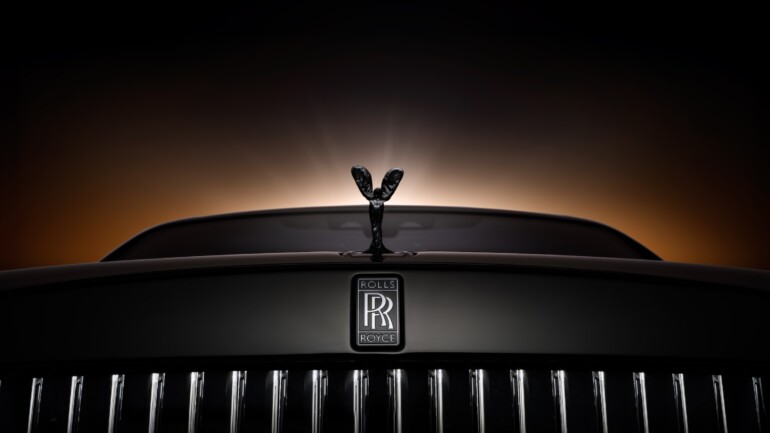
The Black Badge line expresses the bold, unconventional side of the British luxury automobile marque Rolls-Royce with uncompromising clarity. The first deep-black models of the Black Badge family were presented at the Geneva Motor Show in 2016, although the origins of the series reach much further back.
In December 1964, John Lennon—who had just released the album »A Hard Day’s Night« with the Beatles—ordered a new Rolls-Royce Phantom V from R. S. Mead in Maidenhead. However, it was to be completely black—inside and out, including all trim. He also wanted the car to have tinted glass in the rear doors, the quarter windows, the rear window, and the partition. »It’s for late drives home. If it’s light when you get home, it’s still dark in the car. You just close all the windows and you’re still in the club«, Lennon explained in an interview with Rolling Stone. Rolls-Royce naturally fulfilled the exceptional musical talent’s wishes and delivered an entirely black car. Only the two iconic brand signatures—the Pantheon grille and the Spirit of Ecstasy—remained chrome. Today, John Lennon’s black Phantom V is considered the most important predecessor of the Black Badge line introduced in 2016, with which the British brand aimed from the outset to appeal primarily to younger customers. Strictly speaking, however, the Rolls-Royce 20 H.P. Brewster Brougham delivered in 1928 must also be counted among the forebears of Black Badge, as it was handed over to its owner with an unusual special specification: both the Spirit of Ecstasy and the Pantheon grille were painted black.
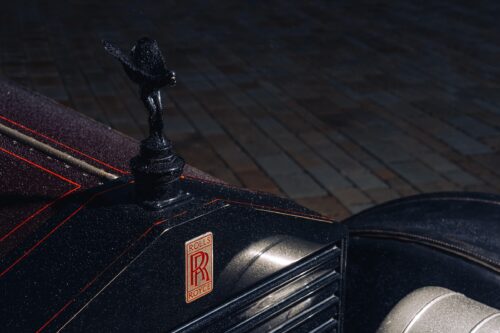
Rolls-Royce 20 H.P. Brewster Brougham
In an interview with Chapter, Domagoj Dukec, Director of Design at Rolls-Royce Motor Cars, describes Black Badge as the brand’s subversive alter ego. »It was an unexpected, yet compelling statement, and this creative tension was exactly what made it so powerful. Today, Black Badge stands as a bold expression of our design philosophy. A contemporary reinterpretation that has not only become part of our identity, but has also introduced a new and younger audience to the marque«, says Dukec.
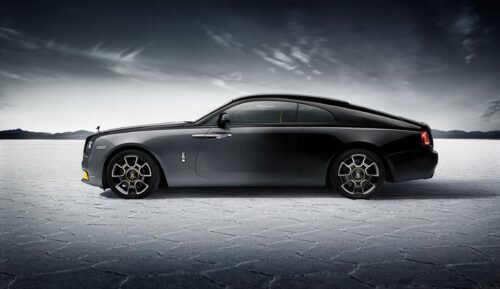
Rolls-Royce Black Badge Wraith Black Arrow
From John Lennon’s legendary vehicle to the introduction of the Black Badge line in 2016, however, several decades passed. The starting point for developing this subversive alter ego was above all the desire to offer young, up-and-coming entrepreneurs a vehicle that is instantly recognizable as a Rolls-Royce, yet at the same time has a more unconventional, almost rebellious character. »We see ourselves not as creators imposing a vision, but as interpreters of our clients’ aspirations, philosophies and values. When they choose to push the boundaries, our role is to guide that exploration with understanding and precision«, says Domagoj Dukec—referring not only to Black Badge, but also to Rolls-Royce’s long, brand-defining Bespoke tradition. »Since joining the marque, I’ve been struck by just how singular each of our clients truly are. No two share the same vision, and that uniqueness continually inspires us to think beyond convention. From a design perspective, it compels us to consider not only what feels relevant now, but what will remain meaningful in decades to come.«
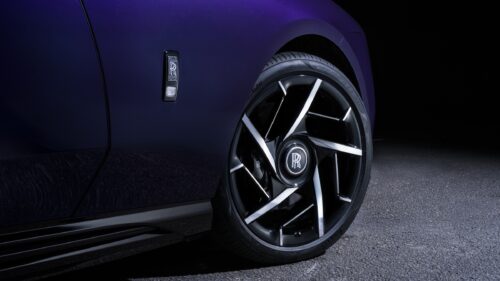
Rolls-Royce Black Badge Spectre
Black Badge doesn’t just stand for deep black tones in the exterior and interior, but also for more engine power and a sportier chassis. This makes the series especially appealing to those who don’t want to be chauffeured, but want to experience for themselves what the more direct throttle response and increased performance are all about. Pressing the »Infinity« button on the steering wheel can even unlock additional power reserves. In addition, the chassis is lowered and slightly stiffened.
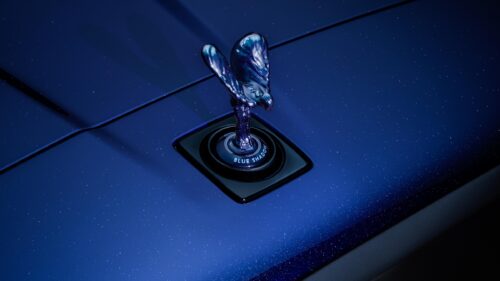
Rolls-Royce Black Badge Cullinan Blue Shadow
While John Lennon was still denied this option, today the Spirit of Ecstasy, the Pantheon grille, and the double-R emblem can also be produced in black. Instead of simply painting these icons, a special chrome electrolyte is added to the traditional chrome-plating process, which deposits on the stainless-steel substrate and darkens the surface. The layer thickness is just one micrometer—about one hundredth the width of a human hair. Each of these components is precision-polished before being fitted to the vehicle to achieve a mirror-smooth black chrome surface. The current Black Badge portfolio includes Ghost, Cullinan, and Spectre. The latter was unveiled in February 2025 and, at 659 hp, is the most powerful version of the all-electric coupé to date.
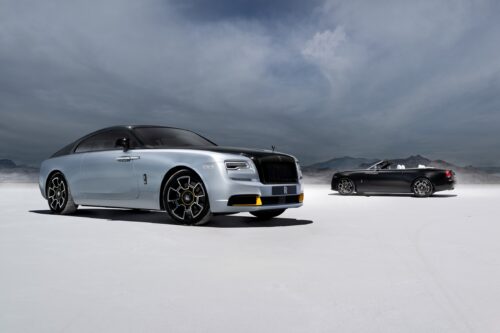
Rolls-Royce Black Badge Landspeed Collection
Crucial to understanding the story of Black Badge is also the fact that the boldness mentioned above has been part of Rolls-Royce’s brand identity long before 2016. Through their own biographies, the two founders anchored the courageous breaking of conventions firmly in the brand’s DNA. Henry Royce overcame poverty, illness, and a lack of formal education to become one of the world’s greatest engineers. Charles Rolls, born an aristocrat and educated at Cambridge University, could have lived a life of luxury, but instead chose to expose himself to the dangers of early motorsport and aviation. The spirit of self-fulfillment that defines both stories continues to shape Rolls-Royce to this day and finds its most intense expression in Black Badge, the subversive alter ego of the Goodwood-based marque. [SW]