
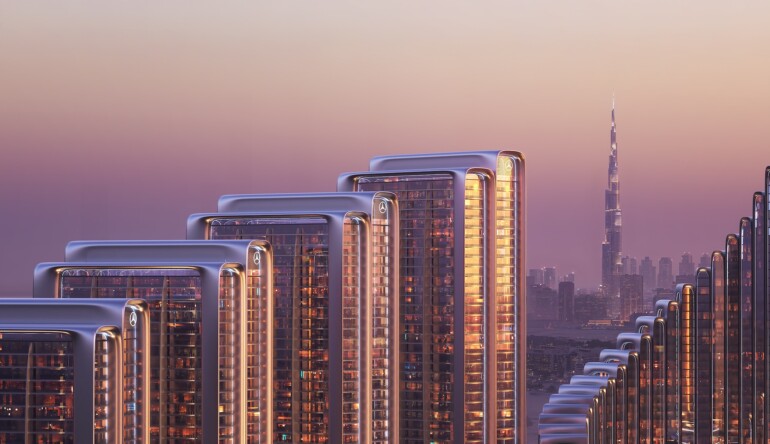
Mercedes-Benz and Binghatti have already proven in Dubai that automotive brand identity and design can be convincingly translated into architecture. The first joint project, Mercedes-Benz Places Dubai, is currently in its final construction phase and is scheduled for completion by the end of this year. Now comes the next step, or more precisely: the next scale. With Mercedes-Benz Places | Binghatti City, the cooperation extends from a single high-rise to an urban structure spanning approximately 836,000 square meters. Chapter was on site at the presentation of Mercedes-Benz Places | Binghatti City and was able to get an idea of the level to which the concept of Branded Residences is being raised here.
Staging and Substance
From the outset, the project’s official launch event left little doubt about the ambition Mercedes-Benz and Binghatti attach to their second joint venture. On the evening of January 14, 2026, the area in front of the renowned Meydan Hotel in Dubai was transformed into an expansive stage of light and choreographed drone formations. that even turned the city sky into a projection surface. It was that form of staging that is almost a matter of course in Dubai, but even here it set new standards.
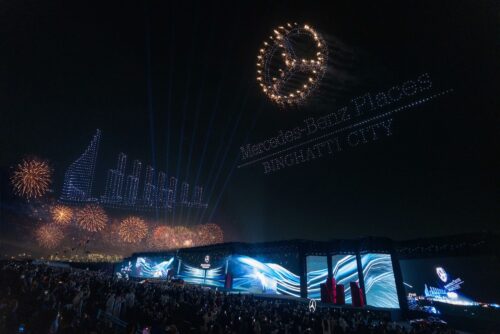
With all the visual bombast, it should not be overlooked that the evening was less to be interpreted as an end in itself, but as a visible expression of a partnership based on substantive content. Because Mercedes-Benz and Binghatti are connected by more than a lucrative business relationship and strategic co-branding. Design excellence, the pursuit of constant innovation and a clear commitment to the highest quality form the common ground.
A Market in a Permanent State of Exception
Hardly any real estate market is developing as dynamically as Dubai’s. In recent years alone, billions have been invested there in high-quality residential, hospitality and mixed-use projects, and numerous new luxury quarters are under construction or in planning. International developers, luxury brands and investors are competing for attention, location and relevance. In such an environment, financial clout and size alone are no longer enough. Visibility only arises where architectural clarity, design vision and brand authority come together. And this is precisely where the collaboration between Mercedes-Benz and Binghatti comes in. Both partners have a high level of recognition, but also the necessary credibility to transfer this to a project of this magnitude. The fact that Mercedes-Benz recently demonstrated its design expertise once more with projects such as the Vision Iconic (whose influence is now also reflected in the concept of Mercedes-Benz Places | Binghatti City) further reinforces this ambition.
Binghatti: Developer with its own signature
While Mercedes-Benz’s design and technological expertise has been established internationally for over a century, Binghatti has also consistently earned its status in the Real Estate market in recent years. Regardless of who you talk to in Dubai, one point comes up again and again: Binghatti stands for architecturally clear and immediately recognizable projects. In a city where formal exaggeration is omnipresent, the company has established its own design-driven visual signature, with a clearly recognizable commitment to architecture as an art form. This development is largely driven by Muhammad BinGhatti, whose charismatic presence and entrepreneurial talent sharpen the brand’s profile.
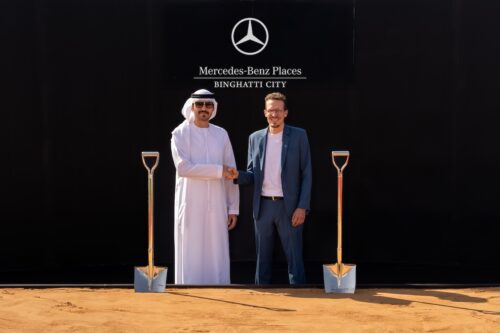
Muhammad BinGhatti (CEO of Binghatti) and Mathias Geisen (Member of the Board of Management Mercedes-Benz)
As CEO and Chairman, he embodies a form of developer role that brings together architecture, brand management and media impact. Binghatti is not a typical developer, but a trained architect: he graduated from the American University of Sharjah with a degree in architecture and took over the management of the family business, which his father founded in 2008, at an early stage. At the presentation in Dubai, Muhammad BinGhatti says that he has always wondered why, for example, the design of cars effortlessly fascinates even children, while buildings hardly receive any attention in perception. His conclusion: buildings must be able to have an earlier, more immediate and emotional effect.
He wanted to achieve exactly this potential for buildings that evoke reactions beyond pure function and remain anchored in the collective consciousness. At the same time, he transferred the principles of strategic brand management into his work at an early stage by combining architectural identity with brand identities that are otherwise more familiar from the world of luxury goods. This is also demonstrated by previous collaborations with brands such as Bugatti or Jacob & Co. Against this background, Mercedes-Benz Places | Binghatti City can be seen not only as a logical continuation but also as the most far-reaching formulation to date of a strategy in which a globally established brand identity and clear design language become the design basis for an entire district.
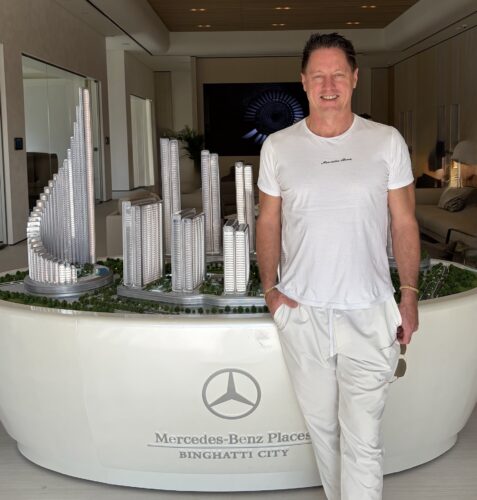
Gorden Wagener, Chief Design Officer of Mercedes-Benz, at the presentation in Dubai. One of his last public appearances in this function — he is leaving the company on January 31, 2026.
A city within a city
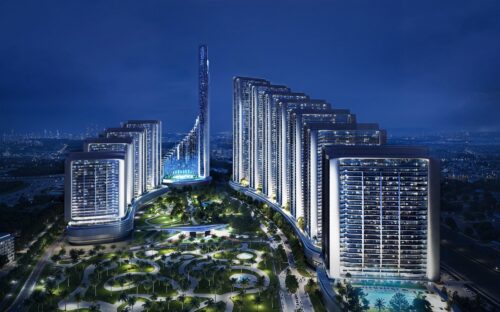
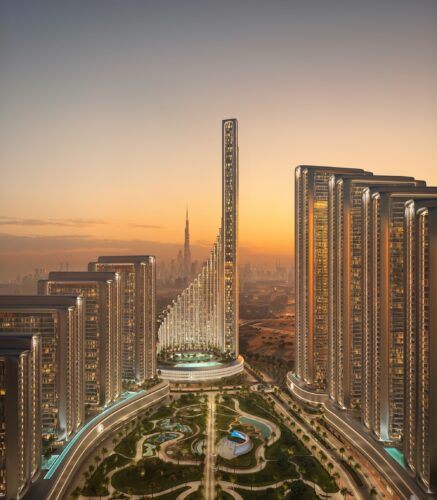
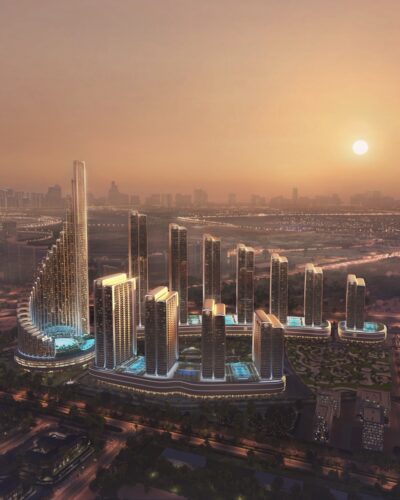
Mercedes-Benz Places | Binghatti City is designed as a »City within the City«. Not in the sense of a closed enclave, but as a structurally independent urban structure. The project covers approximately 836,000 square meters in the Meydan area and comprises more than 13,000 residential units, spread over twelve towers. At the center is the so-called Vision Iconic, which functions as a spatial and visual reference point and connects the surrounding structures.
The entire building composition follows a clear, recurring design language derived from the Mercedes-Benz design philosophy of Sensual Purity. The successively rising volumes create a dynamic skyline that suggests movement and progress, while metallic accents in silver and chrome tones are intended to subtly reference the brand’s industrial heritage. An additional level of meaning is created by the naming of the individual towers: each bears the name of a Mercedes-Benz concept car—from the Mercedes-Benz Vision One-Eleven, the historical Vision Mercedes Simplex to the Vision AVTR.
Design, Landscape, Community
This approach remains consistent inside as well. According to the developers, the residences should follow a reduced, timeless design that avoids contrasts and instead works with a few, controlled materials. Black and silver tones form the basis, complemented by leather and wood. Technological integration is an integral part, but does not take center stage, but supports comfort and everyday usability. The residential offer is complemented by a finely tuned system of communal, sporting and landscape spaces. The Grand Promenade is intended to form the green backbone of the project and offer, among other things, wellness and sports facilities as well as event areas and family-oriented areas. It goes without saying that mobility and EV infrastructure are also integrated as an important part of the overall concept.
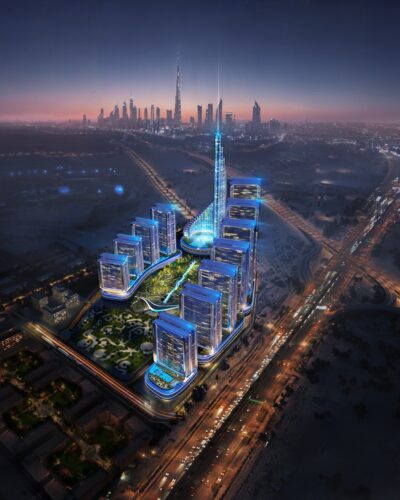
Mercedes-Benz Places | Binghatti City is therefore less a collection of individual building blocks than a thoroughly composed luxury quarter in which architecture, use and brand identity are coordinated. And this is precisely where the actual claim and the special feature of the project lie: In a market like Dubai, which is characterized by ever more extreme luxury stagings and a competition to outdo each other in terms of size and effect, the project deliberately focuses on design stringency, coherence and long-term relevance—regardless of the spectacularly designed staging of the launch event. [CPS]
