
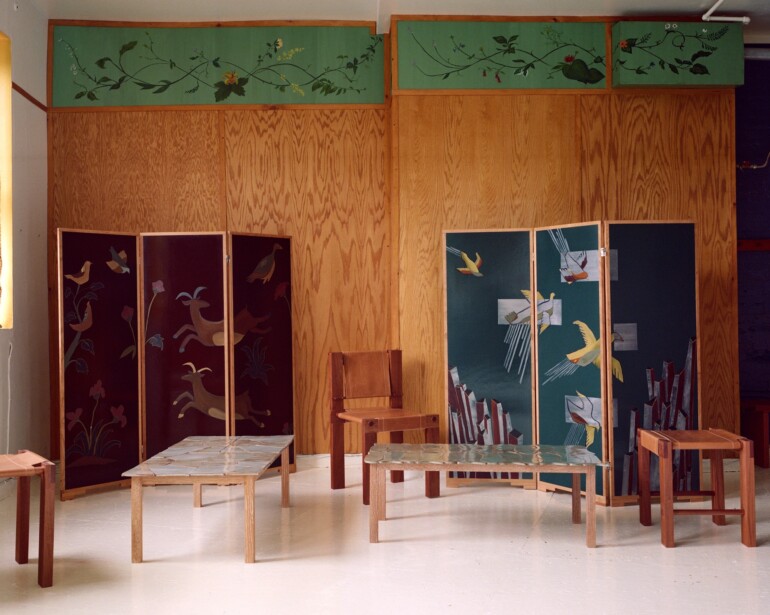
Julia Eshaghpour and Kevin Hollidge, founders of the New York–based design studio Sunfish, talk in the Chapter Interview about their work at the intersection of furniture, architecture, and fine art, offering insight into a material-driven design process shaped by craftsmanship, intuition, and narrative depth.
Chapter Wood is central to your work, not only as a material but also as a spatial tool. What does wood allow you to express that other materials do not?
Sunfish Producing space and furniture with wood is appealing in its versatility and its connection to craft and architectural/design history. We love the variety of finishes and tonality you can get out of wood and the narratives those can create. For our home, we paneled a wall with oak and used a shellac image to reference the type of tones you see in 1950s, 1960s modernist French architecture. Even though our space is set in a loft in Chinatown, we love the idea that a wood paneled wall could feel transportive like that.
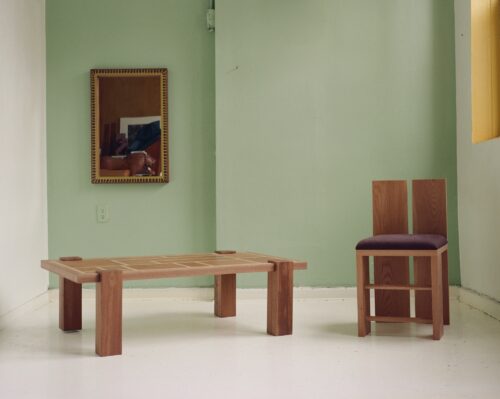
Board Chair, Skyscraper Coffee Table, and Hand-Painted Mirror (Sun), 2025

Chapter Your pieces often sit somewhere between furniture and architecture. At what point does a work stop being an object and start becoming a space?
Sunfish That’s a question we’ve been trying to answer for quite some time. Before Sunfish, we were working together mostly on sculptural installations. Our work was pretty fixated on domestic space, architecture and design. It feels quite comfortable to us to run full circle and work on furniture pieces, fine artworks, spatial projects, etc.
In some instances, our work is inherently integrated with a space. We recently had the opportunity to paint a custom ceiling mural for a client in a bedroom alcove with wooden beams. The architectural style of the Tudor house informed our painted depictions, but also, our painting invited a new focal point, with which to notice that space and its architectural language.
While our work is often commissioned as individual objects, our intention behind the objects is to create a collection and interior-based narrative. Even when a work is placed in isolation, we hope that it connects to a larger visual story we’ve built.
Chapter How much of your designs is derived from the inherent logic of woodworking, and how much is the result of conscious design decisions?
Sunfish In the beginning of Sunfish, a lot of the original designs really took from that ‘inherent woodworking logic’. We were trying to articulate form through simple joinery and forms that were clear and concise. We’ve always been opposed to trying to work against the material.
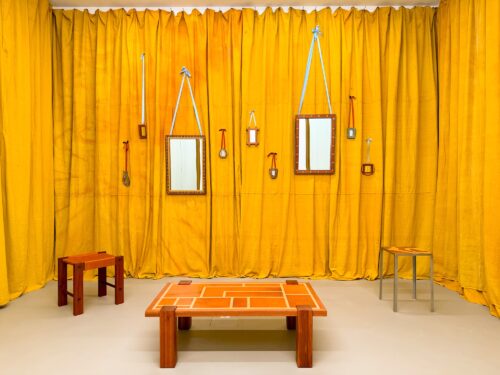
Presentation as Guest Designers during the Convey showcase organized by Simple Flair in Milan. The selection features our Skyscraper Coffee Table, Patchwork Side Table, Leather Sling Stool and a selection of hand-painted and ceramic mirrors on hand-dyed turmeric curtains.
For us, we were always trying to find a way to bring the project back to our roots in fine art in addition to our interests in material exploration, and that’s where a lot of the painting, ceramics, and different finishing techniques are coming from. It was quite liberating for us to evolve the project from mostly carpentry and create a historically researched, but idiosyncratic visual language.
Chapter Room dividers appear repeatedly in your practice. Can you talk about what draws you to forms of separation that remain open and adjustable rather than fixed?
Sunfish The adjustability of the room dividers is definitely an appealing element for us. We paint the panels flat and always delight in the final step of unifying them with hinges. Transforming the painting into a sculpture always brings about surprising, new dimensional relationships between the flat motifs. We use multidirectional hinges to heighten this variability beyond the traditional accordion style to arced forms as well. Because of the room divider’s ability to change the contours of a space, it is one of those objects, as you mentioned, that we believe becomes a space itself.
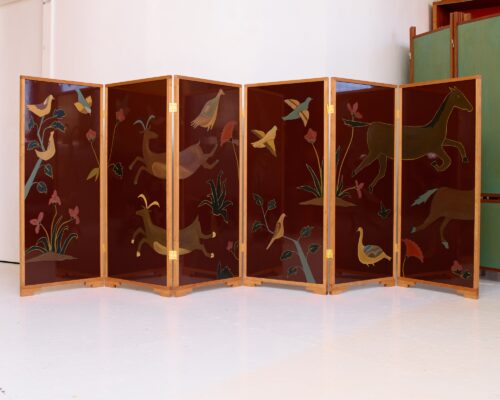
Custom six-part room divider, designed for a client in Mumbai, India. The room divider expands on the motifs of the three-part version shown during Design Week in New York in 2024. It is made of lacquer, oil paint and cherry wood.
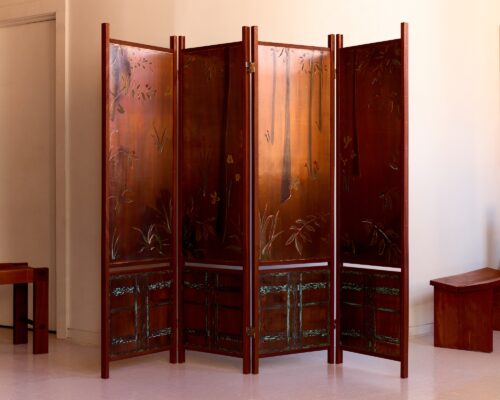
Four-part room divider made of copper and mahogany frames.
The copper panels are treated with patina and oil paint and show a spring scene with Art Deco elegance.
Chapter When one of your pieces enters a room, what do you hope it changes first for the people entering or moving through the space?
Sunfish We hope that our pieces recall a sense of history, while also inviting new moments of curiosity and playfulness. Whether it’s a hand-crafted detail, pop of color, or balance of proportion, we desire our pieces to come off as considered, with a natural ease. Brushstrokes, hand sculpted ceramics, and wood surface variations, to us, add depth and narrative. We often talk about how in our favorite works, whether it’s furniture, art, or architecture, you can see the artist’s hand. In other words, the work reveals their process. We hope that when people encounter our work in a space they experience that process. [DM]
