
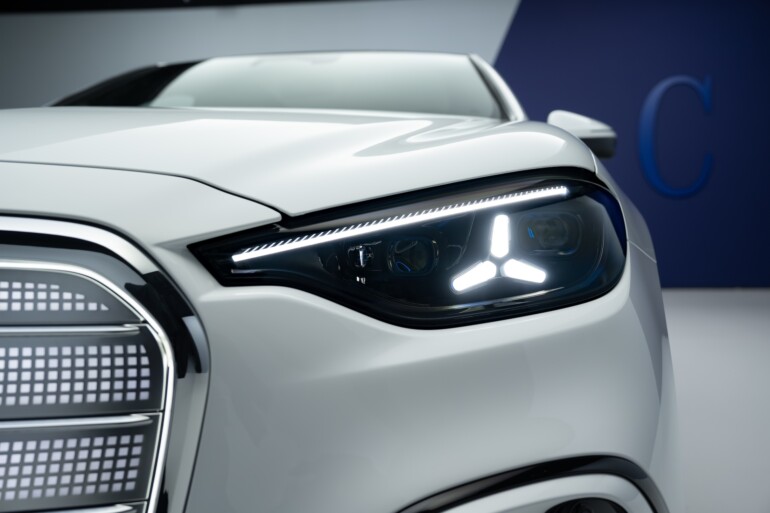
Since the 190 of 1982 and the first officially named C-Class of 1993, the model series has been a mainstay in the Mercedes-Benz lineup. For decades, it has repeatedly redefined what a compact Mercedes sedan should look like and how it should present itself. With the first electric C-Class, now unveiled in Seoul, Mercedes-Benz continues this legacy while at the same time taking it in a new design direction: with an elegant, coupé-like silhouette, an illuminated iconic grille, and an interior that brings together comfort, digitalization, and Mercedes’ currently strongly emphasized »Welcome home«.
That this world premiere is taking place in Seoul of all places feels only fitting. Hardly anywhere else blends technological modernity and a pronounced design sensibility as naturally as the South Korean capital. For Mercedes-Benz, which describes Korea as an important premium market with a strong affinity for sedans and design quality, the launch of the electric C-Class also takes on a symbolic dimension. During the world premiere, we spoke with Mathias Geisen, Member of the Board of Management of Mercedes-Benz Group AG, Sales & Customer Experience, about the role of the C-Class in the brand’s transformation, the design latitude of a global core model, and the question of how a Mercedes-typical design language can endure across very different markets.
Chapter Mr. Geisen, today we’re experiencing the world premiere of the new electric C-Class—a global volume model in the premium segment. What strategic significance does this vehicle have for Mercedes-Benz?
Mathias Geisen The C-Class is among the top three of our best-selling models and therefore has a very high importance for Mercedes. It also fills a “white spot” in our portfolio: until now, we’ve been missing an electric GLC and an electric C-Class. We can already see this very clearly in the strong order intake, for example for the electric GLC in Europe, but also in general in the high demand for our new electric models. Whether it’s the CLA, which was named Car of the Year 2026, the GLC or the GLB—they’re all off to a very strong start. A key reason is that with ranges of 700 to 800 kilometers, the vehicles are now truly suitable for everyday use, and “range anxiety” is therefore largely losing relevance.
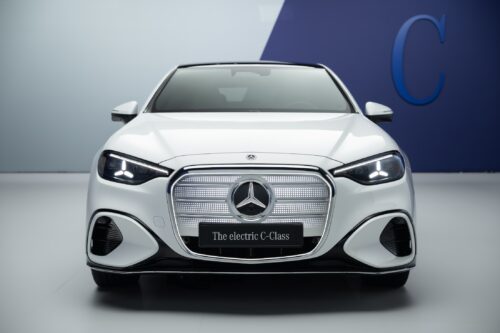
The new iconic grille with Mercedes-Benz light signature and 1,050 illuminated dots defines the presence of the new electric C-Class.
Chapter Seoul was likely not chosen by chance as the setting for this world premiere, as an important premium market. What global message is this location meant to convey for the product and the Mercedes-Benz brand?
Mathias Geisen When you introduce a vehicle like the new electric C-Class, you deliberately choose a place that reflects the product’s key characteristics. What sets Korea—and Seoul in particular—apart is its very pronounced approach to tradition and innovation. That fits well with our Mercedes-Benz brand, which looks back on 140 years of automotive history but doesn’t rest on it, instead consistently driving technological and design developments forward. At the same time, Korea is a very important market for us—the fifth-largest worldwide—with a loyal customer base and a very high affinity for sedans. It’s also a market with very tech-savvy customers and high expectations for design, quality, and execution. Last year, we also opened the world’s first Maybach Brand Center here. Against this backdrop, Seoul was a very fitting place for this world premiere.
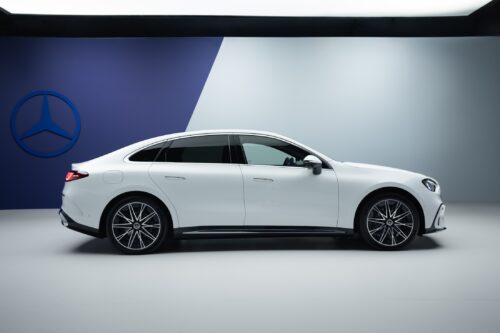
With its coupé-like, aerodynamically optimized silhouette and short overhangs, the new electric C-Class looks more stretched and elegant than ever—while offering ranges of up to 762 kilometers.
Chapter What role does design innovation play in such a central volume model as the C-Class ? Are the design parameters more tightly defined here than with niche models?
Mathias Geisen All-electric models like the new C-Class open up entirely new possibilities for us. Proportions and space change. That’s an opportunity. Design, together with the brand, is the number-one reason to buy in most countries. That’s why it’s highly relevant to us what our vehicles look like. That applies to a C-Class just as much as to an SL. A volume model in particular has to shape the Mercedes-typical, iconic design, because it carries the core of the brand to the outside world. At the same time, more emotional models like the SL can be more expressive. You can see this clearly in the connecting element of our iconic radiator grille. It’s how our vehicles have differentiated themselves for 140 years. The C-Class picks up this element just like the GLC and future vehicles. The grille is derived from the so-called honeycomb radiator, which Mercedes first used in 1901 in the Mercedes 35 PS. Back then, it was a purely technical solution that Wilhelm Maybach implemented to cool the engine. And we’re picking up that motif again today and reinterpreting it—for example with LEDs. It’s a style-defining, very authentic element. As part of the transformation, a lot becomes digital, including the exterior. Our goal is to define design approaches that preserve our iconic, brand-defining elements while also taking our models into the future. I think the C-Class shows that very well.
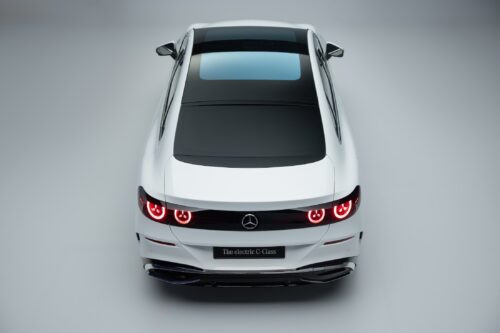
Four round star-design taillights and the expressive GT rear end create a distinctive identity—even in nighttime appearance.
Chapter A model like the electric C-Class has to work worldwide while also responding to very different customer needs. How does Mercedes-Benz develop a global design language that works across markets—and where is local adaptation necessary?
Mathias Geisen A global brand needs products that work globally. A brand with the reach and recognition of Mercedes-Benz—we’re among the ten most valuable brands in the world—shouldn’t become fragmented. We have a clear brand identity and a consistent global brand presence. At the same time, we respond to local requirements with local adaptations. Specifically, that means we don’t design only out of Sindelfingen. We have design centers in Carlsbad, in Nice, and in Shanghai. This allows our designers to anticipate different cultural trends early and incorporate them into our concepts. That’s how we ensure we remain a leading brand—not only technologically, but also in design. Localization then mainly happens in the execution. For the Chinese market, for certain models like the GLC and also the C-Class, for example, we offer versions with an extended wheelbase. In the interior, we shape adaptation through trim elements, color concepts, or materials. On top of that comes the digital design of the interior. The large display isn’t just a surface—it opens up entire design worlds and literally connects with the customer. If you change the wallpaper, for example, the ambient and headliner lighting changes as well. With elements like these, we can respond very individually to personal and local preferences without changing the vehicle’s basic design.
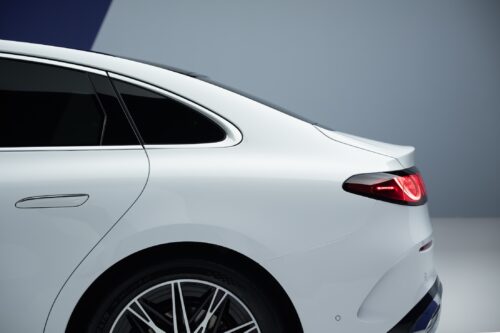
Taut surfaces, muscular wheel arches, and the flowing rear end give the electric C-Class a new presence.
Chapter And conversely: How strongly do key markets—such as Asia—influence Mercedes-Benz’s global design language, especially with regard to technological developments and digital expectations?
Mathias Geisen Asia influences our global design language just as much as any other region. What we fundamentally do—and that also applies to design—is test different concepts worldwide in so-called »product clinics.« That’s how we check how our vehicles are perceived in different markets. We show early concepts of new vehicles to Chinese, American, or European customers, for example, and receive important feedback that then flows into the development process. So our customers’ tastes play a major role in developing a new model.
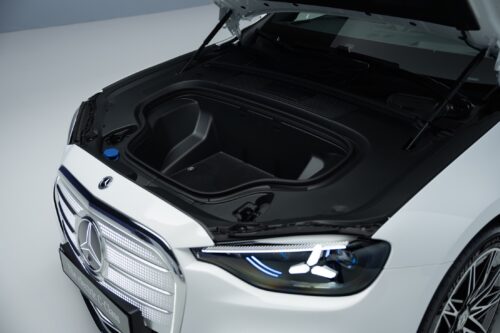
The 101-liter frunk adds an additional,
fully functional storage compartment to the electric C-Class.
Chapter You bring a lot of experience in this area from your career at Mercedes-Benz—across product management, strategy, and portfolio management. How has that background shaped your view of design and the overarching brand strategy?
Mathias Geisen In my career, I’ve actually been fortunate to get to know very different areas. I worked in passenger-car product management for a long time, then led sales and product management for the G-Class—a great job! After that, I was responsible for the Vans business unit, where design plays a very different role again. Before my role at Mercedes-Benz Vans, I also led corporate strategy, and now I’m back in the product and brand context. That gives me a broad perspective and an understanding of the importance of design. Design is one of the key reasons to buy. Accordingly, we attach great importance to design—throughout the entire product creation process. At the same time, Mercedes-Benz has a fundamental aspiration: we want to build the most desirable vehicles in the world. Even a Sprinter has the ambition to be the most attractive commercial vehicle in its segment—just as an S-Class has the ambition to be the most attractive vehicle in the luxury class. I think the Sprinter is just as design-defining in the commercial space as our vehicles are in the private-customer space.
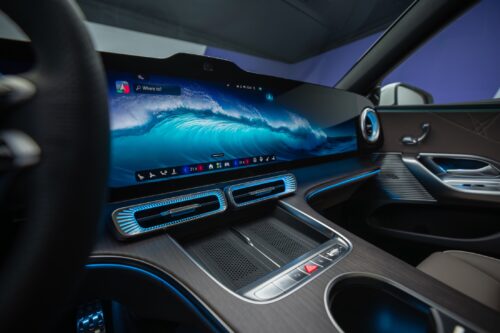
Inside, the MBUX Hyperscreen spanning the full width of the vehicle, ambient lighting, and new material worlds merge into a significantly more digital comfort zone.
Chapter Back to the new electric C-Class: You recently described status, personalization, comfort, safety, and intelligence as defining factors in today’s premium understanding at Mercedes-Benz. Where would you place the new electric C-Class within that coordinate system?
Mathias Geisen The C-Class appeals to a broad customer group and embodies Mercedes’ core values: comfort, safety, quality, and design. In my view, design plays a major role for this vehicle, especially because of the proportions—it has simply become a fantastic vehicle. At the same time, the new C-Class also makes a very big leap in comfort, safety, and especially in innovation and intelligence—for example in automated driving.
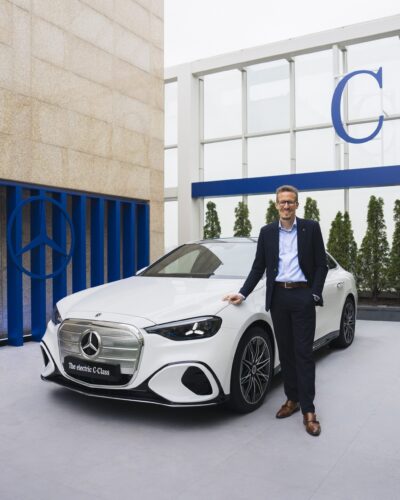
Mathias Geisen, Member of the Board of Management of Mercedes-Benz Group AG, at the world premiere of the new electric C-Class in Seoul.
Chapter Finally, looking to the future of Mercedes-Benz: What is your personal long-term vision for the brand—beyond individual models and technologies? And what role do new brand fields such as branded real estate or other areas in which Mercedes-Benz is increasingly active play in that?
Mathias Geisen No matter what we do, Mercedes-Benz always has the ambition to set benchmarks. That’s deeply anchored in our DNA. It applies to technology in the vehicle just as much as to the entire brand presence. The strength of our brand isn’t defined solely by our great products, but by the interplay of product, brand, and customer experience. Our goal is to deliver the best in every area so that customers feel completely at home with the brand. In short: whatever the customer is looking for—there should be no way around Mercedes-Benz. That has to be our aspiration, and it is our aspiration. [CPS]
