

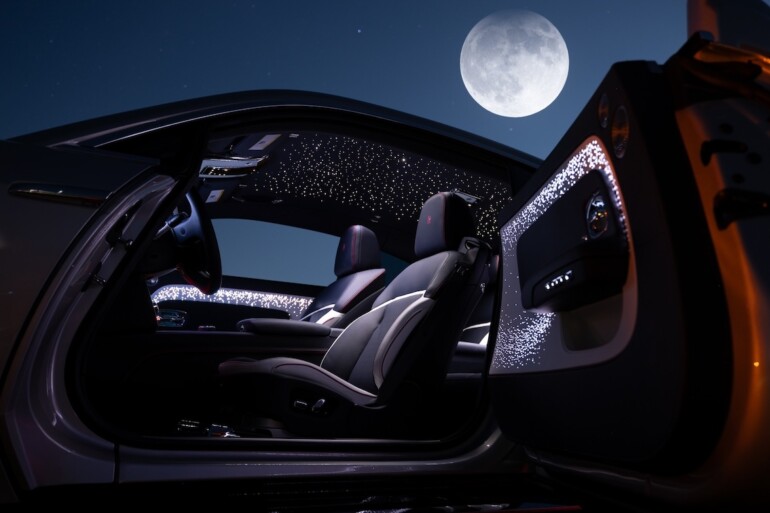
Rolls-Royce is one of the few marques that resists the banalities of everyday life, writes author Diana Kinnert. In this spirit, she took the British luxury limousine on a nocturnal drive into Westhavelland, one of the rare places in Germany where the annually Leonid meteor shower can still be observed with exceptional clarity. What begins as a journey to an astronomical event becomes for Kinnert a reflection on what luxury can mean today and how vulnerable the very cosmos has become—that realm which has long shaped orientation, myth and human imagination.
The night sky is captivating. Hardly any sphere is so steeped in legend, so mystical. Its mere contemplation offers some a transcendental experience. Such was the case in November 1966, when the residents of Arizona witnessed an unprecedented celestial spectacle. Up to 50 meteors per second shot into the Earth’s atmosphere and burned up before everyone’s eyes in the black night sky. The storm of shooting stars lasted barely fifteen minutes. But even today, stories are told of it; the comet dust was so dense that people believed the sky was sparkling.
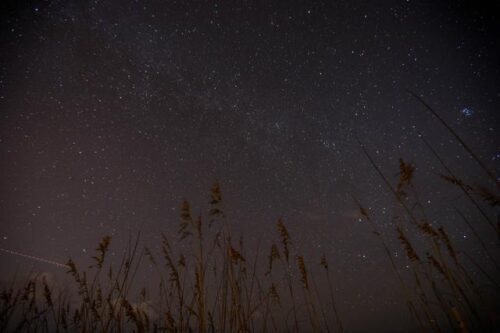
Similar events had already occurred in 1833 and 1866. It is now known that the annually recurring Leonid meteor shower only appears with such intensity every few decades. Nevertheless, observing the Leonids every November since their discovery has been a major event for astronomers, stargazers, and night dreamers. As long as it lasts.
Because the night sky is facing its demise. Heads of government and space entrepreneurs are competing for extraterrestrial supremacy. The universe is more contested than ever. While around 750 active satellites were in space around the year 2000, that number has risen to over 10,000 satellites in recent years. By 2030, 60,000 satellites are expected to be installed, and by 2050, hundreds of thousands. Light pollution is increasing significantly more than previously assumed. While an annual increase in brightness of about two percent had been assumed, researchers found that sky brightness is increasing by 9.6 percent per year. A child who sees 250 stars at their birthplace will see only 100 stars by their 18th birthday if the trend continues. And this prediction is optimistic. Reason enough to pull out all the stops to not only see but also celebrate the Leonids this year. Where better to do this than in the Natur und Sternenpark Westhavelland, near the darkest place in the republic, Gülpe, the site certified by the International Dark Sky Association with the least light pollution.

On the evening of November 17, the sky-watcher is excited as he sets off for Havelland in no ordinary vehicle. Rolls-Royce offers the bright yellow »Ghostmobile«, and the sky-watcher reverently takes the driver’s seat. Some say it’s perfectly fitting to travel in the most exquisite luxury car with a history of excellence. Others say it’s unusual to speed from Berlin towards Gülpe over rough terrain. An SUV would also do. But it has become this unreal spaceship of a Rolls-Royce, and it is at least befitting of its status. The drive feels like a space journey. So quiet, so imperceptible is the movement of the Ghost, so smooth the driving experience, that rough terrain is not noticeable. And people stare as if one has come from the moon. They haven’t seen anything like it here before. The Ghost is a monolith. An authority. Originally, Rolls-Royce limousines were designed not for the self-driver, but for the chauffeur.
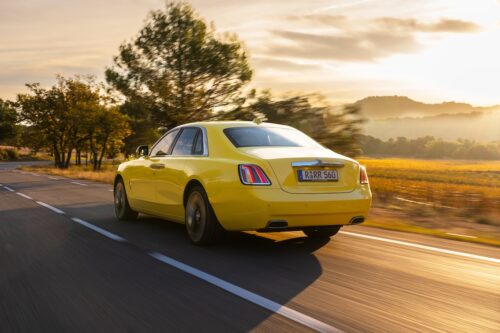
Originally, the Rolls-Royce was not considered a tribute to driving, but to being driven. A vehicle for kings and maharajas. Hardly any automotive brand ranks higher than the company founded by Charles Stewart Rolls and Frederick Henry Royce in 1904, which just two years later produced the Rolls-Royce Silver Ghost—a vehicle quickly lauded as the best in the world.
The sky-watcher enters the Sternenpark Westhavelland just as Katy Perry, Oprah Winfrey, and Lauren Sanchez-Bezos recently entered space in the Blue Origin rocket. Their endeavor lasted longer than the five-minute scheduled extraterrestrial stay. The overall experience includes ascent and descent, breakthrough and downfall; the journey is the destination. And whoever wants to go to Westhavelland for the Leonids also wants their journey to the meteors to be a galactic overall experience. And so the drive into the dark Brandenburg feels like casting off. Like an astronaut, the sky-watcher glides from the congested capital traffic onto the deserted country roads of Brandenburg. The Ghost is a colossus. It is generously proportioned. It demands its space and power. The interior, however, appears discreet. It doesn’t scream. It doesn’t overpower anything. Driving a Rolls-Royce feels like entering a concert hall. Everything is silent. As if the car absorbed the harshness of the outside world. As if one were enclosed in a cocoon. Lovingly enveloped, carefully woven. Enclosed. But safe.
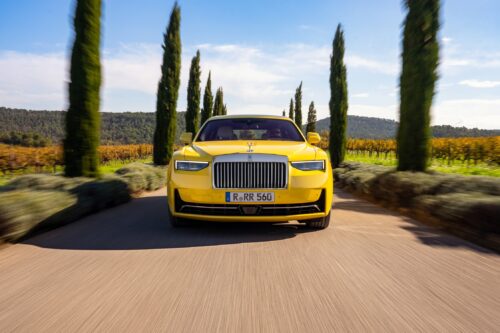
The outside world falls behind a heavy curtain. An immunity to the unfamiliar emerges. The feeling of triumphant invulnerability in the armored luxury sedan meets the promise of silence and mindfulness. The world’s crises bounce off the car. They bounce off the sky-watcher. He is no longer at the mercy of the world. Unreachable. Unavailable.
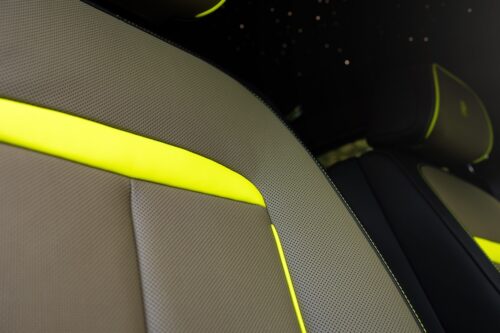
In times like these, when even the most materially secure, the supposedly most privileged, are endlessly subjected to demands—through performance pressure, consumer pressure, digitalization, distractions, compensations, and ever-increasing requirements, both professional and private—the place of silence is what constitutes true luxury. Rolls-Royce has been whisking people away behind this curtain of appropriation and control since its founding.
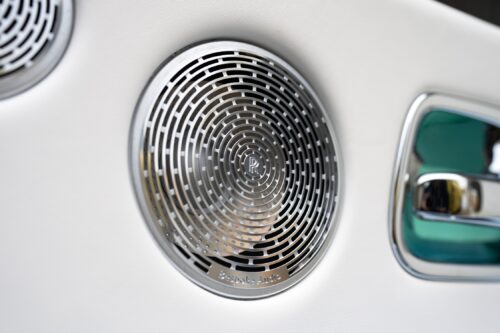
Is the brand’s honor solely due to its tradition? The brand’s success has lasted over 100 years, now under the umbrella of the BMW Group. Rolls-Royce cars have always been surrounded by an aura of triumphalism and untouchability. This may be a counter-narrative in times of political asceticism and uncertainty. Sustainability and reduction were never primary associations. However, modern antipathies are being put to the test with the introduction of the Rolls-Royce Spectre.
In a magazine in 1900, pioneer Charles Stewart Rolls made a bold prediction: »The electric car is perfectly noiseless and clean. There is no smell or vibration. They should be very useful when fixed charging stations can be established.« These words, put to paper four years before the historic founding of the company, would prove prophetic. In 2021, the British automaker confirmed the testing of the first model in the brand’s history to be conceived and designed as an electric car from the outset. Just one year later, the Spectre (top image showing the one-of-one Spectre Lunaflair) was introduced to the world. Rolls-Royce is seeking the future. This makes the brand forward-looking rather than sentimental.
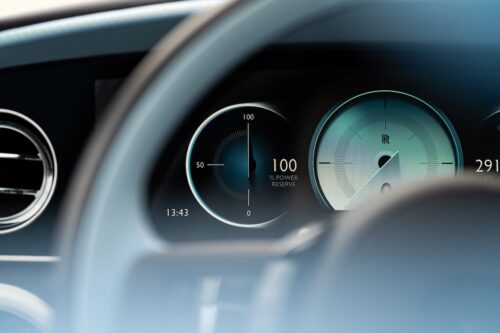
The sky-watcher turns onto unpaved forest roads. One must not tell the lessor, Rolls-Royce, about this. The Ghost pushes its way through the grasses, past the fir trees, out onto the stargazing clearing. Once there, it appears like a monument of fantasy, literature, and antiquity. It looks a bit like Stonehenge.
In the clearing, the sky-watcher looks up. He targets the constellation Leo. So this is where it’s supposed to happen. And behold—the meteors are flying. It’s impossible to describe what a spectacle it truly is. They trail burning tails behind them. Some make one startle in awe. Others evoke a playful, tender gentleness. Picnic blankets and sparkling wines are retrieved from the Ghost. Thus, one waits for morning in the Star Park.
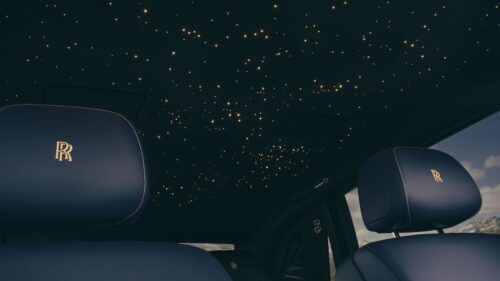
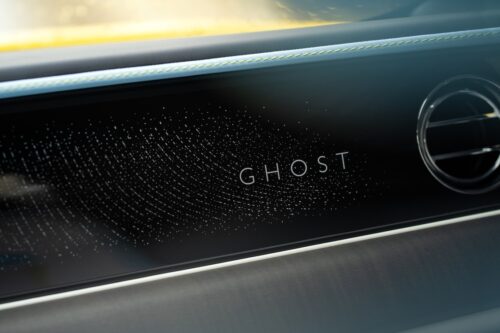
The return journey is no less dreamlike. Rolls-Royce is said to have a love for the night sky. The LED light points in the headliner of the limousines are a trademark of the British. Above the heads of the sky-watchers, shooting stars continue to shimmer, and in the console in front of the passenger, another 850 LED stars glow around the Ghost lettering. For the Spectre model, approximately 5,000 LED light points were developed for this special starlit interior in an incredible precision effort of over 10,000 hours. Light choreographies allow for the recreation of real constellations in the night sky and even meteor showers. The project has been verified by the South Downs Planetarium near the company’s headquarters in Goodwood, England.
Rolls-Royce is one of the brands that defies the trivialization of everyday life. In times when the night sky is being disregarded, the English automotive brand invites reflection. A haven of peace in a world of a thousand storms. Rolls-Royce transports one as if into the eye of a hurricane, into a nearly windless center.
Once in human history, one’s own destiny was believed to be subject to the signs of the heavens. In navigation, people were guided by celestial bodies. Indigenous peoples aligned their cities with the sun, moon, and stars. Some settlements were precisely aligned with the north-south and east-west cardinal directions. Others were meant to orient themselves to sunrise or sunset points at the time of the solstice. Is the imitation of the night sky in a luxury object from an automobile manufacturer not, therefore, blasphemous? One could see it that way. Or one could understand it as a homage to the cosmos as a sphere of human experience, whose destruction would be an irrevocable civilizational rupture. The drive in the Rolls-Royce—it almost made me political.
Text by Diana Kinnert